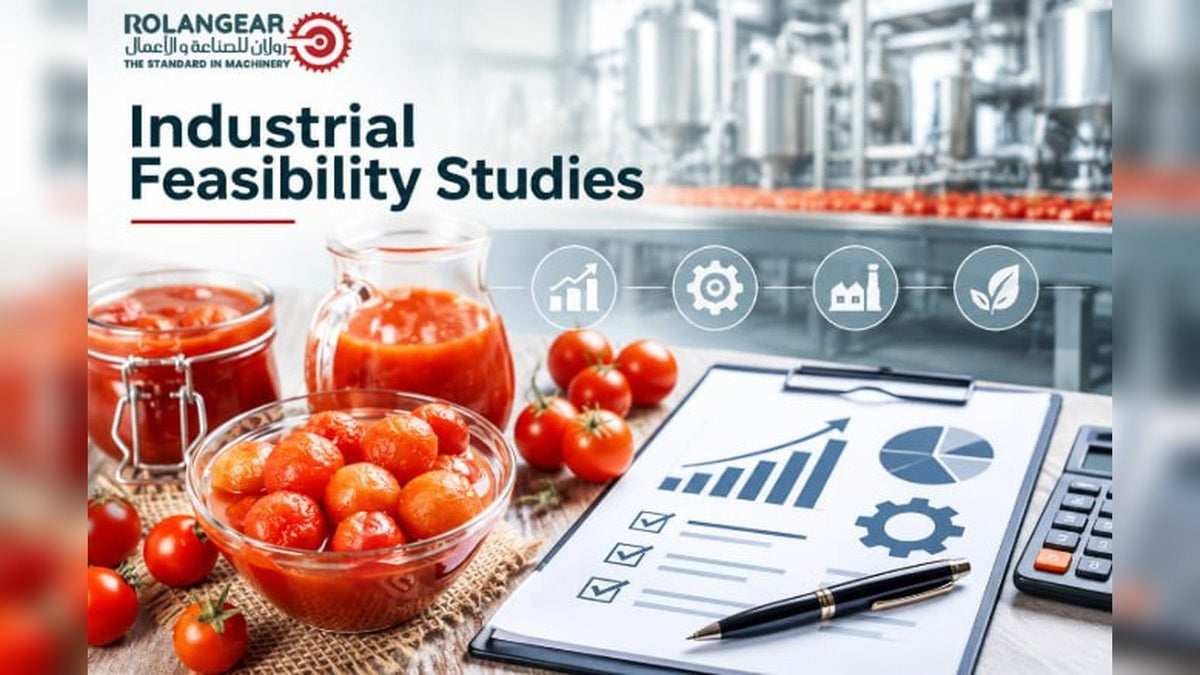
Tomato Paste Factory Industrial Feasibility Studies
Tomato Paste Factory Feasibility Study
Professional feasibility study for a small-to-medium tomato paste processing factory producing retail tomato paste, sauce base and industrial aseptic tomato paste. Because no country, farm price, building condition, supplier quotation or packaging mix was supplied, this report uses transparent USD planning assumptions that must be localized before investment approval.
1. Executive Summary
The project is a tomato processing factory designed around 5 tons/hour fresh tomato input during a 150-day season. The base case assumes 8 operating hours/day, 18% saleable paste-equivalent yield and annual saleable output of 1,080 tons. The product plan includes retail tomato paste, tomato sauce base and industrial aseptic paste for food processors.

Using a blended ex-factory selling price of USD 1150/ton and variable cost of USD 500/ton, total investment of $850,000 and ramp-up from 50% to 90% utilization, Year-5 revenue reaches $1.12m and Year-5 net profit reaches $314,096. The base model produces NPV of $152,727 at a 12% discount rate and IRR of 18.1%. Break-even utilization is 32.8%. The project is feasible under the stated assumptions, but final approval depends on fresh tomato contracts, Brix/color quality, packaging prices, local market prices, power/steam cost, permits, building condition and confirmed machinery quotations.
2. Study Scope and Methodology
This feasibility study covers project concept, product analysis, economic indicators and project location, target-market indicators, demand, local production, import and export caveats, competitor analysis, market gap, SWOT, marketing, pricing, distribution, machinery, production capacity, supplier quotations, raw-material costs, operating expenses, utilities, staffing, investment, financing, financial statements, indicators, break-even, sensitivity, legal/regulatory requirements, environmental health and safety, risk, implementation schedule, sources, consultation and final conclusion.
The methodology combines source-backed agriculture and standards context, transparent capacity formulas, practical machinery-cost assumptions, a five-year financial model and sensitivity testing. FAO and Codex sources provide tomato and processed-food standards context, while machinery and investment costs are treated as budgetary planning estimates rather than final supplier quotations [1][2][3][4][5].
3. Project Concept and Nature
The project nature is an industrial fruit-and-vegetable processing plant. Fresh tomatoes are received, washed, sorted, crushed, preheated, pulped, refined, concentrated by evaporation, sterilized, filled into retail or bulk packaging, coded, packed and stored. The factory can support local tomato farmers, substitute imported tomato paste, and supply retail, HORECA and food-manufacturing channels.

4. Product Analysis and Product Specification Table
The primary product is tomato paste, commonly produced at 28–30 Brix for retail and industrial use. Product rules, preservatives, acidity, labeling and can/pouch requirements must be checked locally; Codex provides processed tomato standards context but this study does not claim verified certification [2].
| Product | Typical pack | Target channel | Quality / storage notes |
|---|---|---|---|
| Tomato paste 28–30 Brix | 70 g / 210 g can, sachet, pouch | Retail and wholesalers | Acidity, color, Brix and fill weight control |
| Industrial tomato paste | 220 kg aseptic drum | Sauce, ketchup and food processors | Aseptic filling, shelf-stable bulk storage |
| Tomato puree / sauce base | Bottle, pouch or can | Retail, HORECA | Lower concentration, flavor adjustment possible |
| By-products | Pomace and seeds | Feed, compost or extraction buyers | Requires hygiene and disposal planning |
5. Economic Indicators and Project Location
Location should be selected based on tomato-growing area, harvest logistics, road access, water, steam, electricity, wastewater handling, packaging supply and market access. Country-specific inflation, GDP, population and agriculture data should be added from official datasets once location is selected [1].
| Location factor | Weight | Preferred condition | Feasibility effect |
|---|---|---|---|
| Fresh tomato catchment | 30% | Near tomato-growing farms within short transport distance | Highest effect on yield and raw material cost |
| Harvest-season logistics | 20% | Good road access, crates/bulk bins, weighing area | Controls receiving losses |
| Utilities | 15% | Power, steam, process water, compressed air and wastewater | Critical for evaporation and cleaning |
| Building and land | 15% | Food-grade building with drainage and expansion area | Reduces civil cost |
| Packaging supply | 8% | Can, pouch, carton, label and drum supply access | Reduces stock risk |
| Labor and QC | 7% | Operators, lab staff and maintenance available | Supports quality consistency |
| Market access | 5% | Near distributors or export route | Improves sales execution |
6. Target-Market Indicators
Target-market indicators include household consumption, restaurant and catering demand, retail shelf volume, food-processor usage, import volumes under relevant HS codes and local tomato-processing capacity. The project forecast is capacity-led because no country market data was supplied.
| Market layer | Definition | Planning treatment |
|---|---|---|
| TAM | All tomato paste and tomato sauce demand in the target country | Not fully available to the project |
| SAM | Demand reachable through planned retail, wholesale and processor channels | Requires distributor validation |
| Realistically obtainable market | Volume a new plant can capture within five years | Limited by price, brand trust and channel access |
| Project sales forecast | Ramp-up from 50% to 90% utilization | Capped by 1,080 tons/year saleable capacity |
7. Demand Analysis
Demand should be calculated using household consumption, food-service purchases, processor demand and import-replacement potential. In this preliminary model, expected sales follow the formula: fresh tomato input 5 t/hour × 8 h/day × 150 days = 6,000 tons/year raw tomatoes. Paste-equivalent output = 6,000 × 18% yield = 1,080 tons/year. Year-1 sales = 1,080 × 50% = 540 tons.
Confidence is medium for the capacity formula and low-to-medium for market absorption until local retail, HORECA and processor demand are verified.
8. Local Production Analysis
Local production analysis should identify tomato-growing areas, seasonal harvest windows, existing paste plants, small sauce producers, canning factories and informal fresh tomato markets. Exact local production is not stated because no target country was provided; it must be researched with official agriculture data and field checks.

9. Import and Export Analysis with HS-Code Caveats
Likely HS codes include HS 2002 for tomatoes prepared or preserved otherwise than by vinegar or acetic acid, including tomato paste categories in many tariff schedules. HS codes can include different tomato preparations, so broad import data must not be treated as exact tomato paste demand without subheading validation. Country-level trade checks should use customs data, UN Comtrade or ITC Trade Map after confirming HS code scope.
10. Competitor Analysis
| Competitor type | Examples to research locally | Competitive pressure | Response |
|---|---|---|---|
| Large paste brands | National retail tomato paste producers | High | Compete on quality, price pack sizes and distribution |
| Regional processors | Seasonal tomato processors and sauce factories | Medium-high | Secure farmer supply and improve packaging |
| Imported paste | Turkey, China, Italy or regional bulk/retail imports | Medium | Position local freshness, lead time and import substitution |
| Substitutes | Fresh tomato, canned tomato, sauces, ketchup | Medium | Use recipes and channel-specific pricing |
| Private-label suppliers | Contract packers for retailers | Medium | Offer reliable private-label service and consistent fill weights |
11. Market-Gap Analysis
Market gap should equal estimated local demand plus realistic import substitution minus reliable local supply. Because country data is missing, the gap is not quantified. Practically, the plant needs to sell 972 tons in Year 5, so securing distributor and food-processor contracts is more important than assuming total national demand is available.
12. SWOT Analysis
| Strengths | Weaknesses | Opportunities | Threats |
|---|---|---|---|
| Tomato paste is shelf-stable and widely used | Seasonal raw tomato supply creates working-capital pressure | Import substitution and private-label retail packs | Raw tomato price and crop yield volatility |
| Flexible retail and bulk SKUs | Evaporation requires steam and energy control | HORECA and food-processor supply contracts | Strong imported brands and low-cost origins |
| By-product recovery possible | Quality depends on harvest handling and sorting | Farmer contract programs can secure supply | Packaging material cost increases |
13. Marketing and Promotional Plan

The marketing plan should use retailer listings, wholesaler cartons, HORECA sampling, distributor incentives, private-label offers and quality claims based on verified Brix, color, acidity and fill weight. KPIs include active outlets, tons sold per channel, return rate, gross margin by pack size, late deliveries, complaint rate and repeat processor orders.
14. Pricing Plan
| Product | Standard ex-factory planning price | Pricing logic |
|---|---|---|
| Retail tomato paste small pack | USD 0.18–0.45/pack | Depends on pack size, can/pouch cost and brand position |
| Tomato sauce base | USD 700–950/ton equivalent | Lower concentration and channel-specific recipes |
| Aseptic tomato paste 28–30 Brix | USD 950–1,250/ton | Bulk buyer and export/import-parity pricing |
| Blended model price | USD 1,150/ton paste equivalent | Used for the base financial model |
15. Distribution Plan
Distribution should combine retail wholesalers, supermarket distributors, food-service suppliers, institutional kitchens and industrial food manufacturers. Industrial paste can move by aseptic drums, while retail packs require carton handling, labels, shelf positioning and promotional support.
16. Machinery, Equipment, and Production-Line Costs
Machinery costs are presented as budgetary planning estimates for a small-to-medium tomato paste processing project. The final equipment cost must be confirmed through formal technical offers based on fresh tomato input capacity, target Brix, evaporation system, filling format, automation level, utility scope, installation, commissioning and destination requirements [3][4][5].
| Machine / equipment | Function | Budgetary equipment cost estimate |
|---|---|---|
| Tomato washing, sorting and crushing system | Remove soil, inspect and prepare tomatoes | USD 40k–90k |
| Preheater, pulper/refiner and seed/skin removal | Extract tomato pulp and remove waste | USD 60k–130k |
| Vacuum evaporator / concentration system | Concentrate puree into paste | USD 140k–280k |
| Sterilizer and aseptic filler for drums or bag-in-box | Bulk shelf-stable paste packaging | USD 90k–180k |
| Retail can/pouch filling and sealing line | Consumer packs | USD 70k–160k |
| CIP system, pumps, tanks and pipelines | Cleaning and process transfer | USD 40k–90k |
| Boiler, compressor, cooling and water treatment | Utility support | USD 80k–160k |
| Lab equipment, coding, conveyors and secondary packing | Quality and packaging support | USD 30k–70k |
17. Building, Facility, and Construction Costs

The facility should include raw tomato receiving, washing and sorting, processing hall, evaporation/utility room, filling room, packaging storage, finished goods store, laboratory, CIP/chemical area, boiler area, staff hygiene areas, office, loading area and wastewater handling. Floors require drainage and washable surfaces.
18. Production Capacity and Line Suitability

Rated capacity is 5 tons/hour fresh tomato input. Annual raw input = 5 × 8 × 150 = 6,000 tons. Saleable paste equivalent = 6,000 × 18% = 1,080 tons/year. Bottlenecks may occur in receiving, sorting, evaporation, sterilization/filling, steam capacity, packaging speed and seasonal raw tomato supply.
19. Supplier Quotations and Technical Offers
No supplier quotation was provided. Final supplier offers must confirm tomato input capacity, target Brix, evaporation technology, steam consumption, filling format, sterilization temperature, CIP automation, packaging scope, utility load, spare parts, installation, training, warranty and Incoterm.
20. Raw-Material Costs

Main raw materials are fresh tomatoes, cans/pouches/drums, labels, cartons, salt/spices if sauce is made, cleaning chemicals and laboratory consumables. The base variable cost is USD 500/ton paste equivalent, including tomatoes, packaging, steam, power, direct labor and normal processing loss. Fresh tomato price and Brix are the most important cost drivers.
21. Operating Requirements and Expenses
Annual fixed operating expenses are estimated at $165,000 before depreciation. This covers management, seasonal supervision, QA, maintenance, sales/admin, insurance, security, office costs and normal non-variable overhead.
22. Utility Requirements
| Utility | Typical requirement to confirm | Feasibility effect |
|---|---|---|
| Electricity | 3-phase power and backup for critical systems | Controls downtime |
| Steam / boiler fuel | Evaporation, sterilization and CIP heating | Major operating-cost driver |
| Process water | Washing, pulping and cleaning | Affects hygiene and yield |
| Compressed air | Valves, filling and packaging machines | Affects line stability |
| Wastewater | Tomato solids and organic load | Environmental compliance risk |
| Cold / ambient storage | Packaging and finished goods depending on SKU | Affects quality and shelf life |
23. Organizational and Management Structure
| Role | Headcount | Main responsibility |
|---|---|---|
| General manager | 1 | Operations, sales and finance |
| Production manager / food technologist | 1 | Process, recipes, yield and QA coordination |
| Shift supervisors | 2 | Seasonal production execution |
| Operators and sorters | 18 | Receiving, sorting, processing, filling and packing |
| Quality/lab staff | 3 | Brix, acidity, color, microbiology and release records |
| Maintenance and utilities | 3 | Boiler, evaporator, pumps and filling line |
| Warehouse/logistics | 4 | Packaging, finished goods and dispatch |
| Sales/admin/finance | 4 | Orders, accounts and customer service |
24. Investment Costs
| Investment item | Standard estimate | Basis |
|---|---|---|
| Building fit-out, drainage, raw-material receiving and storage | $150,000 | Food-grade civil allowance; excludes land purchase |
| Tomato washing, pulping, evaporation, sterilization and filling line | $390,000 | Budgetary processing-line package |
| Boiler, water treatment, compressor, pumps and utility installation | $110,000 | Auxiliary utility allowance |
| Packaging, lab, conveyors, coding and material handling | $50,000 | Support equipment |
| Freight, duties, installation, training and commissioning | $65,000 | Destination-dependent allowance |
| Pre-operating expenses, permits and launch | $25,000 | Planning estimate |
| Contingency reserve | $45,000 | Approximate reserve |
| Initial working capital | $15,000 | Tomato, packaging and receivable buffer; seasonal stock may require more |
| Total project investment | $0.85m | Calculated subtotal |
25. Financing Requirements and Conditions
Base financing assumes 40% equity and 60% debt. Equity requirement is $340,000 and loan requirement is $510,000. Loan terms are modeled at 9% annual interest, five-year equal principal repayment and no grace period. Final terms depend on lender, collateral and sponsor profile.
26. Revenue and Sales Forecasts
| Year | Utilization | Sales volume, tons | Revenue | Net profit | DSCR |
|---|---|---|---|---|---|
| Y1 | 50.0% | 540 | $621,000 | $60,080 | 0.85x |
| Y2 | 65.0% | 702 | $807,300 | $151,664 | 1.56x |
| Y3 | 75.0% | 810 | $931,500 | $215,168 | 2.16x |
| Y4 | 85.0% | 918 | $1.06m | $278,672 | 2.86x |
| Y5 | 90.0% | 972 | $1.12m | $314,096 | 3.41x |
Optimistic scenario assumes earlier distributor contracts, 95% Year-5 utilization and better paste pricing. Conservative scenario assumes slower sales, 75% Year-5 utilization, lower selling price and higher fresh tomato cost.
27. Financial Statements
| USD | Y1 | Y2 | Y3 | Y4 | Y5 |
|---|---|---|---|---|---|
| Revenue | $621,000 | $807,300 | $931,500 | $1.06m | $1.12m |
| COGS | $270,000 | $351,000 | $405,000 | $459,000 | $486,000 |
| Gross profit | $351,000 | $456,300 | $526,500 | $596,700 | $631,800 |
| EBITDA | $186,000 | $291,300 | $361,500 | $431,700 | $466,800 |
| Depreciation | $65,000 | $65,000 | $65,000 | $65,000 | $65,000 |
| EBIT | $121,000 | $226,300 | $296,500 | $366,700 | $401,800 |
| Interest | $45,900 | $36,720 | $27,540 | $18,360 | $9,180 |
| Tax | $15,020 | $37,916 | $53,792 | $69,668 | $78,524 |
| Net profit | $60,080 | $151,664 | $215,168 | $278,672 | $314,096 |
| USD | Y0 | Y1 | Y2 | Y3 | Y4 | Y5 |
|---|---|---|---|---|---|---|
| Equity / project cash flow | -$340,000 | $23,080 | $114,664 | $178,168 | $241,672 | $277,096 |
| Cumulative cash flow | -$340,000 | -$316,920 | -$202,256 | -$24,088 | $217,584 | $494,680 |
| Debt principal repayment | - | $102,000 | $102,000 | $102,000 | $102,000 | $102,000 |
| Closing debt | - | $408,000 | $306,000 | $204,000 | $102,000 | $0 |
| USD | Y1 | Y2 | Y3 | Y4 | Y5 |
|---|---|---|---|---|---|
| Fixed assets net | $535,000 | $470,000 | $405,000 | $340,000 | $275,000 |
| Working capital and cash | $15,000 | $15,000 | $15,000 | $232,584 | $509,680 |
| Total assets | $550,000 | $485,000 | $420,000 | $572,584 | $784,680 |
| Debt | $408,000 | $306,000 | $204,000 | $102,000 | $0 |
| Equity and retained earnings | $142,000 | $179,000 | $216,000 | $470,584 | $784,680 |
| Liabilities plus equity | $550,000 | $485,000 | $420,000 | $572,584 | $784,680 |
28. Financial Indicators and Financial Analysis
| Indicator | Formula / basis | Base result | Interpretation |
|---|---|---|---|
| Gross margin | (Revenue - COGS) / Revenue | 56.5% | Good if raw tomato procurement and evaporation yield are controlled |
| Contribution margin | Price - variable cost | USD 650/ton | Used for break-even |
| Break-even quantity | Fixed cost / contribution | 354 tons/year | Requires 32.8% utilization |
| ROI | Average net profit / investment | 24.0% | Positive after ramp-up under standard-cost assumptions |
| NPV | Unlevered FCFF discounted at 12% | $152,727 | Positive but sensitive to selling price and tomato cost |
| IRR | Discount rate where NPV = 0 | 18.1% | Above the 12% discount rate in base case |
| Payback | Cumulative levered cash recovery | During Year 5 | Requires stable harvest and sales execution |
| Debt-to-equity | Debt / equity | 1.50x | Moderate leverage |
| DSCR | Operating cash flow / debt service | Y1 0.85x; Y5 3.41x | Weak early, improves with utilization |
29. Break-Even Analysis
Contribution per ton = selling price (1150) − variable cost (500) = 650 USD. Break-even quantity = fixed cost plus depreciation ($230,000) ÷ contribution (650) = 354 tons/year. Break-even revenue = $406,923. Break-even utilization = 32.8% of saleable capacity.
Source: calculated base-case model, 2026.
30. Sensitivity Analysis
| Variable tested | NPV result | Impact vs base NPV |
|---|---|---|
| Selling price -10% | -$100,573 | -$253,300 |
| Sales volume/utilization -10% | $9,557 | -$143,169 |
| Fresh tomato and packaging +10% | $42,596 | -$110,130 |
| Fixed operating expenses +10% | $105,144 | -$47,583 |
| Capital cost +10% | $67,727 | -$85,000 |
| One-season launch delay | -$297,812 | -$450,539 |
| Selling price +10% | $406,026 | $253,300 |
| Variable cost -10% | $262,857 | $110,130 |
Source: calculated sensitivity model, 2026.
Critical variables are selling price, fresh tomato cost/yield, utilization, packaging cost, energy/steam cost and seasonal launch timing.
31. Legal and Regulatory Requirements

Requirements normally include company registration, food processing license, product labeling approval, food safety plan, worker health rules, tax registration, environmental approval and wastewater permit. Codex provides standards context for tomato products, but local food-law review is required before production [2].
32. Environmental, Health, and Safety Analysis

EHS issues include tomato waste, wastewater organic load, boiler safety, steam burns, chemical handling for CIP, wet floors, moving conveyors, can/pouch machinery safety and food-safety recall risk. The project should implement HACCP-style controls, pest control, CIP validation, traceability and a by-product/wastewater plan.
33. Risk Analysis and Risk Register
| Risk | Probability | Impact | Mitigation |
|---|---|---|---|
| Fresh tomato supply shortage | Medium | High | Farmer contracts, crop calendar and receiving plan |
| Low Brix or poor color | Medium | High | Variety selection, sorting, lab testing and supplier incentives |
| Steam/energy cost increase | Medium | Medium-high | Efficient evaporator, boiler maintenance and fuel plan |
| Packaging shortage | Medium | Medium | Multi-supplier cans, pouches, drums and cartons |
| Slow distributor acceptance | Medium | High | Pre-launch sales agreements and sampling |
| Food safety or contamination event | Low-medium | High | CIP validation, metal detection, traceability and HACCP-style controls |
34. Implementation Schedule
| Phase | Duration | Key tasks |
|---|---|---|
| Feasibility localization | 2–4 weeks | Country data, tomato price, market validation |
| Engineering and permits | 1–2 months | Layout, food license, wastewater and utility design |
| Supplier quotation and procurement | 2–3 months | Technical offers, contract and manufacturing |
| Civil works and utilities | 2–4 months | Drainage, floors, boiler, water and power |
| Installation and commissioning | 4–8 weeks | Machine installation, CIP testing and trial production |
| Harvest-season launch | 1 season | Supplier receiving plan, distributor onboarding and sales ramp-up |
35. Sources and Assumptions
Assumptions Register
| Assumption | Value | Basis | Confidence | Effect |
|---|---|---|---|---|
| Currency | USD | Analyst assumption | Medium | All financial outputs |
| Fresh tomato input | 5 tons/hour × 8 hours/day × 150 season days = 6,000 tons/year | Standard seasonal small-to-medium tomato plant basis | Medium | Capacity |
| Paste yield | 18% saleable paste equivalent | Analyst estimate; depends on tomato Brix and evaporation target | Low-medium | Revenue and COGS |
| Annual saleable output | 1,080 tons/year | Calculated from raw input and yield | Medium | Sales forecast |
| Selling price | USD 1,150/ton paste equivalent | Blended ex-factory planning assumption | Low-medium | Revenue and margin |
| Variable cost | USD 500/ton paste equivalent | Fresh tomatoes, packaging, steam, power, labor and QA consumables | Medium | Gross margin |
| Total investment | USD 0.85m | Budgetary machinery-cost basis plus factory allowances | Medium | NPV, IRR and funding need |
| Debt terms | 60%, 9%, 5 years | Analyst assumption | Low-medium | Cash flow and DSCR |
Source Register
| Ref | Organization | Source and URL | Data used | Access date | Confidence |
|---|---|---|---|---|---|
| [1] | FAO | FAOSTAT crops and livestock platform, https://www.fao.org/faostat/en/#data/QCL | Official agricultural production data platform; country tomato data must be localized | 2026-08-05 | High |
| [2] | FAO/WHO Codex Alimentarius | Standards list, https://www.fao.org/fao-who-codexalimentarius/codex-texts/list-standards/en/ | Tomato and processed tomato standards context | 2026-08-05 | High |
| [3] | Supplier marketplace reference | Tomato paste processing equipment price review | Budgetary machinery-cost benchmarking for small equipment and wider line references | 2026-08-05 | Medium |
| [4] | Supplier marketplace reference | Tomato processing equipment category review | Budgetary machinery category benchmarking for tomato processing | 2026-08-05 | Medium |
| [5] | Supplier marketplace reference | Tomato paste production line price review | Budgetary supplier-reference check; not treated as a final quotation | 2026-08-05 | Low-medium |
| [6] | Analyst calculation | Transparent model in this study | Capacity, yield, investment, revenue, break-even, NPV and IRR calculations | 2026-08-05 | Medium |
36. Consultation Section
Need a Localized Tomato Paste Factory Study?
For a bankable tomato paste factory report, confirm country, tomato-growing area, farm-gate tomato price, target Brix, packaging format, building status, utility tariffs, tax rate, financing terms and supplier quotation. Rolangear can support tomato processing-line configuration, machinery selection, capacity planning and quote comparison.
Contact Rolangear37. Final Conclusion and Recommendation
The tomato paste factory is technically feasible and financially positive under the stated standard-cost assumptions. The investment is most attractive when the plant is close to tomato farms, secures seasonal tomato contracts, maintains good Brix/color quality and sells a mix of bulk and retail paste. The recommendation is to proceed to localized validation before final investment: confirm raw tomato supply, target market pricing, packaging costs, steam/power costs, building condition, wastewater solution and formal supplier quotation.
Data-Driven Charts
Source: calculated base-case model, 2026 planning assumptions. Unit: USD million.
Source: calculated base-case model, 2026 planning assumptions. Unit: USD thousand.
Source: calculated base-case model, 2026 planning assumptions. Unit: percent.
Source: calculated base-case model, 2026 planning assumptions. Unit: tons.
Equipment: 45.9%Building: 17.6%Utilities: 12.9%Other: 23.5%
Source: analyst budgetary investment model, 2026.
Retail paste: 45.0%Aseptic bulk paste: 40.0%Sauce base: 15.0%
Source: analyst budgetary investment model, 2026.