Chocolate bars remain one of the most successful confectionery products in the global snack market. From classic milk chocolate and premium dark tablets to filled bars, nut bars, wafer products and chocolate-coated protein snacks, manufacturers need production systems that can deliver consistent quality at commercial speed. A good recipe is important, but stable production depends on accurate tempering, precise depositing, controlled cooling, reliable demoulding and professional packaging.

For factories that want to reduce manual handling and increase output, an automatic chocolate bar production line provides a complete workflow from prepared chocolate mass to finished packaged products. Instead of treating every machine as a separate operation, the line connects melting, storage, tempering, mould filling, vibration, cooling, demoulding, inspection and wrapping into one coordinated system. This improves productivity, food safety and product consistency while giving manufacturers more flexibility to launch new products.
In this guide:
1. Why manufacturers invest in automatic chocolate bar production
2. How the production flow works
3. Key equipment in the line
4. Product types and flexibility
5. Capacity, cost and layout planning
6. Quality control and automation benefits
7. How to choose the right supplier
8. FAQ
Why Invest in an Automatic Chocolate Bar Production Line?
The chocolate market is becoming more competitive. Retail customers expect attractive products, stable quality, accurate weight and dependable delivery. At the same time, factories face higher labor costs, stricter hygiene standards and increasing pressure to improve efficiency. Automation helps solve these challenges by making production more repeatable and less dependent on manual handling.

A well-designed chocolate bar line allows manufacturers to produce large volumes with uniform appearance, clean mould release and stable texture. Depositing accuracy reduces overfilling and chocolate waste. Controlled cooling reduces deformation, cracking and surface defects. Automatic transfer between machines reduces product contact and helps support food safety management. For growing brands, these improvements directly affect profitability and customer confidence.
Main advantages of automation:
- Higher output with fewer manual steps
- Consistent bar weight, size, surface and texture
- Lower labor dependency and fewer repetitive tasks
- Reduced chocolate loss, product breakage and packaging rejects
- Better hygiene through stainless steel contact parts and less handling
- Easier production planning for supermarkets, distributors and export orders
- More flexibility for seasonal, private-label and customized chocolate products
Automation is not only for very large factories. Small and medium manufacturers can also benefit from semi-automatic or modular systems. The key is choosing a configuration that matches current sales volume while leaving room for future growth.
What Is a Chocolate Bar Production Line?
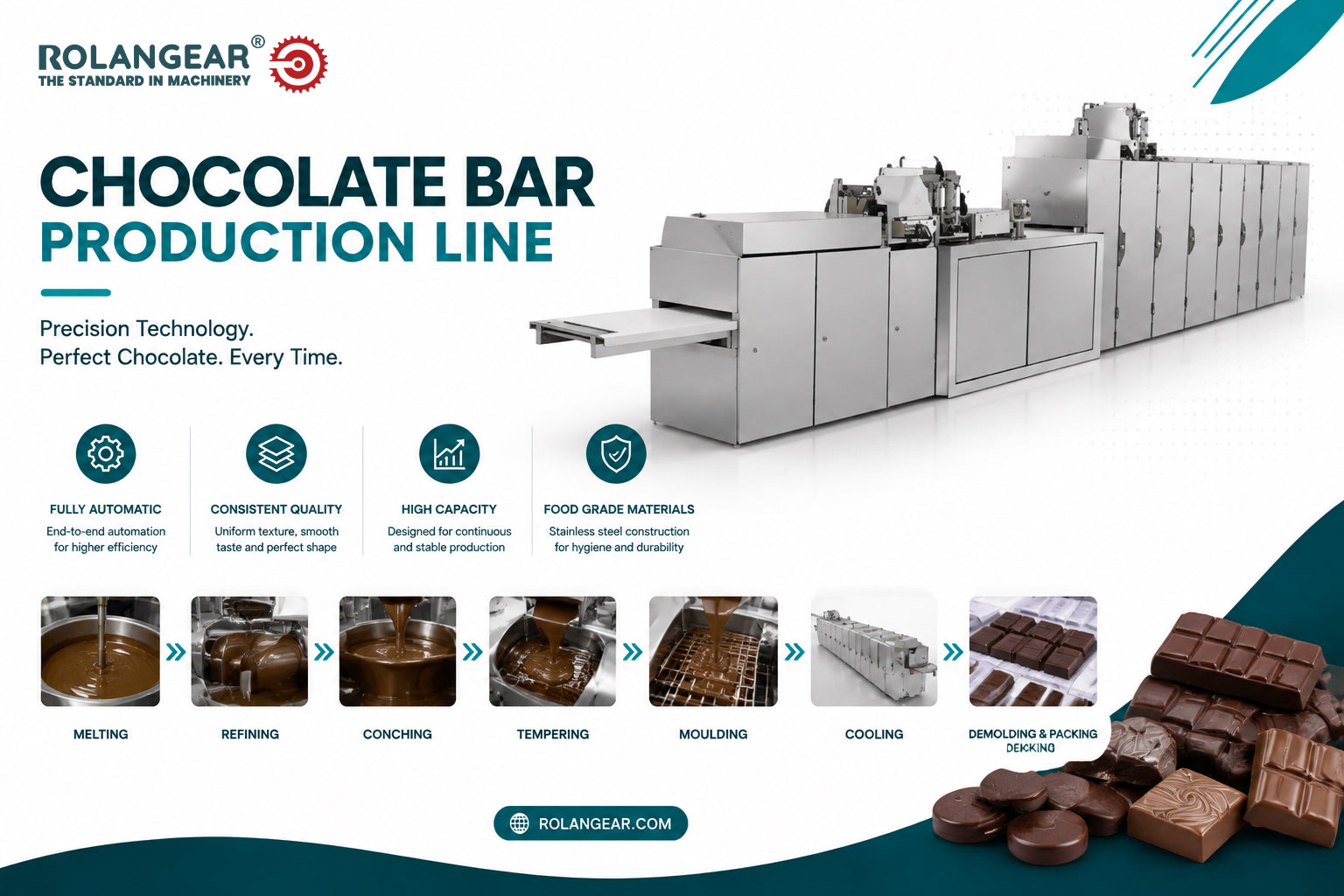
A chocolate bar production line is a connected manufacturing system designed to turn prepared chocolate into finished chocolate bars. The line usually starts after the chocolate mass has been refined or supplied in ready-to-process form. The chocolate is melted, held at a stable temperature, tempered, deposited into moulds, cooled until solid, demoulded, inspected and packed.

The exact design depends on the factory. A boutique chocolate maker may use compact melting tanks, a smaller tempering unit, mould handling conveyors and manual cartoning. An industrial manufacturer may require automatic feeding, high-output tempering, servo depositing, long multi-zone cooling tunnels, automatic demoulding, vision inspection, metal detection, flow wrapping, cartoning and case packing.
The value of an integrated line is synchronization. When mould movement, depositing speed, cooling time and packaging capacity are balanced, the factory can run more smoothly with fewer bottlenecks. This is especially important when producing thousands of bars per hour or operating multiple shifts.
Chocolate Bar Production Process

1. Chocolate Preparation, Melting and Storage
Before moulding, chocolate must be in the right condition for continuous processing. Manufacturers may prepare chocolate in-house or receive finished chocolate from suppliers. Typical formulations include cocoa liquor, cocoa butter, sugar, milk powder for milk chocolate, cocoa powder, emulsifiers, flavorings and functional ingredients depending on the recipe.
Chocolate blocks, chips or liquid chocolate are fed into melting tanks equipped with gentle heating and agitation. The goal is to create a smooth, homogeneous liquid without overheating the chocolate or damaging flavor quality. After melting, the chocolate is transferred to insulated storage tanks. Continuous stirring prevents separation and provides a stable supply to the tempering machine.
Good storage design supports uninterrupted production. Food-grade stainless steel construction, jacketed heating, precise temperature control and hygienic surfaces make cleaning and daily operation easier. If chocolate viscosity or temperature is unstable at this stage, problems will appear later during depositing, mould filling and demoulding.
2. Chocolate Tempering
Tempering is one of the most important steps in chocolate manufacturing. It controls cocoa butter crystallization so the finished bar develops gloss, snap, mould release and shelf stability. Poorly tempered chocolate may look dull, soften too easily, form white fat bloom or stick to the mould.
Modern automatic tempering machines heat, cool and reheat chocolate under controlled conditions. Sensors and control systems maintain the correct temperature curve for different chocolate types, including milk chocolate, dark chocolate, white chocolate, compound chocolate and specialty formulas. Stable tempering reduces defects and makes long production runs more predictable.
3. Depositing and Moulding
After tempering, chocolate flows to the depositing section. This stage determines the final bar shape, thickness and weight. Servo-controlled depositing systems deliver accurate chocolate portions into each mould cavity while synchronizing with the mould conveyor. Accurate depositing reduces product variation, improves packaging compatibility and saves raw material.
Depending on product design, the line can deposit plain bars, mini bars, multi-layer products, filled bars or chocolate with inclusions. Some projects require nut dosing, caramel filling, cream filling, wafer placement or decorative patterns. Mould vibration is normally used immediately after depositing to remove air bubbles, distribute chocolate evenly and improve surface smoothness.
Mould flexibility is a major advantage of modern systems. By changing moulds and adjusting recipes or depositing parameters, manufacturers can produce standard retail bars, premium tablet chocolate, promotional shapes, seasonal products and private-label designs on the same production platform.
4. Controlled Cooling
The cooling tunnel transforms deposited chocolate from liquid into a stable solid bar. Cooling must be controlled carefully because the chocolate structure created during tempering can be damaged by uneven or excessive cooling. A professional cooling tunnel manages air temperature, airflow distribution, humidity, conveyor speed and cooling time.
Proper cooling helps create glossy surfaces, stable shape, clean mould release and consistent dimensions. Cooling too quickly can cause internal stress or cracking; cooling too slowly can lead to deformation and poor demoulding. For thicker bars or high-speed lines, multi-zone tunnels may be required to cool products gradually and evenly.
5. Automatic Demoulding and Mould Return
When cooling is complete, chocolate bars are removed from the moulds. Automatic demoulding systems release bars by inverting, flexing or mechanically assisting the moulds, depending on line design. Gentle demoulding protects product appearance and reduces breakage. Empty moulds are then returned automatically to the depositing station, creating continuous circulation.
Reliable mould circulation improves equipment utilization. It also reduces the need for operators to manually move moulds between stations, which is valuable for hygiene, labor efficiency and production speed.
6. Inspection and Quality Control
Before packaging, chocolate bars should be inspected to confirm they meet quality requirements. Depending on the project, inspection may include visual checks, weight verification, surface defect detection, dimension checking, metal detection, checkweighing and automatic reject systems. Quality control protects brand reputation and helps factories meet customer and regulatory expectations.
For export-oriented manufacturers, traceability is also important. Coding systems can print production date, expiration date, batch number and traceability information on the package. When quality records are linked with production batches, the factory can manage recalls, audits and customer complaints more effectively.
7. Chocolate Bar Packaging
Packaging protects the finished chocolate from moisture, contamination and handling damage while creating a professional retail presentation. Flow wrapping is widely used for individual chocolate bars because it is fast, flexible and suitable for many package sizes. Automatic flow wrappers use heat-sealable film to create clean, sealed packs at high speed.
After flow wrapping, bars may be grouped into retail cartons, multipacks, display boxes or shipping cartons. End-of-line options can include cartoning, checkweighing, metal detection, case packing and palletizing. The right packaging configuration depends on production volume, labor availability, shelf-life requirements and customer packaging format.
Main Equipment in a Chocolate Bar Production Line

A complete line is built from several machines that must work together. The most common equipment includes chocolate melting tanks, storage tanks, tempering machines, depositing machines, mould conveyors, vibration stations, cooling tunnels, demoulding systems, inspection equipment and packaging machines.
Core equipment functions:
- Melting tank: melts chocolate gently and prepares it for continuous processing.
- Storage tank: keeps melted chocolate homogeneous and supplies the tempering system.
- Tempering machine: controls cocoa butter crystallization for gloss, snap and shelf stability.
- Depositing machine: fills each mould cavity accurately for consistent weight and shape.
- Mould conveyor: transports moulds through depositing, cooling and demoulding.
- Vibration unit: removes air bubbles and improves chocolate distribution.
- Cooling tunnel: solidifies the bars under controlled temperature and airflow.
- Demoulding system: releases finished bars with minimal damage.
- Packaging line: wraps, codes, inspects, cartons and prepares products for shipment.
Optional equipment may include automatic ingredient feeding, inclusion dosing, filling systems, mould heating, mould cleaning, vision inspection, metal detectors, checkweighers, robotic loading and case packing. These options should be selected according to product strategy rather than added only for appearance.
Product Types and Production Flexibility

One line can often support many chocolate bar categories when the design allows quick recipe changes and mould replacement. Manufacturers can produce milk chocolate, dark chocolate, white chocolate, filled chocolate, nut chocolate, wafer chocolate, tablet chocolate, mini bars, protein bars with chocolate coating and customized private-label products.
Product flexibility is especially valuable for companies serving supermarkets, seasonal markets or OEM customers. A flexible line can support promotional launches, limited editions and multiple packaging formats without requiring a completely new production system. However, flexibility must be engineered from the beginning. Filling systems, dosing accuracy, mould inventory, cooling time and packaging changeover should all be considered during project planning.
Capacity Selection, Cost and ROI
There is no single price for a chocolate bar production line because every project is different. Cost is influenced by capacity, automation level, product complexity, mould quantity, cooling tunnel length, packaging automation, hygiene requirements and factory layout. Instead of focusing only on the purchase price, manufacturers should evaluate total operating value over the full life of the equipment.
Small factories may choose compact or semi-automatic systems for local markets, boutique brands, product development or seasonal production. Medium factories usually need more stable automation to supply supermarkets, distributors and private-label customers. Industrial manufacturers require high-capacity lines designed for continuous operation, strict quality control and efficient end-of-line packaging.
Cost factors to review before requesting a quotation:
- Target output per hour or per shift
- Chocolate bar size, thickness and weight
- Number of recipes, fillings and inclusions
- Required mould quantity and changeover frequency
- Cooling time and available factory space
- Manual, semi-automatic or fully automatic packaging
- Food safety, cleaning and traceability requirements
- Future expansion plans and spare capacity needs
Automation can improve ROI through labor savings, reduced overfilling, fewer rejects, lower breakage, higher line efficiency and stronger product consistency. The best investment is not always the cheapest machine. It is the system that produces the required quality at the required speed with stable operation and manageable maintenance.
Factory Layout Planning
Factory layout has a direct impact on production efficiency, hygiene and future expansion. A practical layout should support one-way material flow from raw material storage to chocolate preparation, moulding, cooling, packaging and finished goods storage. It should also leave enough space for operators, maintenance access, cleaning, utilities and possible capacity upgrades.

Before manufacturing equipment, Rolangear can help customers review available space, product flow, electrical requirements, compressed air, cooling demand, operator access and packaging logistics. Good layout planning reduces internal transportation, avoids bottlenecks and helps the production line integrate smoothly into the customer’s facility.
Hygiene, Cleaning and Maintenance
Chocolate production equipment must be easy to clean and maintain because hygiene problems can quickly affect product safety, shelf life and brand reputation. Machine contact parts should use food-grade materials, and surfaces should be designed to reduce material accumulation. Operators need convenient access to tanks, pipes, depositor heads, conveyors and packaging areas for daily inspection and cleaning.

Maintenance planning is also important. A chocolate bar line contains heating systems, temperature controls, motors, conveyors, moulds, sensors, pneumatic components and packaging mechanisms. If preventive maintenance is ignored, small issues such as unstable temperature, poor nozzle alignment, worn moulds or inconsistent film feeding can create product defects and production delays. A practical line should be designed for simple inspection, fast adjustment and reliable spare parts support.
Daily operation points to control:
- Keep chocolate temperature and viscosity stable before tempering.
- Check depositor accuracy and nozzle cleanliness regularly.
- Inspect mould condition to avoid scratches, sticking or poor release.
- Monitor cooling tunnel temperature, airflow and condensation risk.
- Confirm wrapper sealing quality, coding accuracy and reject function.
- Record production data for traceability and continuous improvement.
Good hygiene and maintenance procedures make automation more valuable. They help the factory protect product quality, reduce downtime and keep the line performing consistently over many years.
Common Production Problems and How Automation Helps
Many chocolate bar quality problems come from unstable manual operation or poorly matched equipment. Dull surfaces, fat bloom, weight variation, air bubbles, cracking, broken bars, sticking moulds and packaging rejects can all reduce yield. Automation helps by controlling the key variables that affect these defects: chocolate temperature, depositing volume, mould movement, vibration, cooling time, airflow and wrapping speed.

However, automation should be supported by correct recipes, trained operators and suitable factory conditions. For example, a cooling tunnel cannot fully solve problems caused by incorrect tempering. A high-speed depositor cannot perform well if chocolate viscosity is outside the working range. This is why equipment selection, process design and operator training should be planned together rather than separately.
How to Choose the Right Chocolate Bar Production Line
Choosing equipment should begin with a clear production plan. Manufacturers should define the products they want to make, the expected capacity, the packaging style, the available space and the level of automation they can support. It is also important to consider local food safety requirements, operator skill level, maintenance ability and long-term business goals.
Questions to answer before buying:
- What chocolate bar sizes and recipes will be produced first?
- Will the line need filled bars, nut dosing, wafer handling or protein bar coating?
- What is the target capacity per hour, shift and year?
- How many product changeovers are expected each week?
- What packaging formats are required for retail and distribution?
- How much factory space is available for the line and future expansion?
- What level of automation gives the best balance between budget and efficiency?
A reliable supplier should provide more than machines. The supplier should understand the full production flow and offer practical advice on capacity, layout, machine integration, cleaning, commissioning and after-sales support. This reduces project risk and helps the factory start production more smoothly.
Why Choose Rolangear?
Rolangear provides professional chocolate bar production line solutions for manufacturers planning new factories, capacity expansion and automation upgrades. Our team supports customers with equipment selection, customized line configuration, factory layout planning, installation guidance, commissioning, operator training and long-term technical service.
Because every chocolate project is different, Rolangear designs each solution around the customer’s product range, capacity target, factory space and investment plan. Whether you need a compact semi-automatic line or a fully integrated industrial chocolate bar manufacturing system, we help build a practical, efficient and scalable production solution.
Frequently Asked Questions
What is a chocolate bar production line?
It is an integrated manufacturing system that produces chocolate bars through preparation, tempering, depositing or moulding, cooling, demoulding, inspection and packaging. It improves efficiency, consistency and hygiene compared with manual production.
Can one line produce different chocolate bar sizes?
Yes. By changing moulds and adjusting depositing parameters, one line can produce different bar sizes, shapes and weights. Additional systems may be needed for fillings, inclusions or special product structures.
Why is chocolate tempering important?
Tempering creates stable cocoa butter crystals. This gives chocolate a glossy surface, firm texture, clean snap, easy mould release and better shelf stability. Poor tempering can cause dull surfaces, softness or fat bloom.
How long does chocolate cooling take?
Cooling time depends on chocolate formulation, bar thickness, mould design, tunnel conditions and line speed. A properly designed cooling tunnel balances temperature, airflow and residence time to solidify products evenly.
What affects chocolate bar production line cost?
The main factors are capacity, automation level, number of moulds, cooling tunnel length, product variety, filling or inclusion systems, packaging automation, hygiene design and factory layout requirements.
Does Rolangear provide customized turnkey solutions?
Yes. Rolangear can customize chocolate bar production lines according to production capacity, product type, factory space, packaging format and automation requirements. We also support layout planning, commissioning and after-sales service.
Conclusion
A modern chocolate bar production line helps manufacturers produce attractive, consistent and commercially competitive chocolate products with higher efficiency and better quality control. From tempering and moulding to cooling, demoulding and packaging, every stage must be designed as part of one complete workflow.
For companies launching a new chocolate factory or upgrading existing production, the right equipment partner can reduce risk and improve long-term performance. Rolangear offers customized chocolate bar production solutions designed around your products, capacity goals and factory layout. Contact Rolangear to discuss your project, receive professional capacity recommendations and request a tailored turnkey quotation for your chocolate manufacturing business.
Plan Your Chocolate Bar Production Line with Rolangear
Rolangear can help you design a practical chocolate bar production solution based on your product type, factory space, target capacity, packaging format and automation requirements. Contact Rolangear to discuss your project and request a customized turnkey quotation.
Contact Rolangear