Complete Dates Syrup Processing Production Line Guide
Dates Syrup Processing Production Line: Complete Professional Guide for Commercial Date Syrup Manufacturing
A customer-ready Rolangear blog article for date farms, food processors, ingredient suppliers, investors, and factories planning a complete date syrup processing solution.
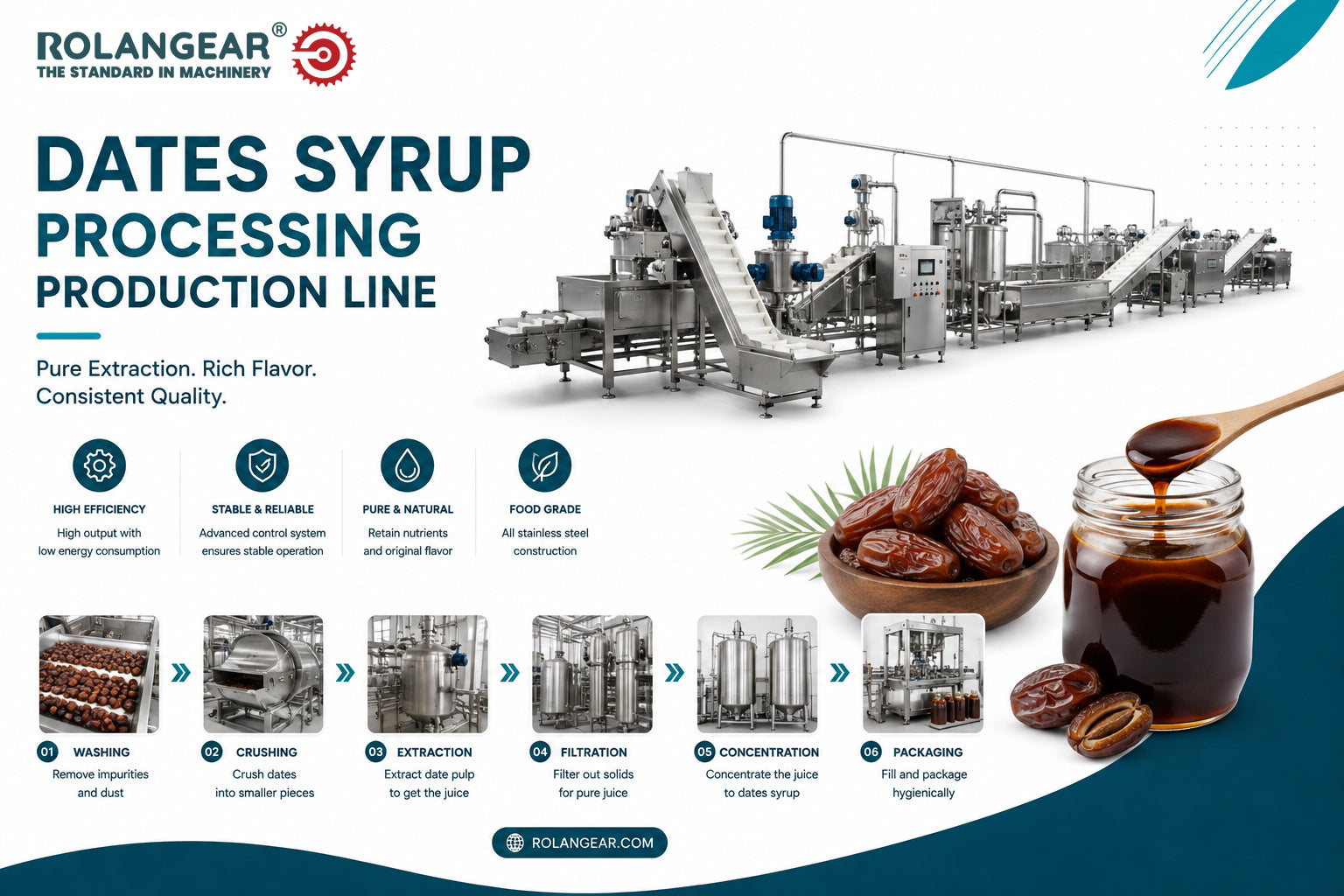
A Dates Syrup Processing Production Line is a complete food-processing system that turns suitable dates into concentrated syrup through receiving, washing, sorting, pitting, preparation, extraction, solid-liquid separation, filtration, vacuum concentration, syrup storage, filling, water treatment, and CIP cleaning.
Date syrup is a practical way to transform agricultural date fruit into a standardized, higher-value food product. For many producers, the opportunity is not only selling dates as a raw commodity. The opportunity is to build a more controlled food-processing business that can supply retail brands, foodservice buyers, bakeries, beverage manufacturers, confectionery producers, and bulk ingredient customers.
A professional date syrup project should not be planned as a simple list of machines. Raw-material characteristics, fruit preparation, extraction conditions, filtration stability, concentration control, packaging format, utilities, cleaning method, factory layout, and target market all affect the final result. When these details are planned together, the production line becomes easier to operate and the finished syrup is more consistent.
Rolangear develops complete processing solutions around real project conditions. The line can be designed according to date variety, raw-material condition, required capacity, syrup specification, packaging format, factory size, automation level, available utilities, and future expansion plan. This guide explains how the production line works, which equipment is normally used, and what buyers should consider before investing.
Products and Markets for Date Syrup
A date syrup processing line can support several product strategies. A retail operation may fill syrup into small bottles, jars, squeeze containers, or other consumer packaging. This product can be positioned as a natural sweetener, topping, breakfast ingredient, dessert ingredient, beverage ingredient, or general food ingredient, depending on the legal claims allowed in the target market.
Foodservice buyers usually require larger and more practical containers. Restaurants, hotels, bakeries, catering companies, professional kitchens, and food distributors often care about stable quality, convenient handling, reliable supply, and cost-effective packaging. For this channel, filling accuracy and package strength may be more important than decorative retail presentation.
Industrial date syrup is normally supplied as an ingredient to other food manufacturers. Potential applications include bakery products, confectionery, beverages, sauces, desserts, breakfast products, snack formulations, and prepared foods. Industrial customers may request defined soluble solids, viscosity, color, filtration level, microbiological standards, and batch-to-batch repeatability.
Bulk date syrup can also be supplied in drums, intermediate bulk containers, or other food-grade bulk packaging. Bulk production can simplify the packaging stage and allow a factory to focus on ingredient supply rather than consumer marketing. This is often attractive for processors that have strong raw-material access and want to sell larger volumes to B2B customers.
The product strategy should decide the line configuration. A retail brand may prioritize filling, labeling, and product appearance. An ingredient supplier may prioritize extraction consistency, concentration control, filtration stability, storage capacity, and bulk handling.
Complete Production Process: From Whole Dates to Finished Syrup
A commercial date syrup process separates useful soluble components from pits, skins, fiber, coarse solids, and unwanted material. After extraction, the liquid is clarified or filtered, then concentrated until it reaches the target soluble-solids level and syrup viscosity. The final product is stored and filled according to the packaging format.
Each process stage influences the next one. If washing and sorting are weak, downstream equipment receives more impurities. If preparation is inconsistent, extraction efficiency can change from batch to batch. If separation and filtration are not stable, concentration equipment may require more cleaning. If concentration control is poor, finished syrup may vary in thickness, color, or quality. A complete line should therefore be engineered as one connected production chain.
Typical process flow: Date Receiving → Washing → Sorting → Pitting and Preparation → Pre-Cooking → Extraction → Separation → Filtration → Vacuum Concentration → Balance Storage → Filling and Packaging → CIP Cleaning.
1. Date Receiving and Initial Washing
Raw dates are received, unloaded, inspected, and washed before entering the main processing line. The receiving area should allow weighing, temporary storage, and quality checking. Initial washing removes surface dirt and prepares the fruit for brush washing, sorting, and preparation.
2. Brush Washing and Sorting
Brush washing improves surface cleaning through brush bars and spraying water. After washing, dates move through a sorting conveyor where unsuitable fruit can be removed. This stage supports better product color, smoother extraction, and more stable downstream processing.
3. Pitting, Pulping, and Pre-Cooking
Depending on the fruit condition and final process design, dates may pass through pitting, kernel separation, pulping, or steaming. Pre-cooking softens the fruit and helps prepare the material for extraction. Pulping turns the material into a more workable form so soluble components can be recovered more efficiently.
4. Juice Extraction
The extraction stage is the core of syrup production. Extraction performance depends on temperature, residence time, agitation, filtration, water ratio, and fruit condition. Controlled extraction helps improve yield and repeatability while avoiding unnecessary product variation.
5. Solid-Liquid Separation
After extraction, the liquid phase must be separated from coarse solids and heavier material. A separator or decanter can reduce the load on downstream filtration. Good separation improves cleanliness, protects pumps and evaporators, and supports a smoother finished syrup.
Filtration and Product Clarification
Filtration level should match the desired product appearance and market requirement. Some buyers may want a smoother, cleaner syrup, while others may accept a thicker ingredient-style product. Multi-stage filtration gives better control than relying on only one filtration point.
7. Vacuum Concentration
The concentration unit removes water and brings the syrup to the target specification. Vacuum concentration can help control temperature exposure and improve process stability. This stage strongly influences soluble solids, viscosity, product flow behavior, energy consumption, and final syrup consistency.
8. Storage, Balance, and Filling
Balance tanks help connect processing and packaging smoothly. Finished syrup can be filled into retail bottles, jars, pouches, foodservice containers, drums, or bulk packaging. The filling system should match product viscosity, filling temperature, package type, and expected production speed.
Water Treatment and CIP Cleaning
RO water treatment supports water quality for food and beverage processing. CIP cleaning helps clean tanks, pipelines, heat-transfer equipment, and product-contact parts in a more systematic way. This can reduce manual cleaning work and improve operational organization.
Main Equipment in the Dates Syrup Processing Production Line
The supplied configuration includes a complete front-to-back date syrup processing system. Final specifications should be confirmed according to target capacity, raw-material testing, finished syrup requirements, packaging format, building conditions, and utility availability. The equipment below shows the practical production logic of the line.
Stage
Equipment
Receiving and washing
Dates Receiving & Washing Machine
Brush cleaning
Brush Washer
Manual inspection
Sorting Conveyor
Thermal preparation
Pre-Cooking Machine / Steaming
Transfer
Hoist Elevator
Pulping and seed removal
Pulping Machine / Kernel Separator
Extraction
Juice Extraction Unit
Separation
Separator / Decanter
Intermediate storage
Balance Tank
Concentration
Vacuum Concentration Unit
Transfer and utilities
Screw Pump / Centrifugal Pump
Packaging and control
Filling Machine, PLC Cabinet, Piping, Water Treatment, CIP
Technical Advantages for Professional Food Processing
Controlled Extraction Conditions
Dates are agricultural materials, so their moisture, maturity, texture, sugar content, and pit characteristics can vary. Controlled extraction helps establish repeatable processing conditions by managing temperature, mixing, liquid-to-fruit ratio, residence time, and filtration. This is important for both syrup quality and production planning.
Efficient Solid Separation
Removing coarse material before fine filtration reduces the workload on downstream equipment. A decanter or separator can help stabilize the liquid phase before the syrup moves into filtration and concentration. This can improve maintenance convenience and protect heat-transfer surfaces.
Multi-Stage Filtration Flexibility
Different products may require different filtration levels. Retail syrup may require a smoother appearance, while some industrial ingredient applications may accept different texture specifications. By selecting suitable filtration stages, the line can be matched to the desired product style rather than forcing every customer into one fixed syrup profile.
Stable Concentration Control
Concentration is one of the most important sections of the date syrup line. It affects soluble solids, viscosity, color, product flow, filling behavior, and energy demand. The evaporator should be selected according to capacity, heat source, product specification, and operating cost expectations.
Hygienic Product Contact
Food-contact parts should be selected and arranged with hygiene in mind. Stainless steel contact materials, smooth surfaces, hygienic piping, suitable valves, drainability, cleaning access, CIP design, and separation of raw and clean zones all contribute to a more professional food-processing plant.
Practical Automation
Automation should be used where it creates operational value. Depending on project requirements, automatic control can support pumps, valves, tank levels, heating, temperature display, product transfer, concentration, filling, and CIP cleaning. The goal is repeatable control and easier operation, not unnecessary complexity.
Capacity Planning: Choose the Right Size
Capacity should be selected according to the full business model. A large system is not useful if raw-material supply, operating hours, storage, utilities, packaging, or sales volume cannot support it. Before selecting capacity, the buyer should estimate how many dates can be secured, how much syrup can be sold, and how many production hours are realistic.
Small-scale systems can be suitable for local date processors, agricultural businesses, start-up food brands, regional suppliers, and product development. Medium-capacity plants are better for businesses with established raw-material sources and broader customer channels. Industrial plants may need higher automation, larger extraction capacity, stronger utilities, advanced concentration, larger tanks, and automatic packaging.
Seasonal planning is also important. Dates are agricultural products, and supply may vary during the year. Some factories may operate seasonally, while others may use raw-material storage, multiple suppliers, finished-product inventory, or scheduled production campaigns. The correct strategy depends on local supply conditions and market demand.
Factory Layout and Hygiene Zoning
A professional layout should move material from raw dates toward finished packaged syrup without unnecessary crossing between raw and clean areas. A typical flow includes raw date receiving, washing and sorting, pitting and preparation, extraction, separation and filtration, concentration, finished syrup storage, filling and packaging, and finished-product warehouse.
The raw-material area should provide space for unloading, inspection, weighing, and temporary storage. Processing sections should follow the actual production sequence to reduce unnecessary movement and improve operator supervision. The concentration and filtration area should consider heating source, product piping, pumps, condensate, water, drainage, instrumentation, cleaning systems, and maintenance access.
Finished syrup storage should be located between concentration and packaging so the filling section can operate more smoothly. Hygiene zoning should distinguish raw-material areas from processed and finished-product areas. Personnel movement, drainage, cleaning procedures, packaging flow, and finished product handling should be considered during layout planning.
For project-specific layout support, prepare building length, building width, ceiling height, column positions, door locations, raw-material storage area, finished-product storage, water supply, drainage, heating source, electrical conditions, and expected capacity.
Investment Factors: Look Beyond Equipment Price
The investment required for a date syrup project depends on the complete production system. Equipment price is only one part of the decision. A realistic evaluation should consider processing equipment, installation, utilities, labor, raw material, energy, maintenance, packaging, logistics, factory preparation, and future expansion.
Extraction and concentration technology can have a strong influence on both capital cost and operating cost. The concentration section is especially important because evaporation removes water and may become one of the major energy-use points in the plant. Selecting equipment only by purchase price can create higher operating costs later.
Packaging can also represent a significant part of the project when the line includes filling, capping, labeling, coding, inspection, and cartoning. The packaging system should match the intended market. Retail packaging, foodservice packaging, and bulk ingredient supply may require very different investment priorities.
Raw-material economics must also be evaluated. Date purchase price, grade, seasonal availability, transportation, storage, extraction yield, and finished syrup output all affect profitability. A low raw-material price does not automatically create a strong project if the fruit gives poor yield or inconsistent product quality.
Why Invest in Date Syrup Processing?
Date syrup gives producers another way to monetize suitable date material. Instead of relying only on whole-date sales, a processor can create a standardized liquid product with applications across multiple food sectors. This is especially useful for producers with access to large local date supply or date grades that are suitable for processing but less suitable for premium retail whole-fruit presentation.
Processing creates value through standardization, concentration, packaging, branding, and distribution. It can help a business expand beyond commodity sales and reach retail, foodservice, and industrial customers. The same core production line can support different product channels if the system is planned correctly.
A successful date syrup operation connects four elements: reliable date supply, efficient processing, consistent product, and a defined market. The processing line is the bridge between agricultural raw material and commercial food product. When designed correctly, it can support business growth, product diversification, and better raw-material utilization.
Why Rolangear Is a Good Solution Partner
Rolangear approaches date syrup projects from a process-engineering perspective. Instead of treating washing, extraction, filtration, concentration, storage, and filling as unrelated equipment purchases, we connect them into one complete production system. This helps the customer see how each machine supports the final product.
A Rolangear project configuration can consider date variety, raw-material characteristics, required capacity, target syrup specification, packaging format, factory dimensions, utilities, automation requirements, cleaning needs, and future expansion. This helps reduce unnecessary equipment and lowers the risk of bottlenecks between process stages.
Process flow comes first. Preparation affects extraction. Extraction affects separation and filtration. Filtration affects concentration. Concentration affects storage and filling. A project designed with this logic is easier to operate and more practical for long-term production.
Support can include requirement analysis, process design, equipment selection, factory layout, manufacturing, installation, commissioning, training, and production support. The objective is to help the customer move from project idea to commercial production with a clearer and more practical plan.
Frequently Asked Questions
What is a Dates Syrup Processing Production Line?
It is an integrated food-processing system that converts suitable dates into concentrated syrup through preparation, extraction, separation, filtration, vacuum concentration, storage, and packaging.
What types of dates can be processed into syrup?
Many date varieties may be suitable, but moisture, maturity, texture, sugar content, pit characteristics, and raw-material quality can affect process performance. Testing the raw material before final configuration is recommended.
Can lower-grade dates be used?
Suitable dates that do not meet premium whole-fruit appearance requirements may be considered if they meet food-safety and quality standards. This can create an additional market for date grades that are suitable for processing.
Can the final syrup concentration be specified?
Yes. The concentration stage can be designed around the required soluble-solids level, viscosity, filling temperature, and final product application.
Can the line include filling and packaging?
Yes. Filling and packaging can be configured for bottles, jars, pouches, foodservice containers, drums, or bulk packaging according to the selected market.
How much factory space is required?
There is no single footprint for every project. The required area depends on capacity, extraction equipment, filtration, evaporators, tanks, filling equipment, storage, utilities, and maintenance access.
What information is needed for a quotation?
Useful information includes date variety, raw-material quantity and condition, target capacity, desired syrup specification, packaging format, factory dimensions, utility conditions, location, automation requirements, and future expansion expectations.
Ready to Turn Dates Into a Commercial Syrup Product?
Ready to turn dates into a commercial syrup product? Rolangear can help develop a complete Dates Syrup Processing Production Line around your raw material, target product, capacity, concentration, packaging, factory layout, utilities, cleaning requirements, and market plan.
Rolangear Buyer Guide
Automatic Carton Box Production Line: Machines, Raw Materials and Factory Cost
A professional Rolangear buyer guide for packaging manufacturers planning corrugated carton pr...
300KG Automatic Mechanical Tire Recycling Production Line: From Waste Tires to Recycled Rubber, Steel and Fiber
End-of-life tires are one of the most challenging waste materials for recycling bu...
Our goal is to provide you with excellent customer service while meeting all of your automation needs. We provide the peace of mind that comes from working with one machinery provider, one service department and one point of contact