What Is a Paper Cup Production Line?
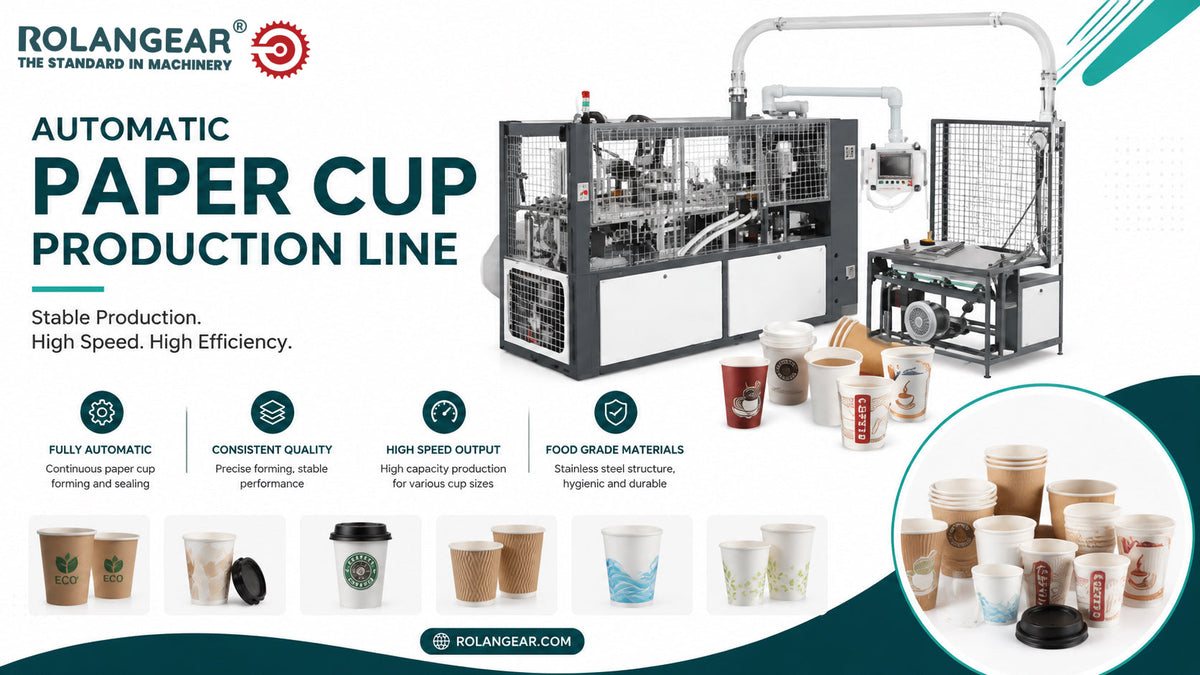
A paper cup production line is an integrated manufacturing system used to produce disposable paper cups from coated paper materials. Instead of relying only on a cup forming machine, a complete production line covers the full workflow from coated paper roll preparation to finished cup packaging.
A typical paper cup production line may include paper roll preparation, a printing machine, die cutting machine, paper cup forming machine, quality inspection system, counting and packaging equipment, and a finished product storage area.
Each stage must work smoothly with the next stage. If printing is inaccurate, the final cup appearance will be affected. If die cutting is not precise, forming may become unstable and material waste may increase. If side or bottom sealing is weak, cups may leak during use. For this reason, paper cup manufacturing requires reliable machinery, suitable materials, and proper production planning.

Why Invest in Paper Cup Manufacturing?
Strong Demand from Food and Beverage Businesses
Paper cups are widely used for coffee, tea, juice, soft drinks, bubble tea, milk tea, fast-food beverages, office drinks, event service, hotels, restaurants, delivery, and takeaway packaging.
Many brands also use printed paper cups as a marketing tool. A paper cup is not only a container; it can display a logo, brand color, promotional message, seasonal design, or event campaign. This creates business opportunities for manufacturers that can provide stable quality and customized printing.
Customization Creates Higher-Value Orders
Compared with plain disposable cups, customized printed cups can offer higher value. Customers may require different cup sizes, paper thicknesses, coating options, designs, and packaging methods.
Common customized products include logo printed coffee cups, seasonal beverage cups, advertising cups, event cups, premium double wall cups, ripple wall insulated cups, and cold drink cups. A factory with printing, die cutting, and forming capability can serve coffee brands, restaurant chains, beverage distributors, corporate customers, and packaging wholesalers.
Automation Improves Efficiency
Modern automatic paper cup production lines reduce manual work and improve production stability. Automated feeding, forming, sealing, counting, and packaging can help manufacturers increase output while reducing dependence on manual operation.
Automation also improves consistency. Cups should maintain stable size, shape, sealing strength, and appearance across production batches. This is especially important when serving chain customers, distributors, or export markets with stricter quality requirements.
Types of Paper Cups Produced by Industrial Lines
A professional paper cup production line can manufacture different cup types depending on machine configuration, material selection, molds, cup size range, and customer requirements.
Common disposable cups used for coffee, tea, soft drinks, and takeaway beverages. They are economical and suitable for high-volume production.
Cups with an additional outer layer for better insulation and a more comfortable hand feel. They are commonly used for hot drinks and premium coffee packaging.
Cups with a textured outer layer that improves grip, insulation, and visual appearance. They are popular in coffee shops and premium beverage markets.
Cups designed for juice, smoothies, soft drinks, iced coffee, milk tea, and other cold beverages. Material selection and coating quality are important to reduce moisture-related problems.
Cups used for branding, advertising, restaurant chains, seasonal campaigns, and corporate events. High-quality printing is important because cup appearance directly affects customer perception.

Complete Paper Cup Production Process
Step 1: Raw Material Preparation
The first step is selecting suitable raw materials. A typical paper cup uses food-contact paperboard with a PE coating, water-based coating, or PLA coating depending on market requirements. Common material components include paperboard, coating material, food-contact suitable printing ink, and optional additional paper layers for insulation.
Material quality has a major effect on final cup performance. Poor material may cause leakage, weak sealing, deformation, poor printing results, or customer complaints. PE-coated paper is widely used because it provides good moisture resistance and stable sealing performance. It is suitable for many hot and cold beverage applications. PLA coating is a bio-based option often used in markets that require compostable or more sustainable packaging, but actual suitability should be confirmed according to local regulations, available composting facilities, and customer requirements.
Step 2: Paper Printing
After material preparation, the paper roll is printed with customer designs, logos, colors, and patterns. For beverage brands, printing quality is very important because the cup works as both packaging and brand communication.
Many industrial paper cup production lines use flexographic printing systems. The process usually includes paper roll feeding, ink application, pattern transfer, drying, and rewinding. Important printing factors include printing speed, number of colors, color registration accuracy, ink suitability, drying performance, and paper tension control.
Poor printing quality can cause blurry patterns, color errors, logo distortion, or a low-grade appearance. A stable printing system helps reduce waste and improve product value.
Step 3: Die Cutting
After printing, the paper roll enters the die cutting stage. The die cutting machine cuts printed paper into accurate fan-shaped blanks. These blanks are later formed into cup bodies.
Die cutting is important because it directly affects material utilization and forming accuracy. Since paper is one of the largest production costs, efficient cutting helps reduce waste and improve profitability. A good die cutting system provides accurate blank shape, stable feeding and cutting speed, efficient waste separation, better material utilization, and smoother downstream forming.
If the blank shape is inaccurate, the cup may have poor sealing, uneven appearance, or forming instability.
Step 4: Automatic Paper Cup Forming
The paper cup forming machine is the core equipment in the production line. It transforms flat paper blanks into finished cup shapes through a series of automatic operations.
A typical forming process includes paper blank feeding, side wall forming, side sealing, bottom paper punching or feeding, bottom insertion, bottom sealing, bottom knurling, top edge curling, and cup discharge. During side wall forming, the fan-shaped blank is wrapped into a cylindrical cup body. The overlapping edge is then sealed using hot air sealing, ultrasonic sealing, or another suitable sealing method.
The bottom paper is inserted and sealed to create a leak-resistant cup base. Bottom knurling strengthens the connection between the cup body and the bottom. Finally, the top edge is curled to create a smooth drinking rim and improve structural strength.
This stage requires accurate control of temperature, positioning, pressure, speed, and material feeding. If any parameter is unstable, it may cause leakage, cup deformation, poor rim quality, unstable stacking, or machine downtime.
Step 5: Quality Inspection
Quality control should happen throughout production, not only at the end. A professional paper cup factory checks raw materials, printing, die cutting, forming, sealing, appearance, leakage resistance, and packaging.
Important inspection items include cup height, top diameter, bottom diameter, rim shape, side sealing strength, bottom sealing quality, leakage resistance, printing accuracy, surface defects, and cup stacking performance. Leakage testing is especially important for beverage packaging. Poor sealing can damage customer trust and create serious quality complaints.
For larger factories, automatic inspection systems can help detect appearance defects, deformation, printing problems, leakage risks, or size errors more efficiently.
Step 6: Counting and Packaging
After inspection, qualified cups are counted, stacked, packed, and prepared for storage or shipment. Automatic packaging systems improve speed, reduce manual labor, and help maintain accurate quantities.
Common packaging methods include sleeve or bag packaging, carton packaging, bulk packaging for distributors, and customized packaging for brand customers. Efficient packaging protects the cups during transportation and makes warehouse management easier.

Main Machines in a Paper Cup Production Line
| Equipment | Function and Key Selection Points |
|---|---|
| Paper Printing Machine | Prints logos, patterns, and designs on coated paper rolls. Key selection points include number of colors, printing speed, registration accuracy, drying performance, and ink compatibility. |
| Die Cutting Machine | Cuts printed paper into fan-shaped blanks. Key selection points include cutting accuracy, material utilization, cutting speed, and waste removal. |
| Paper Cup Forming Machine | Forms flat blanks into finished cups. Key selection points include cup size range, sealing method, capacity, automation level, and mold changeover time. |
| Inspection System | Checks cup appearance, size, defects, leakage risk, and sealing quality. Key selection points include detection accuracy, speed, defect types, and line integration. |
| Counting & Packaging System | Counts, stacks, bags, and packs finished cups. Key selection points include packing format, speed, labor reduction, quantity accuracy, and carton or bag requirements. |
Depending on customer requirements, a production line may also include air compressors, material handling equipment, carton sealing machines, labeling machines, warehouse systems, or additional quality testing equipment.

Capacity Selection Guide
Choosing the right production capacity is one of the most important investment decisions. A production line that is too small may limit growth, while an oversized system may increase unnecessary investment and operating costs.
Suitable capacity depends on target market demand, customer order volume, cup size and product type, number of working shifts, factory space, labor availability, investment budget, and future expansion plan.
30-60 cups/min, suitable for new investors and local suppliers.
60-120 cups/min, suitable for regional distributors and beverage suppliers.
120-250 cups/min, suitable for industrial manufacturers and export businesses.
250+ cups/min, suitable for large packaging companies and high-volume producers.
Actual capacity depends on machine model, cup size, material, automation level, and product specifications. Before ordering equipment, manufacturers should confirm the target cup range, expected daily output, working shifts, and market demand.

Paper Cup Production Line Cost Factors
Many investors ask: How much does a paper cup production line cost? The answer depends on the complete project configuration. A professional quotation should consider equipment, factory setup, raw materials, utilities, labor, packaging, installation needs, and after-sales support.
Equipment Investment
Equipment cost depends on machine speed, automation level, configuration, component grade, sealing technology, inspection system, and packaging requirements. Higher-speed machines usually require more advanced control systems, stronger mechanical structures, and more precise components.
Product Type
Different paper cup products require different machine configurations. A standard single wall coffee cup is usually simpler than double wall cups, ripple wall cups, or customized premium packaging. If the factory plans to produce multiple sizes, extra molds and changeover time should also be considered.
Factory Setup Cost
Besides machines, investors need to plan the factory environment. Important areas include raw material storage, printing area, die cutting area, cup forming area, inspection area, packaging area, finished product warehouse, maintenance area, office, and staff facilities.
Utilities may include electricity, compressed air, ventilation, lighting, and environmental control. Exact requirements should be confirmed according to machine configuration, cup specifications, and factory conditions.
Operating Cost
Long-term profitability depends on daily operating costs. Major operating costs include paper materials, coating materials, printing ink, labor, electricity, packaging materials, spare parts, maintenance, and waste management.
Because paper is usually the largest production expense, reducing material waste through accurate printing, efficient die cutting, and stable forming is very important.
Factory Layout and Utility Requirements
A good factory layout improves efficiency, reduces material handling, and helps maintain a clean production flow. The recommended layout should allow materials to move in one direction.
Raw materials, semi-finished products, and finished goods should not cross each other unnecessarily. A clear material flow reduces confusion, saves labor, and improves factory management. Each machine also needs enough space for operation, cleaning, inspection, mold changeover, maintenance, and spare parts replacement.
Paper rolls require proper storage conditions to avoid moisture absorption or material deformation. Finished cups should also be stored in a clean, dry area before delivery. Factories should reserve space for additional forming machines, extra packaging equipment, or increased warehouse capacity. Good planning allows the business to expand without rebuilding the entire production area.
Quality Control in Paper Cup Manufacturing
Quality control is essential for paper cup production because the final product is used for beverage packaging and must perform reliably. Raw material inspection should check paper GSM, coating quality, surface condition, roll condition, and food-contact suitability. Printing inspection should check color accuracy, logo position, registration, ink drying, surface cleanliness, and printing defects.
Die cutting inspection should check blank shape, cutting accuracy, waste separation, and material utilization. Forming inspection should check cup shape, side sealing, bottom sealing, rim curling, cup height, diameter, and stacking performance. Leakage testing confirms whether the side and bottom seals can hold liquid properly. Packaging inspection should check cup quantity, stacking quality, bag sealing, carton strength, and shipment readiness.
A strong quality control system helps manufacturers reduce complaints, improve brand reputation, and serve larger customers with more stable requirements.

Automation Benefits and ROI Considerations
An automatic paper cup production line is not only a machine investment. It is a long-term production strategy that can improve output, quality, and profitability. Automatic systems can run continuously at stable speeds, helping factories fulfill larger orders and serve high-volume customers.
Automated feeding, forming, inspection, counting, and packaging reduce manual work. This helps control labor costs and improves production efficiency. Machine-controlled production reduces variation caused by manual operation, so cups can maintain more consistent size, appearance, sealing quality, and stacking performance.
Accurate die cutting and stable forming also reduce paper waste. Since paper is a major cost, material savings can significantly affect profitability. Manufacturers with stable capacity and reliable quality can accept larger contracts, serve beverage chains, supply distributors, and expand into export markets.
How to Choose the Right Paper Cup Production Line
For startup manufacturers, a smaller or medium-capacity line may be more practical. It can reduce initial investment and allow the business to grow step by step. For established packaging companies or export-oriented factories, higher-speed machines, automatic inspection, and automatic packaging systems may provide better long-term efficiency.
Why Choose Rolangear?
Rolangear provides complete packaging machinery solutions for customers planning to start or expand paper cup manufacturing. Instead of only supplying individual machines, Rolangear helps customers consider the complete production process, equipment configuration, factory layout, automation level, quality-control requirements, and future expansion.
Rolangear can support customers with production process planning, equipment recommendation, customized line configuration, factory layout guidance, installation support, operator training, technical service, and spare parts support. Every project has different requirements. A suitable paper cup production line should be designed according to cup type, capacity target, material requirements, factory conditions, investment budget, and market plan.
With professional equipment solutions and project support, Rolangear helps customers build stable, efficient, and scalable paper cup manufacturing factories.
Frequently Asked Questions
What machines are needed for a complete paper cup production line?
A complete line usually includes a printing machine, die cutting machine, paper cup forming machine, inspection system, and counting or packaging equipment. The exact configuration depends on cup type, production capacity, printing requirements, coating material, and automation level.
Can one paper cup machine produce different cup sizes?
Many paper cup forming machines can produce different cup sizes by changing molds and adjusting machine settings. However, the available size range depends on the machine model, mold design, material thickness, and product specifications.
What materials are used for paper cups?
Common materials include food-contact paperboard with PE coating, PLA coating, or other approved coating options depending on market requirements. Material selection depends on whether the cup is used for hot drinks, cold drinks, sustainable packaging markets, or customized customer requirements.
How do I choose the right production capacity?
Capacity should be selected according to market demand, customer order volume, cup size, working shifts, factory space, investment budget, and future growth plan. A professional supplier can help calculate a suitable configuration.
What affects the cost of a paper cup production line?
Cost is affected by machine speed, automation level, number of machines, sealing technology, product type, inspection system, packaging system, factory setup, installation requirements, and after-sales support.
Is automatic packaging necessary?
Automatic packaging is not always required for small factories, but it becomes very useful when production volume increases. It improves counting accuracy, reduces labor, protects cups, and speeds up warehouse preparation.
What quality problems can happen in paper cup production?
Common problems include leakage, weak side sealing, poor bottom sealing, uneven rim curling, cup deformation, printing defects, inaccurate size, and poor stacking. These issues can be reduced through suitable materials, stable machines, proper settings, preventive maintenance, and regular quality inspection.
Can a paper cup production line be customized?
Yes. A production line can be customized according to cup size, cup type, printing requirements, material and coating requirements, capacity target, automation level, packaging method, factory layout, and future expansion plan.
Conclusion
A paper cup production line is a complete manufacturing system that transforms coated paper rolls into finished disposable cups through printing, die cutting, forming, sealing, inspection, and packaging. To build a successful paper cup manufacturing business, investors need to consider not only the cup forming machine but also the full production process, material selection, factory layout, quality control, automation level, and long-term operating costs.
The right equipment configuration can help manufacturers achieve stable cup quality, higher output, lower labor dependency, reduced material waste, and stronger market competitiveness.

Plan Your Paper Cup Production Project with Rolangear
If you are planning to start a new paper cup factory or expand an existing packaging business, Rolangear can provide customized paper cup production solutions based on your cup type, material requirements, capacity target, factory conditions, and investment plan. Contact Rolangear to discuss your project and receive a suitable equipment recommendation and production line proposal.
Suggested image alt text: Automatic paper cup production line with printing, die cutting, forming, inspection, counting, and packaging equipment.
Contact Rolangear