
A Soft & Hard Biscuit Production Line is a complete industrial system that turns flour, sugar, oil, water, leavening agents, and flavor ingredients into finished biscuits through controlled mixing, forming, baking, cooling, and packaging. For investors and food manufacturers, the main value of a complete line is not only automation. It is process stability. Biscuit quality depends on whether dough consistency, forming accuracy, oven temperature, moisture removal, cooling time, and packing speed are synchronized from the first mixer to the final package.
Soft biscuits and hard biscuits look similar to consumers, but they require different production logic. Soft biscuits such as cookies and butter biscuits normally use short dough with higher fat and sugar content. Hard biscuits such as Marie biscuits, soda crackers, and thin biscuits require stronger dough structure, controlled sheeting, and accurate cutting. A well-designed production line must support these differences through suitable mixing, forming, oven control, and product handling.
This guide explains how a modern biscuit production line works, what equipment is required, how to compare soft and hard biscuit technology, and what buyers should confirm before ordering machines for a new biscuit factory.
What Is a Soft & Hard Biscuit Production Line?

A Soft & Hard Biscuit Production Line is an integrated bakery processing system designed to manufacture different biscuit types with one coordinated production flow. Depending on the configuration, it can produce cookies, butter biscuits, cream biscuits, sandwich biscuits, thin biscuits, soda crackers, animal biscuits, vegetable biscuits, and other shaped biscuits.
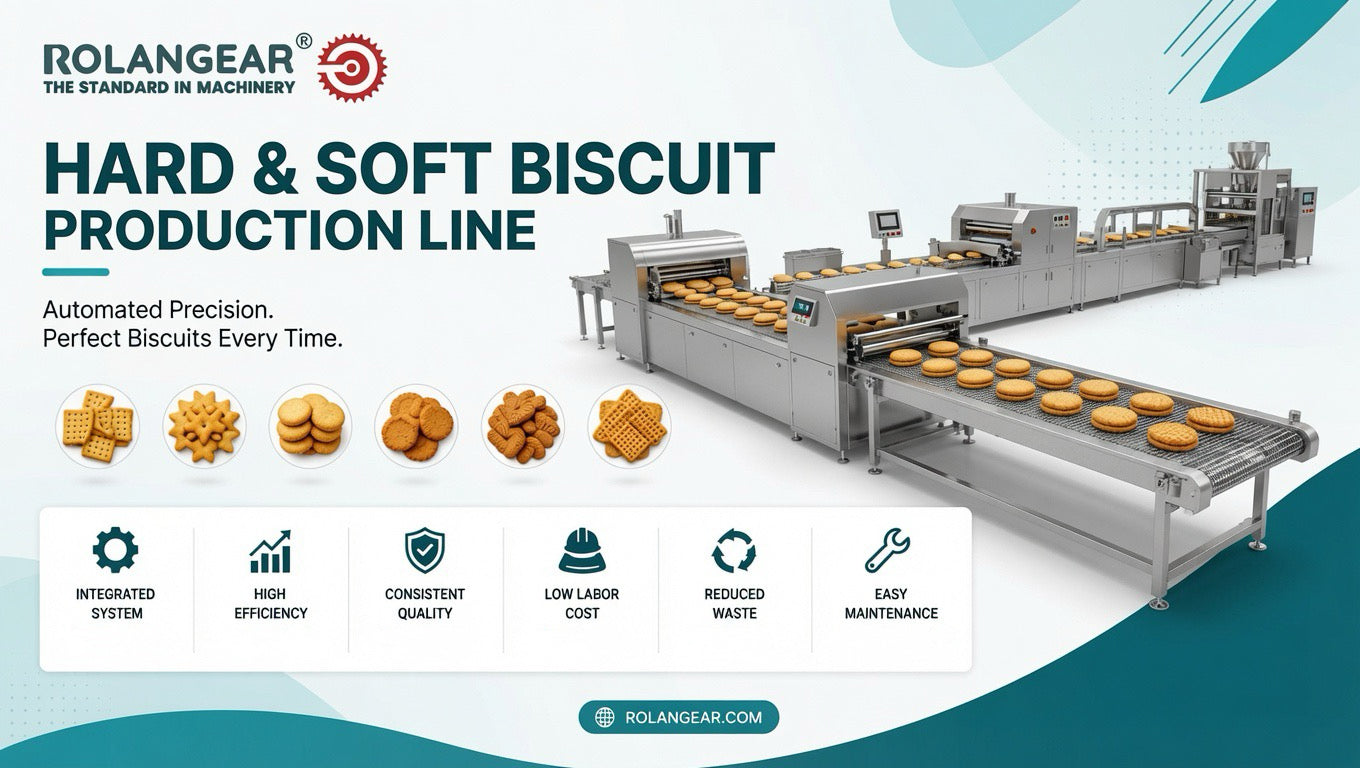
A typical line includes raw material preparation, dough mixing, dough feeding, forming, tunnel baking, optional oil spraying or surface treatment, cooling, product arranging, and automatic packaging. These machines must work at matched speed. If the forming machine produces biscuits faster than the oven can bake them, dough pieces may accumulate or deform. If the cooling conveyor is too short for the oven output, biscuits may enter the packing machine while still warm, causing condensation, soft texture, or poor shelf life. This is why a complete production line should be designed as one system instead of a random collection of machines.
For small and medium factories, Rolangear’s Automatic Soft & Hard Biscuit Production Line is designed for approximately 150–200 kg/hour production, depending on recipe, biscuit size, thickness, and final product format. It is suitable for new biscuit factories, regional snack brands, bakeries upgrading from manual production, and companies developing private-label biscuit products. Larger capacities can be planned by increasing line width, oven length, automation level, and packaging configuration.
Soft Biscuit vs Hard Biscuit Production Technology
The most important technical decision is whether the main product is soft biscuit, hard biscuit, or both. The difference starts from the dough.
Soft biscuit dough is usually a short dough. It contains relatively higher fat and sugar, lower water, and requires limited gluten development. During mixing, the goal is to distribute fat and sugar evenly while keeping the dough plastic and easy to mould. Excessive mixing can develop too much gluten, making the biscuit dense or hard. Soft biscuits are commonly formed by rotary moulding, wire cutting, or depositor systems. Rotary moulding is especially useful for cookies and patterned biscuits because the dough is pressed into engraved cavities and released onto the oven band with consistent shape and thickness.
Hard biscuit dough needs more elasticity and stronger structure. The dough must tolerate sheeting, gauging, laminating, and cutting without tearing. For products such as Marie biscuits and crackers, uniform sheet thickness is critical because thickness affects baking time, expansion, moisture removal, and final crispness. Hard biscuit lines normally use dough sheeters, gauge rollers, laminators, and rotary cutters. For soda crackers, fermentation or resting may also be required to improve texture and flavor.
In simple terms, soft biscuit production focuses on dough plasticity, mould release, pattern clarity, and delicate texture. Hard biscuit production focuses on gluten control, sheet stability, thickness accuracy, cutting precision, and moisture balance. When one line is expected to produce both categories, the supplier must confirm which forming modules, molds, rollers, and process settings are required.
Complete Biscuit Manufacturing Process

The standard industrial process is:
Each step has a direct influence on biscuit quality.
1. Raw Material Preparation
Raw materials normally include wheat flour, sugar, vegetable oil or butter, water, milk powder, egg powder, salt, starch, leavening agents, cocoa powder, flavors, and functional additives. Flour quality affects gluten strength and dough behavior. Fat affects crispness and mouthfeel. Sugar affects sweetness, spreading, color development, and texture. Leavening agents influence expansion, surface cracking, and internal structure.
Before mixing, ingredients should be weighed accurately according to the recipe. Flour is often screened to remove foreign matter and improve feeding stability. Liquid ingredients should be measured consistently because small water variations can change dough softness, forming accuracy, and baking performance. A professional factory should also separate raw material storage from processing areas, control humidity, and follow first-in-first-out inventory management.
2. Dough Mixing
Mixing is more than combining ingredients. It creates the dough structure required by the forming machine and oven. For soft biscuits, operators usually add fat, sugar, and liquid ingredients in a controlled order before flour is fully incorporated. The aim is a uniform but short dough that can fill molds without becoming tough. Mixing time, speed, ingredient temperature, and batch size must be controlled.

For hard biscuits, the mixer must develop enough elasticity for sheeting. If the dough is too weak, it may tear on rollers. If it is too strong, it may shrink after cutting and lose shape. Some hard biscuit recipes need dough resting so stress can relax before forming. For fermented crackers, temperature and time control become even more important because fermentation affects flavor, texture, and volume.
A production mixer should have food-contact parts suitable for biscuit dough, strong torque, stable discharge, and easy cleaning access. The final dough should be checked for softness, temperature, color uniformity, and absence of dry flour lumps.
Dough Feeding and Forming
After mixing, dough is transferred to the forming section. Feeding must be stable because irregular feeding creates weight variation. For soft biscuits, dough enters a rotary moulder or similar forming device. The rotary mould presses dough into engraved cavities. A scraper removes excess dough, and a take-off belt transfers shaped biscuits to the oven band. Important settings include mold depth, scraper pressure, roller speed, dough temperature, and belt tension.
For hard biscuits, dough is sheeted into a continuous band. Gauge rollers gradually reduce thickness instead of compressing the dough too aggressively at one point. This helps prevent tearing, surface stress, and uneven baking. A rotary cutter then cuts shapes and may add holes or patterns. Scrap dough is usually returned to the system, but excessive scrap recycling can change dough quality, so operators must control the recycle ratio.
Forming accuracy affects finished product weight, size, appearance, and packaging compatibility. If biscuits vary too much, automatic packing becomes unstable and retail packages may not meet weight requirements.
Tunnel Oven Baking

Baking is the core process of a biscuit production line. In a tunnel oven, biscuits move continuously through heating zones. Each zone has a different purpose. The first zone heats the dough and begins moisture removal. The middle zones set the structure, expand the biscuit, and develop crispness. The final zones complete color formation and reduce moisture to the target level.
Temperature, baking time, oven band speed, heat distribution, and exhaust control must match the recipe. Under-baked biscuits may have high moisture, poor crispness, and shorter shelf life. Over-baked biscuits may become dark, bitter, fragile, or inconsistent in color. Uneven heat can create one side lighter than the other, which affects brand presentation.
A good tunnel oven should offer stable temperature control, reliable conveyor movement, proper insulation, and enough baking length for the required capacity. Heating can be electric or gas, depending on factory utilities and local energy cost. Buyers should confirm oven type, heating zones, available temperature range, conveyor width, and expected energy consumption with the manufacturer.
Oil Spraying and Surface Treatment

Some products, especially crackers and savory biscuits, require surface oil after baking. The oil spraying machine applies a controlled layer of edible oil to improve shine, flavor, and eating quality. The key is uniform application. Too little oil reduces flavor impact; too much oil causes greasy texture, packaging stains, and higher cost.
Surface treatment can also include seasoning, sugar sprinkling, or other customized modules depending on the product. These options should be confirmed during line design because they affect space, cleaning, product handling, and packaging requirements.
Cooling Before Packaging
Biscuits must be cooled before packing. After leaving the oven, biscuits are hot and still releasing moisture. If they are packed immediately, water vapor may condense inside the package. This can soften the biscuit, reduce crispness, shorten shelf life, and create quality complaints.
The cooling conveyor provides time for temperature and moisture to stabilize. Conveyor length, product spacing, room ventilation, and line speed must match oven output. Fragile biscuits also need smooth transfer points to reduce breakage. For cream or sandwich biscuits, cooling is even more important because filling application requires stable biscuit temperature and structure.
Arranging and Packaging

Packaging protects biscuits from moisture, oxygen, dust, handling damage, and contamination. It also creates the product’s retail appearance. Common formats include pillow packs, family packs, individual snack packs, stacked packs, and carton packaging.
An automatic packing machine may include product feeding, counting, film forming, sealing, cutting, date coding, and discharge. Stable packaging depends on consistent biscuit size, good product alignment, correct film selection, sealing temperature, and matched feeding speed. If the upstream line does not deliver biscuits evenly, the packaging machine may stop frequently. Therefore, product arranging conveyors and buffer systems are important for practical production.
Main Machines in the Production Line

A complete biscuit production line usually includes the following equipment:
- Flour mixer: prepares uniform soft or hard dough. Key points include batch capacity, mixing torque, contact material, discharge method, and cleaning access.
- Dough feeding system: transfers dough to forming equipment with stable supply. Key points include feeding consistency and dough damage control.
- Biscuit forming machine: shapes dough into required products. Soft biscuits may use rotary moulding; hard biscuits may use sheeting and cutting.
- Tunnel oven: bakes biscuits continuously. Key points include heating method, number of zones, oven length, belt width, temperature control, insulation, and exhaust.
- Oil spraying machine: applies surface oil for crackers or savory biscuits when required.
- Cooling conveyor: stabilizes biscuit temperature before packing. Key points include length, hygiene design, transfer smoothness, and available workshop space.
- Product arranging system: aligns biscuits before packaging and reduces manual handling.
- Automatic packing machine: completes retail packaging. Key points include pack style, film width, sealing method, speed, coding system, and changeover flexibility.
- Control system: coordinates line speed, machine operation, safety protection, and production adjustment.
For Rolangear’s solution, the standard configuration can include a dough mixer, biscuit forming machine, tunnel baking oven, oil spraying machine, cooling conveyor, and automatic packing machine. Final configuration should be confirmed according to product size, recipe, required capacity, packaging format, and available factory utilities.
Capacity Selection and Factory Planning
Capacity should be selected according to market demand, investment budget, product positioning, available space, and expansion plans. Many new investors want the largest line possible, but an oversized line can create high operating cost, difficult sales pressure, and unnecessary financial risk.
A 150–200 kg/hour line is practical for startups, local snack brands, bakery companies entering industrial production, and small to medium food factories. It allows product testing, brand development, and distribution building without the complexity of a large plant. Medium lines of 500–1000 kg/hour are more suitable for regional supermarket supply, wholesale distribution, and stronger brand operations. Large lines above 1000 kg/hour normally require professional plant management, larger warehouses, multiple packaging machines, and stable market channels.
Factory planning should follow one-way material flow: raw material storage → weighing and mixing → forming → baking → cooling → packaging → finished goods warehouse. This reduces cross contamination and unnecessary handling. The layout should also reserve space for maintenance access, operator movement, carton packing, ingredient storage, and future expansion.
Utility Requirements and Workshop Layout
A biscuit factory requires reliable electricity, heating energy, compressed air, water, ventilation, and drainage. Electricity powers motors, conveyors, control panels, forming systems, and packaging equipment. The tunnel oven may use electric or gas heating. Gas heating can reduce energy cost in some regions, while electric heating may be easier where gas supply is limited. The best option depends on local utility conditions and regulations.
Compressed air is often used for pneumatic components, packaging machines, and automation devices. Water is required for recipes, equipment cleaning, and sanitation. Ventilation is important around the oven because baking produces heat and moisture. The workshop floor should be easy to clean, and the packaging area should be kept away from dust and excessive heat.
Before ordering, buyers should prepare factory drawings, available voltage and frequency, gas conditions, compressed-air capacity, water supply, drainage plan, and workshop height. These details help the supplier design a realistic layout and avoid installation problems.
Biscuit Production Line Cost Factors

The cost of a biscuit production line depends on capacity, line width, oven length, heating method, forming technology, automation level, packaging format, material requirements, and customization. A basic line for one product type costs less than a flexible line designed for many shapes, recipes, and packing styles.
The complete investment may include machines, molds, spare parts, shipping, installation, commissioning, operator training, factory construction, utility installation, packaging materials, raw material inventory, and quality-control equipment. Buyers should not compare only the machine price. A cheaper line may become expensive if it causes high waste, unstable baking, frequent stops, poor packaging performance, or difficult maintenance.
A good quotation should clearly define the production capacity, machine list, technical configuration, power and utility requirements, packaging scope, spare parts, installation support, and after-sales service. If these details are not clear, the buyer should request confirmation before making a final decision.
Quality Control, Cleaning, and Maintenance
Quality control should start before production and continue through every stage. Raw materials should be checked for freshness, storage condition, and recipe accuracy. Dough should be checked for temperature, softness, color, and mixing uniformity. After forming, operators should inspect shape, weight, thickness, pattern clarity, and dough scrap control. During baking, color, moisture, texture, and breakage rate should be monitored. Before packaging, biscuits should be cooled, aligned, and inspected for foreign matter or broken pieces.
Cleaning is essential for food safety and product consistency. Mixers, contact conveyors, forming parts, molds, oil sprayers, and packaging contact areas should be cleaned according to a daily schedule. Crumbs and oil residues must be removed because they can affect hygiene, attract pests, and create product contamination risks. For factories producing different flavors, cleaning between batches also helps prevent flavor crossover and allergen issues.
Preventive maintenance reduces downtime. Important items include checking belts, bearings, chains, motors, gearboxes, heating elements or burners, sensors, electrical cabinets, pneumatic components, sealing jaws, and cutting knives. Wearing parts such as belts, scrapers, molds, cutters, packaging knives, and sealing components should be planned in advance. A spare-parts plan is especially important for export projects where emergency delivery may take time.
How to Choose the Right Biscuit Production Line
Before choosing a Soft & Hard Biscuit Production Line, prepare clear product and factory information. The supplier should know your target biscuit types, product size, thickness, weight, recipe category, required capacity, packaging format, factory space, energy source, automation expectation, and budget range.
For soft biscuits, confirm whether rotary moulding, wire cutting, or depositing is required. For hard biscuits, confirm whether sheeting, laminating, rotary cutting, and fermentation or resting systems are needed. If sandwich biscuits or cream biscuits are planned, additional filling, sandwiching, arranging, and cooling modules may be necessary. If several packaging styles are required, the packing section should be designed with suitable changeover and buffering.
The best production line is not simply the largest or cheapest option. It is the configuration that can produce your target products consistently, fit your factory, match your labor and utility conditions, and support future growth.
Frequently Asked Questions
What is the difference between soft biscuit and hard biscuit production?
Soft biscuit production usually uses short dough with higher fat and sugar and focuses on moulding, shape, and delicate texture. Hard biscuit production uses more elastic dough and focuses on sheeting, thickness control, cutting, and stable baking.
Can one line produce both soft and hard biscuits?
Yes, one line can produce different biscuit types if it is configured with suitable forming modules, molds, process settings, and sometimes additional equipment. The final capability should be confirmed according to the product list.
What capacity is suitable for a new biscuit factory?
For many startups and regional manufacturers, 150–200 kg/hour is a practical starting point. It supports commercial production while keeping investment, factory management, and market risk more controllable.
What machines are included in the Rolangear biscuit production line?
The LY400 solution can include a dough mixer, biscuit forming machine, tunnel oven, oil spraying machine, cooling conveyor, and automatic packing machine. The exact configuration depends on product type and packaging requirements.
How much does a biscuit production line cost?
Cost depends on capacity, equipment configuration, oven type, automation level, packaging machine, molds, and customization. A detailed quotation should be prepared after confirming product specifications and factory conditions.
Why is cooling important before packaging?
Cooling allows biscuits to release heat and stabilize moisture. If biscuits are packed too warm, condensation can occur inside the package, reducing crispness and shelf life.
What should I prepare before asking for a quotation?
Prepare your target products, biscuit size and weight, hourly capacity, recipe type, packaging format, factory layout, voltage, heating energy, compressed-air conditions, and any future expansion plan.
Conclusion
A Soft & Hard Biscuit Production Line is the foundation for efficient, consistent, and scalable biscuit manufacturing. From ingredient preparation and dough mixing to forming, tunnel baking, cooling, and packaging, each stage must be technically matched to the product category. Soft biscuits need careful control of short dough and moulding performance, while hard biscuits require stable sheeting, cutting, and moisture control.
For investors, the right line should match market demand, factory space, available utilities, packaging plan, and future growth strategy. Rolangear provides complete biscuit production solutions for customers planning new factories or upgrading existing production. If you are preparing a biscuit manufacturing project, share your target products, capacity requirement, packaging style, and factory conditions so Rolangear can help design a suitable production solution.
Plan Your Biscuit Production Line with Rolangear
Prepare your biscuit type, target capacity, factory layout, heating energy, packaging format, and utility conditions before requesting a customized production line proposal.