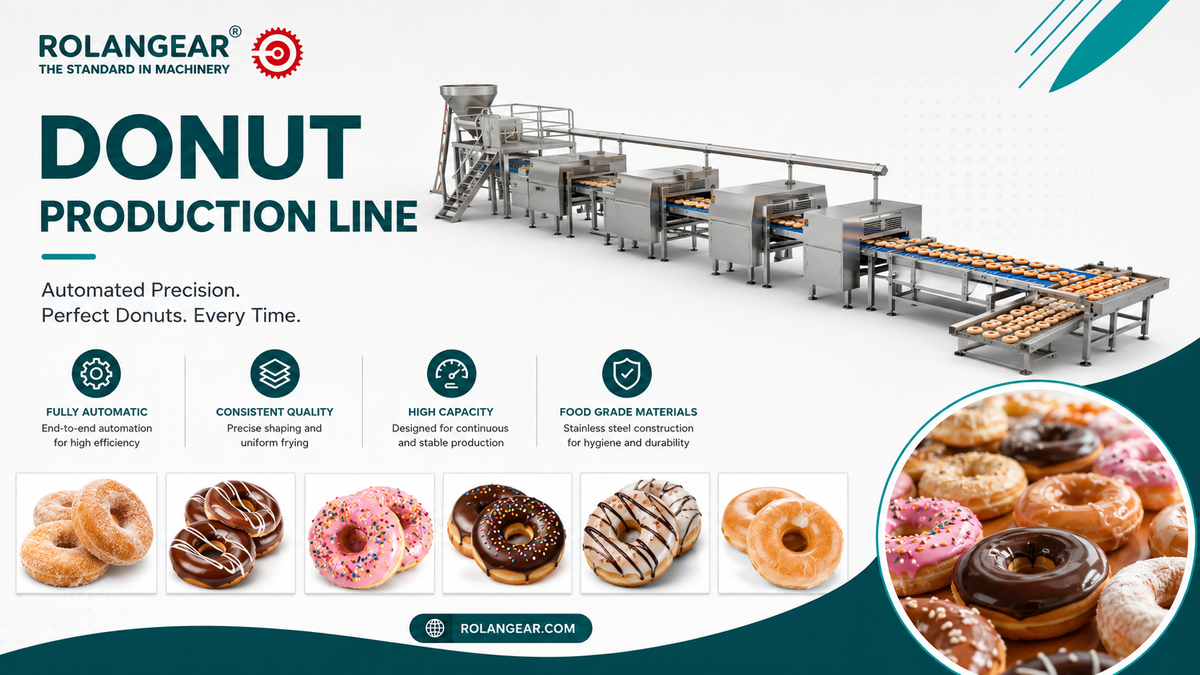

The global donut market has grown from traditional bakery counters into a modern industrial bakery category. Donuts are now sold through supermarkets, café chains, convenience stores, hotels, restaurants, frozen food channels, airline catering, and private-label retail brands. To serve these markets reliably, manufacturers need more than skilled manual production. They need a donut production line that can deliver consistent product weight, shape, color, texture, decoration, packaging quality, and daily output.
A donut production line is a complete manufacturing system that connects raw material preparation, dough mixing, fermentation, dividing, rounding, forming, proofing, frying or baking, cooling, filling, glazing, decorating, inspection, and packaging. Instead of operating separate machines manually, a modern line synchronizes each stage into one controlled workflow. This improves production efficiency, reduces labor dependency, supports food safety, and helps factories create a wider range of products.
This guide explains how an industrial donut production line works, what machines are included, how to choose capacity, which cost factors influence investment, and what factory planning points should be confirmed before ordering equipment.
What Is a Donut Production Line?
A donut production line is an automated or semi-automated bakery system designed to manufacture donuts from ingredients to finished packaged products. It may be configured for yeast-raised donuts, cake donuts, ring donuts, filled donuts, mini donuts, glazed donuts, chocolate-coated donuts, frozen donuts, or baked donut products.
A complete line normally includes ingredient weighing, dough mixing, dough resting or fermentation, dough dividing, rounding, intermediate proofing, forming, final proofing for yeast donuts, continuous frying or baking, oil removal, cooling, filling, glazing, decorating, inspection, packaging, and carton packing. The exact configuration depends on recipe, product style, target capacity, automation level, heating method, packaging format, and factory layout.
The key advantage of a complete production line is process synchronization. Dough quality affects forming. Forming accuracy affects frying consistency. Frying temperature affects color, oil absorption, texture, and shelf life. Cooling affects filling, coating, and packaging. If one section is not matched with the rest of the line, the whole factory can lose efficiency. For this reason, donut production should be planned as an integrated system, not only as a list of individual machines.
Why Invest in Automatic Donut Production?

Manual donut production is flexible for small shops, but it becomes difficult when the business needs stable output, consistent appearance, and larger orders. Manual weighing, shaping, frying, decorating, and packing can create product variations, higher waste, slower production, and greater labor pressure. Rising labor cost and stricter food safety requirements also make automation more important for commercial bakeries and industrial food factories.
An automatic donut production line helps manufacturers control recipe preparation, dough portioning, product shape, proofing conditions, frying time, oil temperature, coating thickness, filling quantity, and packaging speed. This improves product standardization and reduces the need for repeated manual handling.
The business benefits include higher production capacity, lower labor dependency, better product consistency, improved food safety, reduced raw material waste, and stronger ability to supply supermarkets, foodservice customers, and export channels. Automation also allows manufacturers to develop multiple product lines using one production platform, including seasonal flavors, premium filled donuts, mini snack packs, frozen donuts, and private-label retail products.
Types of Donuts the Line Can Produce
A modern donut production line can be designed for different recipes and product formats. Common product categories include:
Ring donuts: Classic circular donuts suitable for sugar coating, glazing, chocolate coating, or icing.
Filled donuts: Products injected with cream, custard, chocolate, fruit jam, cheese cream, caramel, or specialty fillings.
Yeast-raised donuts: Soft, light donuts that require controlled fermentation and final proofing.
Cake donuts: Chemically leavened donuts with a denser texture, often produced with batter depositing or dedicated forming systems.
Mini donuts: Smaller products for snack packs, amusement parks, convenience stores, hotels, and catering services.
Chocolate-coated and glazed donuts: Value-added products decorated with chocolate, sugar glaze, caramel, icing, sprinkles, coconut, nuts, cookie crumbs, or colored toppings.
Frozen donuts: Unfinished, partially finished, or ready-to-serve products designed for longer storage and wider distribution.
Product flexibility should be considered at the beginning of the project. If a factory wants to make both ring donuts and filled donuts, the line may need filling equipment and suitable product transfer systems. If the target market includes frozen products, freezing and cold-chain packaging must also be planned.
Complete Donut Manufacturing Process

A typical industrial donut production flow is:
Raw material preparation → Ingredient weighing → Dough mixing → Dough resting and fermentation → Dividing → Rounding → Intermediate proofing → Donut forming → Final proofing → Frying or baking → Oil removal → Cooling → Filling → Glazing or coating → Decorating → Quality inspection → Packaging → Finished product storage
Different products may skip or modify some stages. Cake donuts may not require yeast fermentation. Baked donuts use an oven instead of a fryer. Frozen donut projects may require freezing and cold storage. However, the main goal is always the same: stable processing from dough to finished product.
1. Raw Material Preparation and Weighing
High-quality donuts begin with consistent raw materials. Typical ingredients include wheat flour, sugar, yeast or chemical leavening agents, milk powder, eggs or egg powder, shortening or vegetable oil, butter, salt, water, flavorings, chocolate, cream fillings, jam, and toppings.

Ingredient quality affects dough strength, fermentation performance, frying behavior, flavor, product volume, and shelf life. Industrial factories usually set ingredient standards and weighing procedures so every batch follows the same recipe. Automated weighing systems can reduce manual measurement errors, improve recipe repeatability, and support stable production across shifts.
2. Dough Mixing
The dough mixer combines all ingredients into a uniform dough with the correct moisture distribution and gluten development. Important control points include mixing speed, mixing time, dough temperature, water addition, batch size, and discharge method.

Proper mixing improves elasticity, fermentation stability, product weight, internal texture, and frying performance. Poor mixing may create dense donuts, uneven expansion, surface cracks, irregular product size, or higher waste. For high-capacity factories, industrial mixers help maintain stable dough quality and reduce dependence on operator experience.
3. Resting, Fermentation, Dividing, and Rounding
After mixing, yeast-raised dough needs controlled resting and fermentation. This allows gluten to relax and yeast to produce gas, creating a soft internal structure. Fermentation conditions such as temperature, humidity, air circulation, and time must be controlled carefully. Under-fermented dough can be dense, while over-fermented dough may become weak and difficult to form.

The dough then enters dividing and rounding. A dough divider cuts the dough into equal portions according to the required product weight. A rounding machine forms smooth dough balls with consistent tension. Accurate portion control improves frying consistency, product appearance, packaging uniformity, and cost control.
Intermediate Proofing and Donut Forming
Intermediate proofing gives rounded dough pieces a short rest before shaping. This reduces dough tension and helps the forming machine create smoother, more accurate products.

The forming section gives each donut its final shape before cooking. By changing molds or tooling, manufacturers can produce ring donuts, filled donut bases, mini donuts, or specialty shapes. Servo-controlled forming equipment improves product dimensions, reduces dough waste, supports higher speed, and makes product changeover easier. For supermarket or foodservice supply, this consistency is especially important because every product must meet the same visual standard.
5. Final Proofing for Yeast Donuts
Yeast-raised donuts usually require final proofing after forming. A proofing chamber controls temperature, humidity, airflow, and residence time so the shaped donuts reach the desired volume before frying.

Correct proofing creates better softness, larger volume, smoother surface, fine internal crumb, and stable frying results. Under-proofed donuts may be small and dense. Over-proofed products may collapse, absorb more oil, or lose shape. Cake donuts typically bypass this stage because they use chemical leavening rather than yeast fermentation.
Frying or Baking

Frying is one of the most important stages in traditional donut production. Continuous fryers control oil temperature, frying time, conveyor speed, product turning, oil circulation, and filtration. These factors determine product color, surface texture, oil absorption, internal moisture, and eating quality.
Modern fryers may include PLC temperature control, automatic product flipping, oil circulation pumps, continuous oil filtration, energy-saving insulation, and different heating options such as electric, gas, or thermal oil. Compared with manual frying, continuous frying improves productivity, color uniformity, food safety, oil management, and labor efficiency.
For baked donut projects, the fryer can be replaced by a tunnel oven or baking system. Baked donuts are often selected for markets that prefer reduced-oil products, but the recipe and texture will differ from traditional fried donuts.
Oil Removal, Cooling, Filling, and Decoration

After frying, donuts pass through oil removal and cooling conveyors. Cooling allows excess oil to drain and gradually reduces product temperature before filling, coating, or packaging. Proper cooling improves coating adhesion, product stability, packaging quality, and shelf life. Hot products can create condensation and damage packaging.
Filled donuts can be injected with chocolate, custard, vanilla cream, fruit jam, cheese cream, caramel, or other fillings. A filling system controls injection volume and position to reduce leakage and maintain consistent product value.
Glazing, chocolate coating, icing, and decorating systems increase visual appeal and selling price. Automatic systems apply coatings evenly and can add sprinkles, coconut, nuts, cookie crumbs, colored sugar, or seasonal toppings with less waste and better repeatability.
Inspection, Packaging, and Storage

Before packaging, donuts may pass through weight checking, visual inspection, metal detection, and seal inspection. Packaging protects products during storage, transport, retail display, and foodservice handling.
Common packaging formats include individual retail packs, multipacks, trays, family packs, frozen packaging, foodservice packaging, and export cartons. The correct packaging system should match product shelf life, distribution channel, and target market. Finished products should then be stored under suitable conditions according to whether they are fresh, frozen, or ambient packed.
Main Equipment in a Donut Production Line
| Equipment | Main Function | Key Selection Points |
|---|---|---|
| Ingredient weighing system | Measures materials according to recipe | Accuracy, automation level, recipe management, hygiene design |
| Dough mixer | Produces uniform dough | Batch size, mixing speed, temperature control, discharge method |
| Fermentation/proofing system | Controls dough development | Temperature, humidity, airflow, residence time, capacity matching |
| Dough divider and rounder | Portions and shapes dough before forming | Weight accuracy, speed, dough handling, cleaning access |
| Donut forming machine | Creates ring, filled, mini, or special shapes | Mold range, servo control, changeover time, product size |
| Continuous fryer | Fries donuts with stable heat control | Heating method, oil filtration, belt width, temperature zones, oil management |
| Cooling conveyor | Cools products before filling or packing | Conveyor length, airflow, hygiene design, line speed |
| Filling machine | Injects cream, jam, chocolate, or other fillings | Filling type, dosing accuracy, leakage control, cleaning method |
| Glazing/coating system | Applies sugar glaze, chocolate, icing, or toppings | Coating uniformity, temperature control, topping options, waste reduction |
| Inspection and packaging system | Checks and packs finished products | Metal detection, checkweighing, pack style, speed, sealing quality |
Fresh, Frozen, Fried, and Baked Donut Solutions

Fresh donut production is suitable for local bakeries, café chains, supermarkets, convenience stores, hotels, and daily delivery. The main advantage is strong freshness and attractive presentation, but shelf life and distribution range may be shorter.
Frozen donut production is suitable for export markets, hotel groups, restaurants, central kitchens, airline catering, and supermarket chains. Freezing extends shelf life and allows products to be stored or finished closer to the point of sale. However, it requires freezing equipment, cold storage, cold-chain logistics, and suitable packaging.
Fried donuts remain the classic choice because they deliver familiar flavor, color, and texture. Baked donuts are an alternative for health-conscious markets or lower-oil product positioning. The best solution depends on target consumers, product recipe, local energy costs, and distribution strategy.
Capacity Selection and Cost Factors
Capacity should be selected according to sales channels, daily order volume, product size, working shifts, factory space, labor plan, packaging speed, and future expansion. A small commercial line may serve start-ups, cafés, and local bakeries. A medium line can support regional bakery brands or supermarket suppliers. A large line is more suitable for national food manufacturers, export factories, or high-capacity private-label production.
The cost of a donut production line depends on several factors:
Production capacity and operating hours
Product type, recipe, and size range
Automation level and control system
Frying, baking, filling, glazing, freezing, or packaging requirements
Heating method, such as electric, gas, or thermal oil
Stainless steel requirements and hygiene design
Factory utilities, installation, commissioning, and training
Spare parts, maintenance support, and after-sales service
There is no single fixed price for every donut line. A reliable quotation should be based on product specification, target capacity, factory layout, available utilities, packaging method, and desired automation level. The lowest initial price is not always the best choice if the line cannot match output targets or produces unstable quality.
Factory Layout and Utility Requirements

A practical donut factory should follow a smooth material flow:
Raw material warehouse → Ingredient preparation → Mixing area → Fermentation room → Forming section → Frying or baking area → Cooling conveyor → Filling and decoration → Quality inspection → Packaging area → Finished product warehouse
This one-way layout reduces unnecessary movement, improves hygiene control, and helps operators manage production efficiently. The factory should provide space for maintenance access, worker movement, packaging materials, finished goods, cleaning tools, waste handling, and future expansion.
Important utilities may include power supply, compressed air, water, drainage, ventilation, exhaust systems, gas supply or electrical capacity for heating, oil storage and filtration areas, waste oil handling, and temperature control in key production zones. These conditions should be confirmed before ordering equipment so the line can be installed smoothly.
Quality Control, Cleaning, and Maintenance
Quality control should cover every production stage. Important checkpoints include ingredient weighing accuracy, dough temperature, fermentation condition, portion weight, forming shape, proofing volume, frying color, oil quality, cooling temperature, filling quantity, coating appearance, package sealing, metal detection, and final product inspection.
Cleaning is also important because donut production involves flour, dough, oil, fillings, chocolate, glaze, and toppings. Food-contact parts should be easy to clean, and the factory should plan regular cleaning for mixers, dividers, formers, proofers, fryers, conveyors, filling nozzles, coating tanks, and packaging contact areas.
Preventive maintenance helps reduce downtime. Operators should check belts, chains, rollers, blades, motors, pumps, oil filters, heating elements, sensors, bearings, and sealing parts. A spare parts plan is recommended for wearing components so production can restart quickly if replacement is needed.
Common Planning Mistakes to Avoid

Many donut factory projects become inefficient because the buyer focuses only on one machine instead of the full line balance. A fast fryer cannot improve output if the dough preparation, forming, cooling, decorating, or packaging sections cannot match its speed. Before ordering, the complete process should be checked from ingredient weighing to final cartons.
Another common mistake is ignoring oil management. In fried donut production, oil temperature, filtration, circulation, and cleaning routines directly affect color, taste, oil absorption, and operating cost. A professional fryer should be selected together with a practical oil filtration and maintenance plan.
Buyers should also confirm product variety early. Ring donuts, filled donuts, cake donuts, frozen donuts, and decorated premium products may require different forming, filling, coating, or packaging modules. Adding these functions later can be more expensive than planning them correctly from the beginning.
Finally, the factory should reserve enough space for operators, cleaning, spare parts, packaging materials, maintenance access, and future expansion. A production line that fits too tightly into the workshop may be difficult to operate safely and efficiently.
How to Choose the Right Supplier
A donut production line is a complete engineering project. The supplier should understand dough processing, fermentation, forming, frying, oil management, filling, coating, packaging, factory utilities, and capacity matching. Before requesting a quotation, buyers should prepare product type, target weight, capacity requirement, fresh or frozen strategy, heating preference, filling and decoration needs, packaging format, factory dimensions, and utility conditions.
A professional supplier should help confirm the best line configuration, process flow, layout, automation level, installation requirements, operator training, and after-sales support. Rolangear provides complete donut production solutions, including project consultation, equipment configuration, customized engineering, factory layout suggestions, installation guidance, commissioning support, and long-term technical service. For new bakery factories or expanding food manufacturers, careful planning helps reduce project risk and improve return on investment.
Frequently Asked Questions
What products can one donut production line manufacture?
Depending on configuration, one line can produce ring donuts, filled donuts, yeast-raised donuts, cake donuts, mini donuts, glazed donuts, chocolate-coated donuts, decorated donuts, and frozen donuts by changing molds, recipes, filling systems, or decorating modules.
How much does an automatic donut production line cost?
The cost depends on production capacity, automation level, heating method, product range, filling and coating requirements, packaging format, installation conditions, and factory utilities. A customized quotation is recommended.
What production capacity should I choose?
Choose capacity based on sales volume, product size, number of shifts, factory space, packaging speed, and expansion plan. The mixer, proofer, fryer, cooling conveyor, decorating system, and packaging machine should be balanced to avoid bottlenecks.
Can a donut line produce both fresh and frozen products?
Yes, but frozen production may require freezing equipment, cold storage, frozen packaging, and cold-chain planning. These requirements should be included during project design.
Which heating method is best for the fryer?
Electric, gas, and thermal oil heating each have advantages. The right option depends on local energy cost, utility availability, production capacity, installation conditions, and maintenance preference.
What information should I provide before requesting a quotation?
Prepare your product type, product size or weight, target capacity, fresh or frozen plan, heating preference, filling and decoration requirements, packaging style, factory layout, power supply, gas or electricity availability, and automation requirements.
Conclusion
A professional donut production line transforms traditional donut making into a stable industrial manufacturing process. By connecting dough preparation, fermentation, forming, proofing, frying or baking, cooling, filling, glazing, inspection, and packaging, manufacturers can improve capacity, product consistency, food safety, labor efficiency, and market competitiveness.
The best solution depends on product range, target output, factory conditions, heating method, packaging plan, and business strategy. If you are planning a new donut factory or upgrading an existing bakery operation, Rolangear can help design a customized donut production line based on your production goals and available factory conditions. Contact Rolangear to discuss your project and request a suitable donut processing solution.
Plan Your Donut Production Line with Rolangear
If you are preparing a new donut manufacturing project, confirm your product type, target capacity, packaging method, factory layout, and utility conditions before selecting the final machine configuration.