
Why Invest in an Automatic Maamoul Production Line?

The global bakery industry has experienced continuous growth over the past decade, and traditional ethnic bakery products have become increasingly popular beyond their regional markets. As a result, Maamoul manufacturers face growing pressure to increase production while maintaining authentic taste and appearance.
Automatic production provides several practical advantages for commercial bakeries and industrial food manufacturers.
Higher Production Efficiency
Manual Maamoul production requires multiple workers for dough preparation, filling, shaping, tray loading, baking support, inspection, and packaging. This process is labor-intensive and difficult to scale.
An automatic Maamoul production line integrates these operations into a more continuous workflow, increasing hourly output while reducing dependence on manual labor.
For manufacturers supplying supermarkets, wholesalers, or export markets, automation provides the production capacity needed to meet growing demand without compromising product quality.
Consistent Product Quality
Consumers expect every Maamoul to have the same size, weight, filling ratio, baking color, and decorative pattern. Manual production often results in variations that affect customer satisfaction and brand image.
Modern automatic equipment helps manufacturers achieve:
- Accurate dough and filling ratios
- Uniform product weight
- Consistent product shape
- Stable baking performance
- Professional product appearance
This consistency is particularly important for large-scale commercial production and private-label manufacturing.
Lower Operating Costs
Although automatic equipment requires an initial investment, it can reduce long-term operating expenses by:
- Lowering labor requirements
- Reducing raw material waste
- Improving production efficiency
- Minimizing product defects
- Increasing production stability
For many manufacturers, automation supports long-term ROI through higher productivity, lower labor pressure, and more stable production quality.
Greater Production Flexibility
Today’s customers expect a wider variety of Maamoul products. Manufacturers often produce multiple recipes using the same production line.
A modern Maamoul production line can manufacture products with different fillings, including:
- Date paste
- Pistachio
- Walnut
- Chocolate
- Coconut
- Mixed nuts
- Fruit-based fillings
By changing molds and adjusting machine parameters, manufacturers can also produce different shapes and decorative patterns without replacing the complete production line.
What Is an Automatic Maamoul Production Line?
A Maamoul production line is an integrated bakery processing system designed to automate the production of filled Maamoul cookies from raw ingredients to finished packaged products.
Instead of relying on disconnected stand-alone machines, a complete line connects each manufacturing stage into one coordinated process that improves efficiency, product consistency, and production management.

A complete Maamoul production line typically includes:
- Dough preparation
- Filling preparation
- Dough mixing
- Filling mixing
- Automatic encrusting and forming
- Tray arranging
- Baking
- Cooling
- Quality inspection
- Packaging
Each machine performs a specific function while operating seamlessly with the next stage, ensuring smooth product flow throughout the factory.
For businesses planning long-term growth, investing in a complete production line provides greater flexibility, easier management, and improved production efficiency compared with purchasing separate machines over time.
Maamoul Products That Can Be Produced

One of the main advantages of modern Maamoul production equipment is production flexibility. By changing molds, adjusting recipes, and selecting different fillings, manufacturers can produce a wide range of products using the same production line.
By Filling Type
Common filling options include:
- Date paste
- Pistachio paste
- Walnut paste
- Chocolate cream
- Coconut filling
- Fig paste
- Mixed nut fillings
- Customized premium recipes
Flexible filling systems help manufacturers respond to changing market preferences and expand their product portfolio.
By Shape and Pattern
Maamoul is well known for its decorative appearance. Modern forming machines can produce products in various shapes, including:
- Round Maamoul
- Oval Maamoul
- Dome-shaped Maamoul
- Traditional floral patterns
- Geometric decorative designs
- Customized molds featuring customer logos or unique branding
Quick mold replacement enables manufacturers to produce multiple product styles on the same production line, making it easier to serve different markets and seasonal promotions.
Complete Maamoul Production Process Overview
Although specific production configurations vary according to factory requirements and capacity, a standard automatic Maamoul production line generally follows this manufacturing sequence:

Each stage is carefully designed to maintain product quality, production efficiency, and food safety. From accurate ingredient preparation to consistent baking and hygienic packaging, every step contributes to producing premium-quality Maamoul that meets commercial bakery standards.
Maamoul Manufacturing Process and Equipment Guide
After understanding the market opportunities and overall production workflow, the next step is to examine how an industrial Maamoul production line actually works.

Modern Maamoul manufacturing is not only about replacing manual labor with machines. Instead, it integrates ingredient preparation, precise dough and filling control, automatic forming, baking, cooling, and packaging into one continuous production system. Every stage directly affects the final product's appearance, texture, taste, and shelf life.
For manufacturers planning a new factory or expanding production, understanding each processing stage helps determine the most suitable equipment configuration, capacity, and investment level.
Step 1. Raw Material Preparation
Stable Maamoul quality starts with well-prepared raw materials.
Before production starts, all ingredients should be inspected, weighed, and prepared according to the production formula.
Typical dough ingredients include:
- Wheat flour
- Butter or ghee
- Vegetable shortening
- Sugar
- Milk powder
- Yeast or baking powder (depending on recipe)
- Salt
- Water
- Natural flavorings
The filling ingredients vary according to the target market and product type.
Common fillings include:
- Date paste
- Pistachio paste
- Walnut paste
- Chocolate filling
- Coconut filling
- Fig paste
- Mixed nuts
Proper raw material storage is equally important. Flour should remain dry, butter and fillings should be stored at suitable temperatures, and ingredients should be rotated using FIFO (First In, First Out) inventory management to maintain freshness and consistent quality.
Step 2. Dough Mixing
Dough quality directly affects the texture, shape stability, and eating experience of the finished Maamoul.
Industrial dough mixers ensure every batch is mixed evenly and consistently.
During mixing, operators carefully control:
- Mixing time
- Mixing speed
- Dough temperature
- Water addition
- Butter or ghee incorporation
An under-mixed dough may crack during forming, while over-mixing can reduce the characteristic crumbly texture that consumers expect.
Modern spiral or horizontal mixers provide excellent mixing efficiency while protecting the dough structure.
For large factories, multiple mixers can operate simultaneously to supply continuous production.
Step 3. Filling Preparation
The filling is one of the most important quality points in Maamoul production.
Its texture must remain smooth enough for automatic feeding while maintaining its traditional taste.
Depending on the product, the filling preparation process may include:
- Grinding
- Mixing
- Heating
- Moisture adjustment
- Cooling
For example:
Date Filling
Date paste is mixed until smooth and homogeneous.
Natural oils may be added to improve extrusion performance.
Pistachio Filling
Ground pistachios are blended with sugar and binding ingredients to produce a smooth filling suitable for automatic encrusting.
Walnut Filling
Walnuts are finely ground before mixing with sugar and other ingredients to achieve stable consistency.
Chocolate, coconut, and customized fillings follow similar preparation principles.
The filling should remain stable throughout production to ensure accurate weight control and prevent leakage during forming.
Step 4. Automatic Maamoul Encrusting & Forming
This is the core process of the Maamoul production line.

The Automatic Maamoul Encrusting & Forming Machine combines dough and filling into perfectly shaped products with consistent quality.
Unlike manual production, where each pastry is individually wrapped by hand, automatic equipment performs the process continuously and accurately.
How the Machine Works
The machine includes two independent feeding systems:
Dough Feeding Hopper
Prepared dough enters the dough hopper and is automatically conveyed into the forming system.
Filling Hopper
Prepared filling is supplied through a separate hopper.
The filling quantity can be adjusted according to the desired product specifications.
Automatic Encrusting
Inside the machine, the dough wraps completely around the filling before being cut into individual pieces.
This ensures:
- Uniform dough thickness
- Accurate filling ratio
- Stable product weight
- Smooth product appearance
Automatic Forming
After encrusting, products pass through interchangeable molds that create the traditional decorative Maamoul patterns.
Modern control systems can allow operators to adjust:
- Product weight
- Dough-to-filling ratio
- Production speed
- Forming pressure
This ensures excellent production flexibility for different recipes and customer requirements.
Flexible Product Production
One key advantage of Rolangear Maamoul production equipment is its flexibility.
By replacing forming molds and adjusting parameters, manufacturers can produce different Maamoul shapes and patterns using the same forming system.
Examples include:
- Traditional date Maamoul
- Pistachio Maamoul
- Walnut Maamoul
- Chocolate-filled Maamoul
- Coconut Maamoul
- Premium gift-box products
- Customized decorative patterns
This flexibility allows manufacturers to expand their product portfolio without investing in additional forming machines.
Step 5. Tray Arrangement
After forming, Maamoul pieces are transferred onto baking trays for baking.

Depending on factory automation level, tray loading may be:
- Manual
- Semi-automatic
- Fully automatic
Uniform tray arrangement ensures:
- Even heat distribution
- Consistent baking color
- Higher production efficiency
Proper spacing also prevents products from sticking together during baking.
Step 6. Baking
Baking transforms formed dough into finished Maamoul with its characteristic aroma, color, and texture.
Choosing the right oven is one of the most important decisions in the total line investment.
Rotary Rack Oven
Based on the current Rolangear configuration, many medium-capacity Maamoul factories use a Rotary Rack Oven.

The oven works together with:
- Rack trolley
- Baking trays
During baking, the trolley rotates continuously inside the oven while hot air circulates evenly around every tray.
Advantages include:
- Uniform baking
- Stable product color
- Flexible batch production
- Easy recipe changes
- Compact factory layout
Rotary rack ovens are particularly suitable for bakeries producing multiple Maamoul varieties in medium production volumes.
Tunnel Oven
For large industrial manufacturers, a continuous tunnel oven can provide higher production capacity.
Products move continuously through multiple heating zones where temperature, airflow, and baking time are precisely controlled.
Tunnel ovens are ideal for:
- High-volume production
- Continuous operation
- Large export factories
- OEM manufacturing
The choice between rotary rack ovens and tunnel ovens depends primarily on production capacity, available factory space, and investment budget.
Step 7. Cooling
Freshly baked Maamoul should not be packaged immediately.
Products must first cool to an appropriate temperature.
Proper cooling helps:
- Stabilize product texture
- Prevent condensation inside packaging
- Maintain product appearance
- Improve shelf life
Cooling may occur naturally or by using cooling conveyors in high-capacity factories.
Adequate cooling also protects packaging materials from heat damage.
Step 8. Quality Inspection
Before packaging, each production batch should pass quality inspection.
Typical inspection items include:
- Product weight
- Filling distribution
- Shape consistency
- Decorative pattern quality
- Surface color
- Cracks or deformation
Many industrial factories also install:
- Metal detectors
- Check weighers
- Visual inspection systems
These quality control procedures ensure every product meets food safety standards and customer specifications.
Step 9. Packaging
Packaging is the final production stage and plays an important role in product protection, shelf life, hygiene, and brand presentation.

Depending on customer requirements, Maamoul can be packaged in various formats.
Common packaging options include:
- Individual pillow packs
- Flow-wrapped multipacks
- Plastic trays
- Paper cartons
- Premium gift boxes
- Bulk packaging for food service
Automatic packaging systems improve:
- Production efficiency
- Packaging consistency
- Labor savings
- Product hygiene
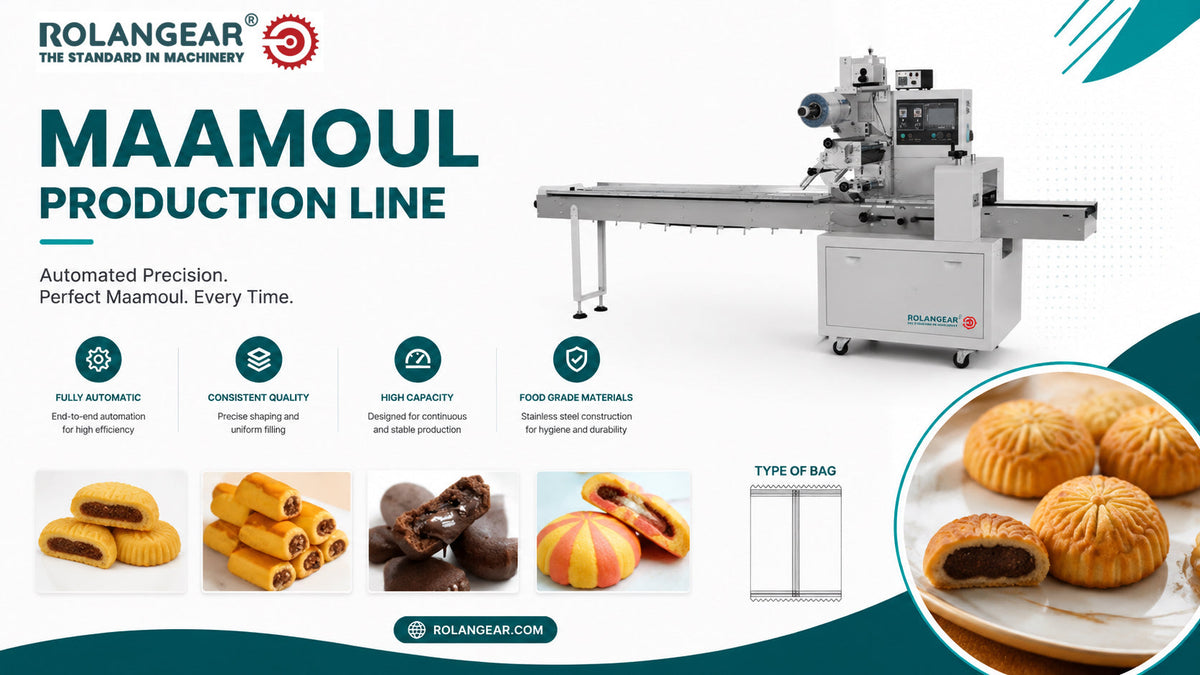
Additional equipment such as metal detectors, date printers, carton sealers, and case packers can also be integrated into the packaging line for fully automated production.
Maamoul Production Line Cost, Factory Planning and Buying Guide
The final question every investor asks is straightforward:
How much does a Maamoul production line cost?
The answer depends on several factors, including production capacity, automation level, baking equipment, filling varieties, packaging requirements, and factory layout. Instead of choosing only the lowest-priced machine, successful manufacturers focus on building a line that delivers stable quality, reliable output, and long-term profitability.
How Much Does a Maamoul Production Line Cost?
There is no single fixed price because every Maamoul production project is customized.
The overall investment is influenced by:
- Production capacity (small, medium, or industrial)
- Product size and weight
- Filling types (date, pistachio, walnut, chocolate, etc.)
- Required automation level
- Rotary rack oven or tunnel oven
- Cooling system
- Packaging automation
- Factory utilities
- Local electrical specifications
- Optional inspection equipment
A complete turnkey solution usually requires a higher investment than a single forming machine, but it also provides better efficiency, lower labor dependence, and more consistent product quality.
Customized Solutions For Different Production Requirements

Main Equipment Investment
A complete Maamoul production line generally includes:
- Dough mixer
- Filling mixer
- Automatic Maamoul encrusting and forming machine
- Baking trays
- Rack trolleys
- Rotary rack oven or tunnel oven
- Cooling conveyor
- Metal detector
- Automatic flow wrapper
- Cartoning system (optional)
Instead of purchasing unrelated machines separately, many manufacturers prefer an integrated turnkey solution to simplify installation, operation, training, and after-sales support.
Factory Layout Planning
A well-designed factory improves efficiency while reducing labor and operating costs.
A typical one-way production flow is shown in the factory layout section below:

This one-way workflow helps minimize cross-contamination risk, reduce unnecessary material handling, and create a smoother production process.
When planning a new factory, Rolangear also considers:
- Equipment dimensions
- Operator movement
- Utility connections
- Maintenance space
- Future expansion
- Food safety requirements
Utility Requirements
A complete Maamoul factory normally requires:
Electrical Supply
Stable industrial power suitable for installed equipment.
Water
Used mainly for cleaning and sanitation.
Compressed Air
Required for certain pneumatic components and packaging systems.
Ventilation
Maintains stable baking conditions and a comfortable production environment.
Production Space
The required workshop area depends on capacity and equipment configuration.
Rolangear can provide factory layout drawings before manufacturing begins to support efficient installation and smoother project planning.
Return on Investment (ROI)
One of the biggest advantages of industrial Maamoul production is reduced labor dependence while improving product consistency.

Compared with manual production, an automated line offers:
- Higher production capacity
- Stable product weight
- Consistent filling ratio
- Better appearance
- Lower material waste
- Reduced labor requirements
- Improved food safety
- Continuous operation
As production volume increases, automation typically delivers a faster return on investment through higher output and lower operating costs.
Why Choose Rolangear?
Purchasing a Maamoul production line is a long-term investment. Choosing the right solution partner is just as important as choosing the right equipment.
Rolangear provides complete food processing solutions, not only individual machines.
Our advantages include:
Customized Turnkey Solutions
Every project is designed according to the customer's product, factory size, and production goals.
Professional Engineering Team
Our engineers assist with:
- Equipment selection
- Factory layout
- Utility planning
- Installation guidance
- Production optimization
Stable Machine Quality
Our machines are manufactured using high-quality components to ensure stable operation and long service life.
Flexible Product Production
By changing molds, one machine can produce different Maamoul shapes and fillings, allowing manufacturers to expand their product range without major additional investment.
Global Export Experience
Rolangear supplies food processing equipment to customers in the Middle East, Southeast Asia, Africa, Europe, and Latin America, providing solutions tailored to local market requirements.
Comprehensive After-Sales Service
We support customers with:
- Installation guidance
- Operator training
- Technical documentation
- Spare parts supply
- Remote technical support
- Long-term maintenance assistance
Our goal is not only to deliver machines, but to help customers build efficient, profitable, and sustainable Maamoul production businesses.
Frequently Asked Questions
What fillings can the production line handle?
The line can process a wide variety of fillings, including date paste, pistachio paste, walnut paste, chocolate, coconut, fig paste, and other customized recipes.
Can one machine produce different Maamoul shapes?
Yes. By changing the molds, the same forming machine can produce different shapes, decorative patterns, and product sizes.
What production capacity should I choose?
Capacity depends on your market demand, labor availability, investment budget, and future expansion plans. Rolangear engineers can recommend the most suitable configuration based on your production goals.
Can the production line be fully automatic?
Yes. A complete turnkey line can integrate mixing, filling preparation, forming, baking, cooling, inspection, and packaging into a more automated production process according to the selected configuration.
Can Rolangear provide factory layout design?
Yes. We provide customized factory layout drawings, equipment arrangement plans, and utility recommendations before manufacturing begins.
Can the line be customized?
Absolutely. We customize equipment configuration, production capacity, product dimensions, filling systems, baking solutions, and packaging systems to match each customer's requirements.
Conclusion: Build a More Efficient Maamoul Production Business
As global demand for premium Middle Eastern pastries continues to grow, investing in an automated Maamoul production line offers manufacturers an excellent opportunity to improve efficiency, expand production capacity, and deliver consistently high-quality products.
A successful production line is more than a collection of machines. It is an integrated manufacturing system where dough preparation, filling, forming, baking, cooling, inspection, and packaging work together to improve productivity and product quality.
Whether you are launching a new bakery, upgrading manual production, or building a large-scale export factory, choosing the right equipment and an experienced solution provider is essential for long-term success.
At Rolangear, we specialize in designing customized Maamoul production solutions that match your products, production targets, factory layout, and investment budget. From equipment selection and engineering design to installation, training, and after-sales support, we are committed to helping customers build efficient, reliable, and profitable food manufacturing operations.
Ready to Build Your Maamoul Production Line?
Contact Rolangear for a customized Maamoul production line consultation, equipment recommendation, factory layout planning, and turnkey quotation.
Contact Rolangear on WhatsApp