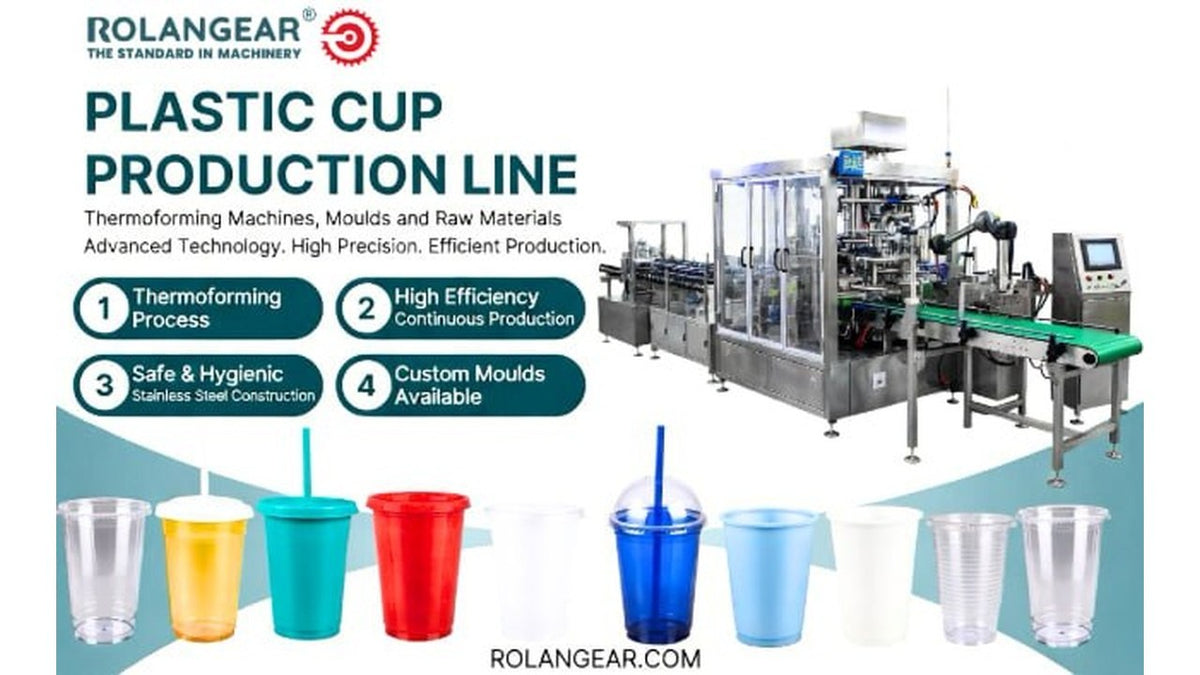
A plastic cup production line is a complete manufacturing system used to produce disposable and reusable plastic cups from thermoformable sheet materials. It normally connects plastic sheet feeding, heating, thermoforming, mould forming, cutting, stacking, scrap collection, inspection and optional packing. For factories that supply beverage cups, yogurt cups, dessert cups, sauce cups, jelly cups, takeaway packaging or food-service containers, the line should be selected according to material type, cup size, output target, mould design, hygiene expectations and packaging method.

For many buyers, the project is not simply choosing one plastic cup thermoforming machine. A professional production plan must connect raw materials, sheet thickness, heating performance, mould cooling, cutting accuracy, cup stacking, compressed air supply, operator workflow and scrap handling. If these sections are not matched correctly, the factory may face unstable cup shape, high waste, weak rims, poor stacking or slow order changeover.
What Is a Plastic Cup Production Line?
A plastic cup production line is an integrated equipment system that converts plastic sheet into finished cup products through heating, forming, cutting and stacking. It can be designed for drinking cups, milk tea cups, coffee cups, yogurt cups, pudding cups, ice cream cups, fruit containers and many other packaging products.

The most common process is thermoforming. In this method, a plastic sheet is heated until it becomes formable, then shaped inside a mould by air pressure, vacuum, plug assist or a combined forming method. After the cup is formed and cooled, it is cut from the sheet and stacked for inspection and packing.
Some factories start production with purchased plastic sheet rolls. Others add a plastic sheet extrusion line to make sheet internally. Buying sheet can reduce initial investment and simplify startup operation. Producing sheet internally may improve long-term material control when order volume becomes stable. The best choice depends on investment budget, local sheet supply, material cost, factory management ability and production scale.
A small factory may use one plastic cup making machine with manual packing. A larger packaging manufacturer may use several thermoforming machines, automatic stacking, cup counting, bagging, carton packing and scrap recycling. The right solution should match actual orders and customer requirements, not only the theoretical maximum speed shown in a brochure.
Why a Complete Solution Matters
Plastic cups look simple, but stable production requires coordination between material, machine, mould and process settings. If the sheet is not suitable, even a good machine cannot produce cups with consistent wall thickness. If the mould design is poor, the cup may have weak corners, difficult demoulding or unstable stacking. If heating is not controlled well, the sheet may be too cold, too soft or unevenly stretched.

A professional plastic cup production line solution should consider the whole workflow. Raw material should be selected according to product use and customer requirements. Cup wall thickness should balance strength, material cost and forming stability. The mould should support cup size, rim shape, bottom design, lid matching and stackability. Downstream handling should also be planned because fast forming is not useful if stacking or packing becomes the bottleneck.
Common Plastic Cup Products and Applications
Plastic cups are used in many packaging markets, so the production line should be selected according to target products and customer applications.
Beverage Cups
Beverage cups are used for cold drinks, juice, milk tea, smoothies, water and takeaway drinks. They usually require a clean appearance, stable rim, good transparency or suitable color, and reliable stacking. If the cup must match a lid, rim dimension and shape accuracy become very important.
Dairy and Dessert Cups
Yogurt cups, pudding cups, jelly cups and dessert cups often require accurate volume, smooth surface quality and food-contact material suitability according to local regulations and customer standards. Some products need film sealing, so rim flatness and cup consistency are key quality points.
Sauce, Sample and Food-Service Cups
Small cups for sauces, condiments, samples, fruit portions and snack packaging may have different heights, opening diameters and bottom designs. Factories serving food-service customers often need several moulds because orders may include multiple sizes and shapes.
Customized Cups
Customized cups may require special shape, color, embossing, logo area or a unique bottom design. For these products, mould engineering is especially important. Buyers should confirm whether the design is practical for thermoforming, whether the cup can stack smoothly and whether the wall thickness can remain stable.
Raw Materials for Plastic Cup Production
Raw material selection affects forming performance, appearance, strength, cost and market acceptance. A plastic cup production line can process different thermoformable materials, but compatibility should be confirmed according to machine configuration and product requirements.
PP Plastic Sheet
PP, or polypropylene, is widely used for plastic cup production because it offers practical toughness, good heat resistance and broad food packaging applications. PP cups are common in beverage, dairy, takeaway and food-service markets. PP may not always provide the same clarity as some transparent materials, but it is suitable for many daily packaging products.
PP processing requires careful heating control. If the sheet is not heated evenly, the cup may show wrinkles, thin areas or unstable shape. For PP cup production, heating zones, mould temperature, forming pressure and cooling should be matched carefully.
PET Plastic Sheet
PET is often selected when clear appearance and product presentation are important. PET cups can be used for cold beverages, desserts, fruit packaging and display-oriented food packaging. PET has good transparency, but its processing conditions differ from PP. The line should be configured according to PET sheet quality, cup depth and cooling requirement.
For food packaging, material source, sheet cleanliness and storage conditions should be controlled. Moisture, dust or inconsistent sheet thickness can affect cup appearance and forming stability.
PS, HIPS and Other Materials
PS and HIPS are used in some thermoformed cup and container applications. HIPS can provide impact resistance for certain packaging products. PLA or other biodegradable materials may also be requested in some markets, but they may need specific processing conditions and storage management. Buyers should not assume every standard plastic cup machine can process all materials without testing.
Complete Plastic Cup Manufacturing Process

A typical plastic cup manufacturing process is:
1. Plastic Sheet Preparation
Production starts with plastic sheet rolls or sheet materials. The sheet must match the required material, thickness, width and quality level. Operators should check surface cleanliness, roll edge quality and thickness consistency. Poor sheet quality can cause uneven stretching, weak cups or high waste.
If the factory uses an internal sheet extrusion line, sheet production and cup forming must be planned together. Sheet width, material formula, roll diameter and cooling quality should support the downstream plastic cup thermoforming machine.
2. Sheet Feeding
The feeding system delivers plastic sheet into the heating section. Feeding must be stable because irregular movement affects heating time and forming position. If sheet tension changes, the cup cavities may not align correctly with the cutting station.
3. Heating
Heating is one of the most important steps. The plastic sheet must reach the correct forming condition before entering the mould. If it is too cold, it may not stretch fully. If it is too hot, the cup may become thin, distorted or difficult to handle. Adjustable heating zones help operators match different materials, thicknesses and cup depths.
4. Thermoforming
In the thermoforming section, the heated sheet is shaped into cups by the mould. The mould cavity defines cup diameter, height, bottom design, rim shape and stacking features. During forming, pressure, timing, mould alignment and cooling must be controlled. Insufficient forming pressure can cause unclear details, while poor cooling can lead to deformation after demoulding.
5. Cutting and Punching
After forming, cups must be separated from the sheet. Cutting accuracy affects rim appearance, sealing performance and user safety. A rough or uneven rim can reduce product quality and may create problems with lids or sealing film. The cutting system should match cup design, material thickness and mould layout.
6. Stacking, Scrap Collection and Packing
Stacking turns separated cups into organized stacks for counting and packing. Good stacking requires stable cup shape, suitable taper angle and reliable stacking equipment. Thermoforming also creates leftover sheet skeleton after cutting. Scrap collection should keep the production area clean and support recycling planning when allowed by product requirements and local regulations.
Finished cups should be inspected for shape, rim quality, cleanliness, weight, stacking and appearance before packing. Packaging may use bags, sleeves, cartons or customized methods according to customer delivery requirements.
Main Machines in the Production Line
| Equipment | Function | Key Selection Points |
|---|---|---|
| Sheet roll loading system | Holds and feeds plastic sheet rolls | Roll diameter, sheet width, loading convenience, tension control |
| Plastic cup thermoforming machine | Heats and forms sheet into cups | Material compatibility, forming area, speed, heating zones, automation level |
| Cup mould | Defines cup size, rim, bottom and stacking design | Cavity number, mould material, cooling design, changeover method |
| Cutting or punching system | Separates cups from formed sheet | Cutting accuracy, rim quality, tool durability, waste handling |
| Cup stacking system | Collects cups into stable stacks | Cup size range, stacking speed, adjustment convenience |
| Scrap collection system | Collects leftover sheet skeleton | Clean operation, recycling plan, crusher compatibility |
| Packing equipment | Packs cup stacks into bags or cartons | Manual, semi-automatic or automatic packing requirement |
Not every project needs all equipment at the beginning. A startup factory may begin with one thermoforming machine and manual packing. A larger manufacturer may require automatic stacking, online counting, packing machines, multiple moulds and scrap recycling equipment.
Thermoforming Machines and Cup Moulds

The thermoforming machine is the core of the plastic cup production line. It determines how the sheet is heated, formed, cut and transferred. When choosing a machine, buyers should focus on production stability, mould compatibility, heating control, operation convenience and service support instead of comparing only price.
Heating System and Forming Area
A good heating system provides adjustable and stable heat across the sheet. Different materials and thicknesses require different temperature settings. Stable heating helps reduce thin spots and improve cup appearance. The forming area affects how many cup cavities can be placed in one mould. A larger forming area may support higher output, but it must match the product design and factory requirements.
Drive, Control and Automation
The drive and control system affects indexing accuracy and forming repeatability. A stable control system helps operators adjust heating, forming time, cutting and stacking. Higher automation can reduce labor dependency and improve consistency, but it also requires better planning and operator training.
Mould Design and Stackability
The mould is one of the most important parts of the project. It defines cup shape, size, rim, bottom, wall distribution and stackability. Poor mould design can create weak cups, unstable stacking or slow production. Cup taper angle, rim strength and bottom design should be evaluated carefully.
Cavity Number and Cooling
More cavities can increase output, but the mould must fit the machine forming area and maintain stable material distribution. Adding too many cavities without considering heating and forming balance may create quality problems. Mould cooling also matters because insufficient cooling can cause shrinkage, deformation or difficult demoulding.
Semi-Automatic vs Fully Automatic Lines
| Option | Best For | Advantages | Limitations |
|---|---|---|---|
| Semi-automatic line | Startups and smaller factories | Lower initial investment, flexible operation | More labor required, lower consistency |
| Automatic thermoforming line | Medium and large factories | Stable output, better stacking, reduced labor | Higher investment, needs trained operators |
| Complete integrated solution | Factories with stable orders | Better workflow and production management | Requires detailed project planning |
Automation should be selected according to real order volume. Buying a very large line without stable customers may create investment pressure. Choosing a line that is too small may limit future growth. The practical approach is to define main cup sizes, daily output target, labor plan and expected market development before selecting equipment.
Factory Layout and Utility Planning
Factory layout should support smooth movement from raw material storage to sheet feeding, thermoforming, stacking, inspection, packing and finished product storage. If the factory also includes sheet extrusion, more space is required for raw material storage, extrusion, sheet cooling, roll handling and recycling.

A practical layout can follow this flow:
The layout should reduce unnecessary material movement and keep operators away from unsafe or crowded areas. Finished cups should be protected from dust, moisture and deformation. Scrap should be collected separately so it does not interfere with packing.
A plastic cup production line may require electricity, compressed air, cooling water and ventilation. Exact requirements depend on machine model, output, material and factory configuration. Buyers should confirm voltage, power supply, air compressor capacity, cooling water conditions and installation space before machine delivery. Stable compressed air is especially important because air pressure can affect forming quality.
Quality Control and Maintenance
Quality control should cover raw material inspection, forming stability, cup dimensions, rim quality, stacking and packing appearance. Before production, operators should check sheet thickness, color, cleanliness and surface consistency. During production, cups should be checked for complete shape, wall thickness balance, bottom strength, rim smoothness and surface defects.

Dimensional accuracy is important when cups need to match lids, sealing film or filling machines. Cup height, top diameter, bottom diameter and rim width should remain consistent. Even small variation can cause lid leakage, sealing problems or packing difficulty.
Maintenance protects production stability. Daily work may include cleaning the machine area, checking sheet feeding, confirming air pressure, inspecting heaters, cleaning mould surfaces, checking cutting edges and removing scrap. Operators should also watch for unusual noise, unstable movement, temperature fluctuation or abnormal cup shape.
Mould maintenance is especially important. Mould surfaces should be cleaned carefully and protected during storage. Cooling channels should remain clear. Cutting tools should be sharpened or replaced when needed. Buyers should also prepare common spare parts according to the machine configuration, such as heating elements, pneumatic parts, sensors, cutting parts and electrical components.
How to Choose the Right Plastic Cup Production Line
Choosing the right plastic cup production line starts with clear product planning. Buyers should prepare cup samples, drawings or target dimensions. Important details include top diameter, bottom diameter, height, volume, material, wall thickness, color, transparency, rim design and lid or sealing requirements.

Material planning is also important. Decide whether the factory will use PP, PET, PS, HIPS, PLA or another material, and whether sheet will be purchased or produced internally. Material choice affects heating, forming, mould cooling and product positioning.
Capacity should be based on real orders and future growth. Actual output depends on cup size, material, mould cavities, machine speed, operator skill and packing method. Buyers should avoid choosing equipment only by the highest speed number in a brochure.
If the factory will produce many cup sizes, mould changeover time becomes important. A line suitable for one high-volume product may not be best for frequent small-batch orders. Buyers should discuss mould storage, installation tools and operator training with the supplier.
Finally, supplier support matters. A production line project requires configuration advice, mould design, installation guidance, operator training, troubleshooting and spare parts. For new factories, professional support can reduce startup mistakes and shorten the learning period.
Why Choose Rolangear?
Rolangear provides professional plastic cup production line solutions for factories planning new packaging projects or upgrading existing production systems. Instead of only selling one machine, Rolangear helps buyers evaluate product type, raw material, cup design, target capacity, mould requirements, factory layout and automation level.
A Rolangear project can include thermoforming machine selection, mould configuration, production workflow planning, utility requirement discussion, installation support and after-sales assistance. This helps buyers build a more practical production system and avoid mismatched equipment.
Frequently Asked Questions
What is a plastic cup production line?
It is a complete system that converts plastic sheet into finished cups through feeding, heating, thermoforming, cutting, stacking, inspection and packing.
What machine is used to make plastic cups?
The main machine is a plastic cup thermoforming machine, also called a plastic cup making machine. The line may also include moulds, stacking equipment, scrap collection, crusher, sheet extrusion and packing equipment.
What raw materials are used for plastic cup production?
Common materials include PP, PET, PS, HIPS and sometimes PLA or other thermoformable materials. The correct material depends on cup application, transparency, heat resistance, strength and customer requirements.
Can one machine make different cup sizes?
One machine may produce different cup sizes if they fit the machine forming area and technical range. Different cup designs usually require different moulds.
Do I need a sheet extrusion line?
Not always. Some factories buy plastic sheet rolls and use a thermoforming line only. Others add sheet extrusion to control material supply when production volume becomes stable.
Can Rolangear customize a plastic cup production line?
Yes. Rolangear can help design a plastic cup production line according to cup type, raw material, target capacity, mould requirements, factory layout and packing method.
Conclusion
A plastic cup production line is a practical solution for manufacturers serving beverage, dairy, dessert, takeaway and food-service packaging markets. However, successful production depends on more than buying one thermoforming machine. Raw material quality, heating control, mould design, forming pressure, cutting accuracy, stacking, scrap handling and packing must work together as one system.
The best plastic cup production line is the one that matches the factory’s product range, target capacity, material plan, customer requirements and future expansion strategy. A small factory may need a flexible entry-level configuration, while a larger manufacturer may need automatic stacking, higher output, multiple moulds and integrated material handling.
If you are planning a plastic cup manufacturing project, contact Rolangear with your cup samples, target capacity, material requirement and factory conditions. Rolangear can help you design a suitable plastic cup production line for stable production, efficient operation and long-term business growth.
Contact Rolangear