Article: Arabic Bread Factory Feasibility Study
Arabic Bread Factory Feasibility Study
Arabic Bread Factory Feasibility Study
Professional feasibility study for a small-to-medium Arabic bread factory producing pita bread, sandwich flatbread, whole wheat Arabic bread and private-label retail packs. Because no country, building condition, supplier quotation, route plan or packaging mix was supplied, this report uses transparent USD planning assumptions that must be localized before investment approval.
1. Executive Summary
The project is an Arabic bread manufacturing factory designed around an automatic flatbread line producing approximately 10,000 pieces/hour at an average 60 g piece weight. The base case assumes 8 operating hours/day, 300 days/year, 90% saleable yield after baking loss, rejects and returns, and annual saleable output of 1,296 tons. The product plan includes pita bread, sandwich flatbread, whole wheat Arabic bread and private-label packs for groceries, restaurants, schools and distributors.

Using a blended ex-factory selling price of USD 1450/ton and variable cost of USD 760/ton, total investment of $780,000 and ramp-up from 50% to 90% utilization, Year-5 revenue reaches $1.69m and Year-5 net profit reaches $401,114. The base model produces NPV of $427,342 at a 12% discount rate and IRR of 29.1%. Break-even utilization is 33.0%. The project is financially positive under the stated assumptions, but final approval depends on flour cost, fuel cost, daily route density, shelf-life control, building condition and confirmed machinery quotations.
2. Study Scope and Methodology
This feasibility study covers project concept, product analysis, economic indicators and project location, target-market indicators, demand, local production, import and export caveats, competitor analysis, market gap, SWOT, marketing, pricing, distribution, machinery, production capacity, supplier quotations, raw-material costs, operating expenses, utilities, staffing, investment, financing, financial statements, indicators, break-even, sensitivity, legal/regulatory requirements, environmental health and safety, risk, implementation schedule, sources, consultation and final conclusion.
The methodology combines source-backed agriculture and standards context, transparent capacity formulas, practical machinery-cost assumptions, a five-year financial model and sensitivity testing. FAO and Codex sources provide raw-material and food-standard context, while machinery and investment costs are treated as budgetary planning estimates rather than final supplier quotations [1][2][3][4][5].
3. Project Concept and Nature

The project nature is an industrial bakery and staple-food production plant. Flour and ingredients are mixed into dough, divided, rounded, rested, sheeted, proofed where required, baked rapidly at high temperature, cooled, counted, packed, coded and dispatched. The business model combines local daily bread supply, HORECA/restaurant distribution, retail bagged bread and private-label production.
4. Product Analysis and Product Specification Table
The core products are Arabic bread and pita-style flatbread. Product formulation, nutrition labeling, allergen declarations, shelf life, moisture, weight tolerance and packaging rules must be checked locally. Codex provides food and wheat-flour standards context, but this study does not claim verified product certification [2].
| Product | Typical pack | Target channel | Quality / storage notes |
|---|---|---|---|
| Arabic bread / pita bread | 5–10 pieces per bag | Retail, groceries, households | Soft texture, pocket formation, freshness and seal quality |
| Small pita / sandwich bread | Small retail bags / HORECA cartons | Restaurants, shawarma shops, cafés | Uniform diameter and folding strength |
| Whole wheat Arabic bread | Retail and health-oriented channels | Supermarkets and specialty buyers | Bran level, softness and shelf-life control |
| Private-label flatbread | Retailer-specific bags and cartons | Supermarkets and distributors | Buyer-specific label, recipe and pack count |
5. Economic Indicators and Project Location
Location should be selected based on flour access, daily distribution routes, utility reliability, bakery hall ventilation, labor availability and packaging supply. Because Arabic bread is normally sold fresh, proximity to retail routes and restaurants is more important than for long-shelf-life products.
| Location factor | Weight | Preferred condition | Feasibility effect |
|---|---|---|---|
| Flour and ingredient access | 25% | Reliable wheat flour, yeast, salt, sugar/oil and packaging supply | Highest effect on margin and daily continuity |
| Daily distribution routes | 22% | Near urban groceries, restaurants and morning delivery routes | Critical because bread has short shelf life |
| Utilities | 16% | Stable power, gas/diesel/electric oven fuel, water and compressed air | Affects baking cost and downtime |
| Building suitability | 14% | Food-grade bakery hall, ventilation and dispatch access | Reduces setup risk |
| Labor availability | 9% | Operators, bakers, packers and delivery staff available | Supports early morning production |
| Packaging and crates | 8% | Plastic bags, clips, cartons/crates available locally | Protects freshness |
| Regulatory environment | 6% | Clear food safety and labeling requirements | Reduces launch delay |
6. Target-Market Indicators
Target-market indicators include household bread consumption, restaurants and shawarma shops, school/institutional demand, grocery shelf availability, local bakery capacity and imported/frozen flatbread alternatives. The project forecast is capacity-led because no country market data was supplied.
| Market layer | Definition | Planning treatment |
|---|---|---|
| TAM | All Arabic bread, pita, flatbread and daily bakery demand in the target country | Not fully available to the project |
| SAM | Demand reachable through planned daily routes, groceries, HORECA and institutions | Requires route and distributor validation |
| Realistically obtainable market | Volume a new plant can capture within five years | Limited by freshness, price, route density and retailer trust |
| Project sales forecast | Ramp-up from 50% to 90% utilization | Capped by 1,296 tons/year saleable capacity |
7. Demand Analysis

Demand should be calculated using population × daily bread consumption, number of restaurants and groceries, route-level sales commitments and import/frozen substitution potential. In this preliminary model, expected sales follow the formula: 10,000 pieces/hour × 60 g × 8 hours/day × 300 days/year = 1,440 tons gross output. Saleable output = 1,440 × 90% yield = 1,296 tons/year. Year-1 sales = 1,296 × 50% = 648 tons.
Confidence is medium for the capacity formula and low-to-medium for market absorption until local route, retail, restaurant and competitor checks are completed.
8. Local Production Analysis
Local production analysis should identify existing industrial bread plants, neighborhood bakeries, supermarket bakeries, restaurant suppliers and frozen/imported flatbread alternatives. Exact local production is not stated because no target country was provided; it must be researched with official industrial data, bakery association information, shelf checks and distributor interviews.
9. Import and Export Analysis with HS-Code Caveats
Likely HS codes include HS 1905 for bread, pastry, cakes, biscuits and other bakers’ wares. This code is broad and may include many products beyond Arabic bread, so broad trade data must not be treated as exact local flatbread demand without subheading validation. Country-level import/export checks should use customs data, UN Comtrade or ITC Trade Map after confirming HS code scope.
10. Competitor Analysis
| Competitor type | Examples to research locally | Competitive pressure | Response |
|---|---|---|---|
| Large industrial bakeries | National bread and bakery brands | High | Compete with freshness, delivery reliability and pack value |
| Neighborhood bakeries | Local pita/Arabic bread bakeries | Medium-high | Use route density, consistent quality and retail bagging |
| Restaurant suppliers | Bakeries supplying shawarma and cafés | Medium | Offer HORECA cartons and custom sizes |
| Imported/frozen flatbread | Frozen or packaged alternatives | Low-medium | Position fresh daily local supply |
| New entrants | Small bakeries and semi-automatic lines | Medium | Secure flour contracts and retail routes early |
11. Market-Gap Analysis

Market gap should equal estimated demand plus realistic import/frozen substitution minus reliable local daily bread supply. Because country data is missing, the gap is not quantified. Practically, the plant needs to sell 1,166 tons in Year 5, so route density, daily delivery reliability and customer retention are more important than assuming total national demand is available.
12. SWOT Analysis
| Strengths | Weaknesses | Opportunities | Threats |
|---|---|---|---|
| Arabic bread is a staple daily product in many markets | Short shelf life increases returns and route pressure | Retail, restaurants, schools and private-label supply | Flour and fuel price volatility |
| Fast production cycle and simple ingredients | Requires early daily distribution discipline | Healthy/whole wheat and sandwich sizes add value | Strong local bakery competition |
| Moderate equipment complexity | Freshness complaints can hurt repeat sales | HORECA contracts support stable volume | Power/fuel interruptions can stop baking |
13. Marketing and Promotional Plan
The marketing plan should focus on daily freshness, consistent bread size, reliable early delivery, restaurant pack formats, school/institutional contracts, route sampling, retailer margins and private-label offers. KPIs include daily route sales, returns rate, active outlets, late delivery rate, average order size, complaint rate and gross margin by channel.
14. Pricing Plan
| Product | Standard ex-factory planning price | Pricing logic |
|---|---|---|
| Retail Arabic bread bags | USD 1,250–1,600/ton finished bread | Staple product with price sensitivity |
| Restaurant / shawarma flatbread cartons | USD 1,300–1,700/ton finished bread | Volume contracts and custom size requirements |
| Whole wheat Arabic bread | USD 1,600–2,000/ton finished bread | Higher ingredient cost and premium positioning |
| Private-label retail packs | Contract-based | Depends on recipe, bag count, route volume and payment terms |
| Blended model price | USD 1,450/ton finished bread | Used for the base financial model |
15. Distribution Plan
Distribution should combine daily direct routes to groceries, restaurants, shawarma shops, supermarkets, institutions and selected wholesalers. Returns management is critical: route planning must balance freshness, stockouts and unsold bread collection.
16. Machinery, Equipment, and Production-Line Costs

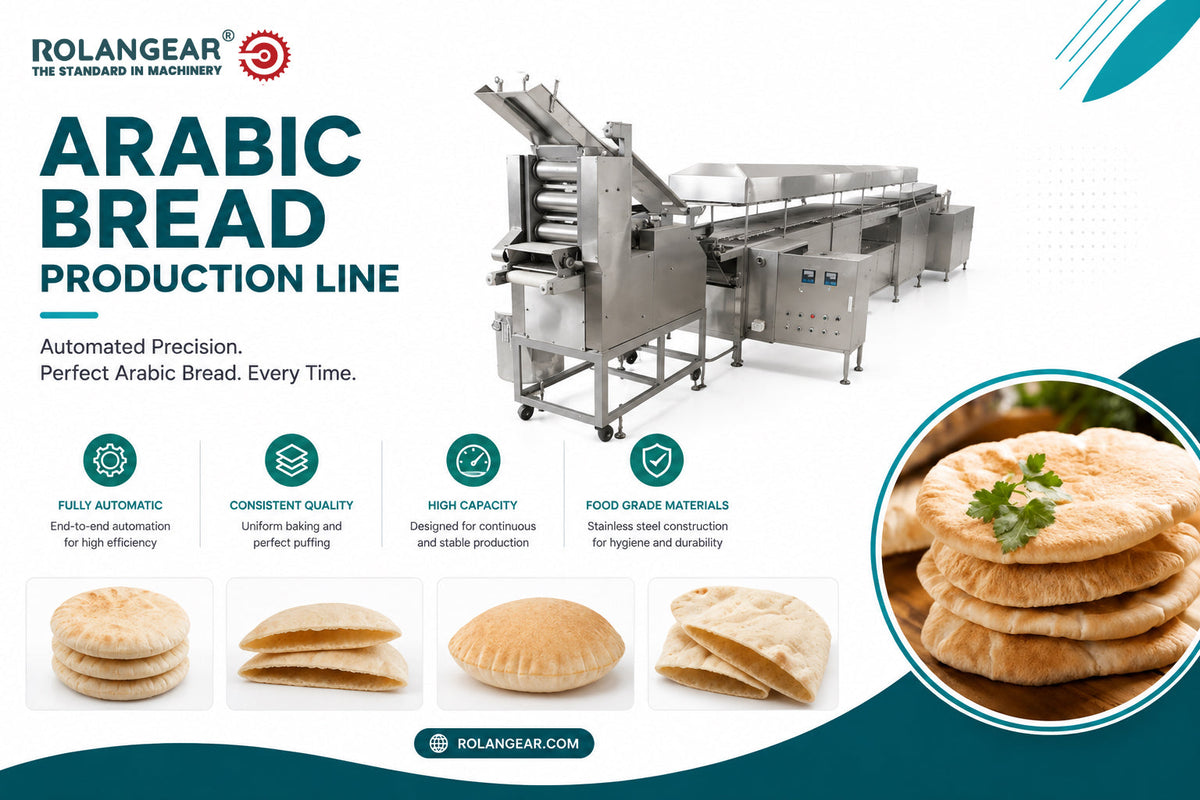
Machinery costs are presented as budgetary planning estimates for a small-to-medium Arabic bread factory. Final equipment cost must be confirmed through formal technical offers based on bread diameter, piece weight, hourly capacity, proofing requirement, oven type, fuel system, packaging format, automation level, installation and destination requirements [3][4][5].
| Machine / equipment | Function | Budgetary equipment cost estimate |
|---|---|---|
| Flour handling, sifter and spiral mixer | Ingredient preparation and dough mixing | USD 35k–80k |
| Dough divider, rounder and resting/proofing system | Portion and relax dough pieces | USD 60k–140k |
| Sheeting / pressing / flatbread forming system | Form round Arabic bread discs | USD 70k–160k |
| Tunnel oven or automatic pita baking oven | High-temperature baking and pocket formation | USD 150k–300k |
| Cooling conveyor and counting/stacking system | Cool and organize bread before packing | USD 60k–130k |
| Bagging, clipping/sealing and date coding line | Retail packaging | USD 50k–130k |
| Metal detector, checkweigher and QA tools | Quality and compliance support | USD 20k–60k |
| Utilities: compressor, oven fuel system, water and electrical works | Factory support systems | USD 70k–150k |
17. Building, Facility, and Construction Costs
The facility should include flour storage, mixing room, dough forming area, proofing/resting zone, tunnel oven hall, cooling and packing area, finished goods dispatch zone, packaging store, QA area, maintenance room, staff hygiene area and delivery loading bay. Ventilation and heat extraction around the oven are important.
18. Production Capacity and Line Suitability

Rated capacity is 10,000 pieces/hour at an average 60 g piece weight. Annual gross output = 10,000 × 0.06 kg × 8 hours/day × 300 days = 1,440 tons. Saleable output after 90% yield = 1,296 tons/year. Bottlenecks may occur in mixing, proofing/resting, oven pocket formation, cooling time, bagging speed, delivery route loading and daily returns.
19. Supplier Quotations and Technical Offers
No supplier quotation was provided. Final supplier offers must confirm capacity by bread size, dough hydration, sheeting and proofing design, oven type and energy load, cooling conveyor length, packaging speed, spare parts, installation, training, warranty and Incoterm.
20. Raw-Material Costs

Main raw materials are wheat flour, yeast, salt, water, small quantities of sugar/oil depending on recipe, bread bags, clips, cartons/crates, labels and cleaning consumables. The base variable cost is USD 760/ton finished bread, including flour, ingredients, packaging, oven fuel, direct labor and normal returns/waste.
21. Operating Requirements and Expenses
Annual fixed operating expenses are estimated at $230,000 before depreciation. This covers management, production supervision, QA, maintenance, sales/admin, route coordination, insurance, security, office costs, basic marketing and non-variable overhead.
22. Utility Requirements
| Utility | Typical requirement to confirm | Feasibility effect |
|---|---|---|
| Electricity | 3-phase power for mixers, conveyors and packing line | Controls uptime |
| Oven fuel / gas / diesel / electric heating | Tunnel oven and baking system | Major cost driver |
| Compressed air | Packaging and machine actuators | Affects line stability |
| Water | Dough and cleaning water | Food safety and recipe consistency |
| Ventilation | Heat extraction from oven hall | Supports labor productivity |
| Waste handling | Dough waste, stale returns and packaging waste | EHS and hygiene requirement |
23. Organizational and Management Structure
| Role | Headcount | Main responsibility |
|---|---|---|
| General manager | 1 | Operations, sales and finance |
| Production manager / bakery technologist | 1 | Recipe, process, yield and quality coordination |
| Shift supervisors | 2 | Daily production execution |
| Mixing/forming/oven operators | 10 | Dough preparation, forming and baking |
| Packing operators | 10 | Bagging, clipping and date coding |
| Quality/lab staff | 2 | Weight, moisture, seal, hygiene and release records |
| Maintenance and utilities | 3 | Oven, mixers, conveyors and packaging machines |
| Drivers / route helpers | 8 | Daily delivery and returns collection |
| Sales/admin/finance | 4 | Orders, accounts and customer service |
24. Investment Costs
| Investment item | Standard estimate | Basis |
|---|---|---|
| Building fit-out, ventilation, hygiene and dispatch area | $140,000 | Planning estimate; excludes land purchase |
| Arabic bread forming, baking, cooling and packing line | $350,000 | Budgetary processing-line package |
| Utilities: oven fuel system, compressor, electrical and water | $100,000 | Auxiliary utility allowance |
| Lab, QA, handling, crates and workshop equipment | $35,000 | Support equipment |
| Freight, duties, installation, training and commissioning | $55,000 | Destination-dependent allowance |
| Pre-operating expenses, permits and launch | $25,000 | Planning estimate |
| Contingency reserve | $45,000 | Approximate reserve |
| Initial working capital | $30,000 | Flour, yeast, packaging, fuel and receivables |
| Total project investment | $0.78m | Calculated subtotal |
25. Financing Requirements and Conditions

Base financing assumes 40% equity and 60% debt. Equity requirement is $312,000 and loan requirement is $468,000. Loan terms are modeled at 9% annual interest, five-year equal principal repayment and no grace period. Final terms depend on lender, collateral and sponsor profile.
26. Revenue and Sales Forecasts
| Year | Utilization | Sales volume, tons | Revenue | Net profit | DSCR |
|---|---|---|---|---|---|
| Y1 | 50.0% | 648 | $939,600 | $88,000 | 1.13x |
| Y2 | 65.0% | 842 | $1.22m | $202,048 | 2.10x |
| Y3 | 75.0% | 972 | $1.41m | $280,326 | 2.91x |
| Y4 | 85.0% | 1,102 | $1.60m | $358,605 | 3.84x |
| Y5 | 90.0% | 1,166 | $1.69m | $401,114 | 4.57x |
Optimistic scenario assumes fast route onboarding, 95% Year-5 utilization and low returns. Conservative scenario assumes slower retail listing, 75% Year-5 utilization, lower selling price and higher flour/fuel cost.
27. Financial Statements
| USD | Y1 | Y2 | Y3 | Y4 | Y5 |
|---|---|---|---|---|---|
| Revenue | $939,600 | $1.22m | $1.41m | $1.60m | $1.69m |
| COGS | $492,480 | $640,224 | $738,720 | $837,216 | $886,464 |
| Gross profit | $447,120 | $581,256 | $670,680 | $760,104 | $804,816 |
| EBITDA | $217,120 | $351,256 | $440,680 | $530,104 | $574,816 |
| Depreciation | $65,000 | $65,000 | $65,000 | $65,000 | $65,000 |
| EBIT | $152,120 | $286,256 | $375,680 | $465,104 | $509,816 |
| Interest | $42,120 | $33,696 | $25,272 | $16,848 | $8,424 |
| Tax | $22,000 | $50,512 | $70,082 | $89,651 | $100,278 |
| Net profit | $88,000 | $202,048 | $280,326 | $358,605 | $401,114 |
| USD | Y0 | Y1 | Y2 | Y3 | Y4 | Y5 |
|---|---|---|---|---|---|---|
| Equity / project cash flow | -$312,000 | $59,400 | $173,448 | $251,726 | $330,005 | $372,514 |
| Cumulative cash flow | -$312,000 | -$252,600 | -$79,152 | $172,574 | $502,579 | $875,093 |
| Debt principal repayment | - | $93,600 | $93,600 | $93,600 | $93,600 | $93,600 |
| Closing debt | - | $374,400 | $280,800 | $187,200 | $93,600 | $0 |
| USD | Y1 | Y2 | Y3 | Y4 | Y5 |
|---|---|---|---|---|---|
| Fixed assets net | $495,000 | $430,000 | $365,000 | $300,000 | $235,000 |
| Working capital and cash | $30,000 | $30,000 | $202,574 | $532,579 | $905,093 |
| Total assets | $525,000 | $460,000 | $567,574 | $832,579 | $1.14m |
| Debt | $374,400 | $280,800 | $187,200 | $93,600 | $0 |
| Equity and retained earnings | $150,600 | $179,200 | $380,374 | $738,979 | $1.14m |
| Liabilities plus equity | $525,000 | $460,000 | $567,574 | $832,579 | $1.14m |
28. Financial Indicators and Financial Analysis
| Indicator | Formula / basis | Base result | Interpretation |
|---|---|---|---|
| Gross margin | (Revenue - COGS) / Revenue | 47.6% | Healthy if flour, fuel and returns are controlled |
| Contribution margin | Price - variable cost | USD 690/ton | Used for break-even |
| Break-even quantity | Fixed cost / contribution | 428 tons/year | Requires 33.0% utilization |
| ROI | Average net profit / investment | 34.1% | Positive after ramp-up under budgetary assumptions |
| NPV | Unlevered FCFF discounted at 12% | $427,342 | Positive but sensitive to price and route volume |
| IRR | Discount rate where NPV = 0 | 29.1% | Above the 12% discount rate in base case |
| Payback | Cumulative levered cash recovery | During Year 3 | Requires route density and low returns |
| Debt-to-equity | Debt / equity | 1.50x | Moderate leverage |
| DSCR | Operating cash flow / debt service | Y1 1.13x; Y5 4.57x | Improves after route ramp-up |
29. Break-Even Analysis
Contribution per ton = selling price (1450) − variable cost (760) = 690 USD. Break-even quantity = fixed cost plus depreciation ($295,000) ÷ contribution (690) = 428 tons/year. Break-even revenue = $619,928. Break-even utilization = 33.0% of saleable capacity.
Source: calculated base-case model, 2026.
30. Sensitivity Analysis
| Variable tested | NPV result | Impact vs base NPV |
|---|---|---|
| Selling price -10% | $44,089 | -$383,254 |
| Sales volume/utilization -10% | $244,966 | -$182,376 |
| Flour and packaging +10% | $226,465 | -$200,878 |
| Fixed operating expenses +10% | $361,014 | -$66,328 |
| Capital cost +10% | $349,342 | -$78,000 |
| Launch delay / route delay | -$146,935 | -$574,277 |
| Selling price +10% | $810,596 | $383,254 |
| Variable cost -10% | $628,220 | $200,878 |
Source: calculated sensitivity model, 2026.
Critical variables are selling price, daily sales route volume, flour cost, fuel cost, product returns and route launch speed.
31. Legal and Regulatory Requirements
Requirements normally include company registration, bakery or food processing license, product labeling approval, food safety plan, worker health rules, tax registration, fire safety, environmental approval and delivery vehicle compliance. Local food-law review is required before production [2].
32. Environmental, Health, and Safety Analysis

EHS issues include flour dust, oven heat, burn risk, moving conveyors, packaging machine guarding, cleaning chemicals, pest control, stale bread returns, packaging waste and fire safety. The project should implement HACCP-style controls, traceability, pest control, equipment guarding, sanitation SOPs and daily returns management.
33. Risk Analysis and Risk Register
| Risk | Probability | Impact | Mitigation |
|---|---|---|---|
| Flour price increase | Medium | High | Supplier contracts and pack price review |
| Fuel or power interruption | Medium | High | Backup power and oven fuel planning |
| High product returns | Medium | High | Route planning, shelf-life control and demand forecasting |
| Packaging shortage | Medium | Medium | Multiple bag and clip suppliers |
| Slow route/distributor adoption | Medium | High | Pre-launch route agreements and sampling |
| Food safety or hygiene issue | Low-medium | High | HACCP-style controls, pest control and traceability |
34. Implementation Schedule
| Phase | Duration | Key tasks |
|---|---|---|
| Feasibility localization | 2–4 weeks | Country data, flour prices, route validation |
| Engineering and permits | 1–2 months | Layout, food license, utility and ventilation design |
| Supplier quotation and procurement | 2–3 months | Technical offers, contract and manufacturing |
| Civil works and utilities | 2–4 months | Floors, ventilation, oven fuel, power and dispatch area |
| Installation and commissioning | 4–8 weeks | Line installation, trial baking and packaging tests |
| Commercial launch | 1 month | Route onboarding, restaurant sampling and retail delivery ramp-up |
35. Sources and Assumptions
Assumptions Register
| Assumption | Value | Basis | Confidence | Effect |
|---|---|---|---|---|
| Currency | USD | Analyst assumption | Medium | All financial outputs |
| Line capacity | 10,000 pieces/hour × 60 g average × 8 hours/day × 300 days/year | Standard small-to-medium Arabic bread line planning basis | Medium | Capacity |
| Saleable yield | 90% after baking loss, rejects and returns | Analyst estimate | Medium | Revenue and COGS |
| Annual saleable output | 1,296 tons/year | Calculated from capacity and yield | Medium | Sales forecast |
| Selling price | USD 1,450/ton finished bread | Blended ex-factory planning assumption | Low-medium | Revenue and margin |
| Variable cost | USD 760/ton finished bread | Flour, yeast, salt, sugar/oil, packaging, oven fuel and direct labor | Medium | Gross margin |
| Total investment | USD 0.78m | Budgetary machinery-cost basis plus factory allowances | Medium | NPV, IRR and funding need |
| Debt terms | 60%, 9%, 5 years | Analyst assumption | Low-medium | Cash flow and DSCR |
Source Register
| Ref | Organization | Source and URL | Data used | Access date | Confidence |
|---|---|---|---|---|---|
| [1] | FAO | FAOSTAT crops and agriculture platform, https://www.fao.org/faostat/en/#data/QCL | Official crop and wheat-related data platform; country localization required | 2026-08-05 | High |
| [2] | FAO/WHO Codex Alimentarius | Standards list, https://www.fao.org/fao-who-codexalimentarius/codex-texts/list-standards/en/ | Wheat flour and food-standard context | 2026-08-05 | High |
| [3] | Supplier marketplace reference | Pita and Arabic bread production line price review | Budgetary machinery-cost benchmarking for flatbread processing equipment | 2026-08-05 | Medium |
| [4] | Supplier marketplace reference | Flatbread machine category review | Budgetary machinery category benchmarking for forming, baking and packing line | 2026-08-05 | Medium |
| [5] | Supplier marketplace reference | Pita bread production line price review | Budgetary supplier-reference check; not treated as a final quotation | 2026-08-05 | Low-medium |
| [6] | Analyst calculation | Transparent model in this study | Capacity, investment, revenue, break-even, NPV and IRR calculations | 2026-08-05 | Medium |
36. Consultation Section
Need a Localized Arabic Bread Factory Study?
For a bankable Arabic bread factory report, confirm country, bread size, pack count, flour and fuel prices, building status, route plan, delivery vehicles, tax rate, financing terms and supplier quotation. Rolangear can support Arabic bread production-line configuration, machinery selection, capacity planning and quote comparison.
Contact Rolangear37. Final Conclusion and Recommendation
The Arabic bread factory is technically feasible and financially positive under the stated budgetary assumptions. The investment is most attractive when the plant secures reliable flour supply, controls fuel and return rates, develops strong daily routes and signs restaurant/grocery commitments before launch. The recommendation is to proceed to localized validation before final investment: confirm flour prices, local selling prices, route demand, packaging costs, fuel/power costs, building condition, product recipe and formal supplier quotation.
Data-Driven Charts
Source: calculated base-case model, 2026 planning assumptions. Unit: USD million.
Source: calculated base-case model, 2026 planning assumptions. Unit: USD thousand.
Source: calculated base-case model, 2026 planning assumptions. Unit: percent.
Source: calculated base-case model, 2026 planning assumptions. Unit: tons.
Equipment: 44.9%Building: 17.9%Utilities: 12.8%Other: 24.4%
Source: analyst budgetary investment model, 2026.
Retail Arabic bread: 50.0%HORECA flatbread: 30.0%Whole wheat: 12.0%Private label: 8.0%
Source: analyst budgetary investment model, 2026.