WPC Door Factory Feasibility Study
WPC Door Factory Feasibility Study
Professional feasibility study for a small-to-medium WPC door factory producing wood-plastic composite interior doors, bathroom doors, frames, architraves and laminated finished door sets. Because no country, city, material price, utility tariff, building condition or supplier quotation was supplied, this report uses transparent USD planning assumptions that must be localized before investment approval.
Study Map
1. Executive Summary
The project is a WPC door factory producing wood-plastic composite door panels, frames, jambs, architraves and laminated or painted finished doors for residential, commercial and institutional buildings. The base case assumes annual saleable capacity of 54,000 finished door sets after normal waste and product-mix adjustment.

Using a blended ex-factory selling price of USD 95/door set, variable cost of USD 58/door set and total investment of $1.77m, Year-5 revenue reaches $4.62m and Year-5 net profit reaches $831,056. Base NPV is $834,863 at a 12% discount rate, estimated IRR is 27.0%, and break-even utilization is 33.8%.
2. Study Scope and Methodology
This study covers market, technical, operating, staffing, investment, financing, revenue, financial statements, indicators, break-even, sensitivity, legal, EHS, risk, implementation, sources, consultation and final recommendation. World Bank indicators support macro and demand-localization context [1][2]. HS Chapters 39 and 44 support plastics, wood and door classification caveats [3][4]. FAO forestry statistics, EPA composite-wood formaldehyde rules, OSHA plastics guidance and EU construction-product references support raw-material, regulatory and safety context [5][6][7][8].
3. Project Concept and Nature
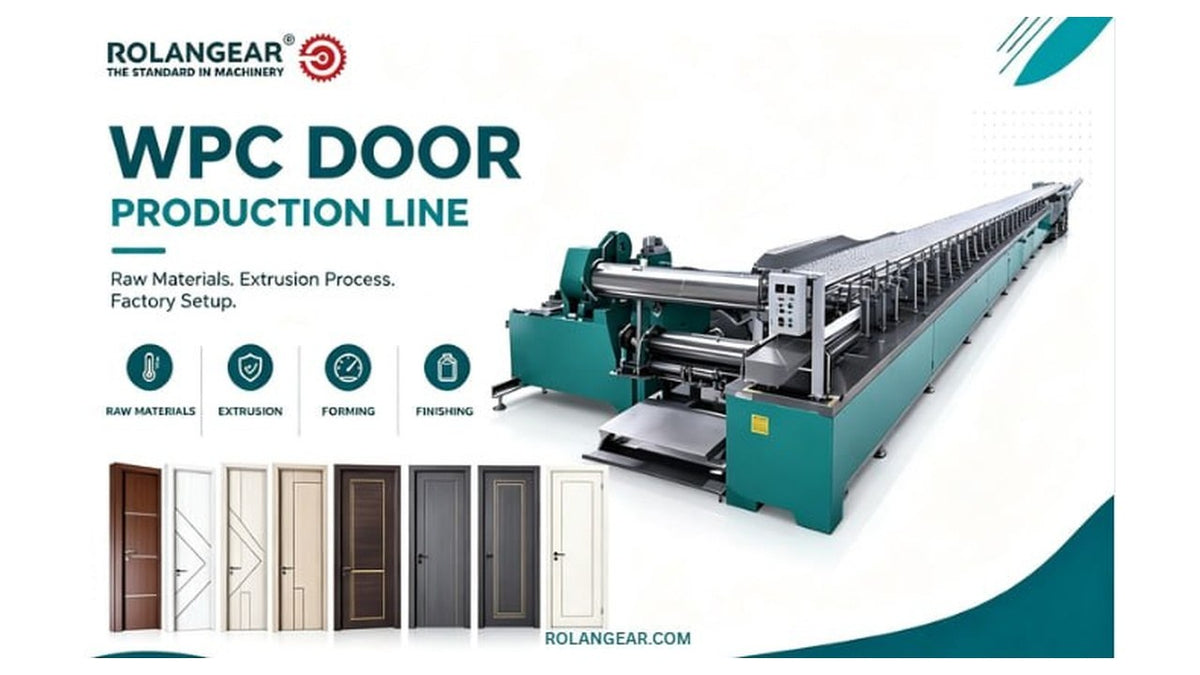
The project is an industrial building-materials manufacturing plant. PVC or PE resin, wood flour, calcium carbonate, stabilizers, lubricants, foaming agents, pigments and additives are mixed, extruded into WPC profiles or door skins, cooled, cut, laminated, routed, assembled into door sets, finished, inspected and packed. The business model can combine wholesale door supply, construction-project supply, distributor sales and private-label production.
4. Product Analysis and Product-Specification Table
Product specifications include door size, thickness, core density, skin design, frame type, surface finish, color, laminate, moisture resistance, screw-holding performance, dimensional stability and fire/acoustic rating where required. Performance and certification claims should not be made until local tests and standards are verified.
| Product | Typical specification | Target customer | Quality notes |
|---|---|---|---|
| WPC interior door sets | 700–1000 mm width, 35–45 mm thickness | Residential developers and retailers | Flatness, color consistency and hinge holding |
| WPC bathroom/kitchen doors | Moisture-resistant door sets | Apartments, hotels, contractors | Water resistance and edge sealing |
| WPC frames and jambs | Matching profiles and architraves | Door installers and distributors | Straightness and installation fit |
| Laminated decorative doors | Film/laminate wrapped surface | Retail and project buyers | Adhesion, scratch resistance and appearance |
| Private-label door programs | Buyer-specific patterns and packaging | Distributors and construction suppliers | Mold, branding and quality approval |
5. Economic Indicators and Project Location
WPC door demand is linked to housing construction, renovation, hotels, offices, public buildings, interior finishing and moisture-resistant door replacement. World Bank manufacturing and population indicators help screen country scale once a target country is selected [1][2]. Location should prioritize building-material distribution routes, resin and filler supply, dry storage, reliable power and access to construction markets.
| Factor | Weight | Preferred condition | Effect |
|---|---|---|---|
| Construction-market access | 24% | Near urban housing and building-material distributors | Improves sales and delivery |
| Raw-material supply | 20% | PVC/PE resin, wood flour, fillers and additives available | Controls unit cost |
| Power and utilities | 16% | Stable power for extrusion and finishing | Protects uptime |
| Industrial zoning and EHS | 14% | Approved plastics/building-material zone | Reduces permit risk |
| Skilled labor and maintenance | 10% | Extrusion, finishing and tooling skills | Supports quality |
| Warehouse and drying area | 9% | Dry resin/filler and finished-door storage | Protects material quality |
| Expansion space | 7% | Room for extra molds, lamination and assembly | Supports growth |
6. Target-Market Indicators with TAM, SAM and Realistically Obtainable Market Separation
| Layer | Definition | Planning treatment |
|---|---|---|
| TAM | All interior door, bathroom door, frame and renovation demand in the target country | Not fully available to one factory |
| SAM | Demand reachable through planned distributors, contractors and project buyers | Requires local channel validation |
| Realistically obtainable market | Volume a new WPC door producer can win within five years | Limited by design range, price, quality and installer trust |
| Project sales forecast | Ramp-up to 48,600 door sets/year by Year 5 | Capacity-led forecast, not a market-share claim |
7. Demand Analysis
Because no country was supplied, this report uses a capacity-led forecast rather than a national construction-demand forecast. Base capacity is 54,000 door sets/year. Year-1 sales = 27,000 door sets and Year-5 sales = 48,600 door sets. Local demand should later be calculated from new housing units, renovation rate, hotel/office projects, average doors per unit, import data and distributor interviews.

8. Local Production Analysis
Local production analysis should identify wooden-door factories, PVC/WPC door producers, aluminum/uPVC door suppliers, imported door distributors, MDF/HDF door producers and project contractors. Exact local production is not stated because no country was provided; it must be verified through industrial registries, building-material markets, contractor interviews and import records.
9. Import and Export Analysis with HS-Code Caveats
Likely classifications can include HS Chapter 39 for plastic articles and HS Chapter 44 for wood articles and doors, depending on product composition, frame material and national tariff interpretation [3][4]. WPC doors may not have a single narrow international HS code at all classification levels. Trade data must therefore be localized and not treated as exact WPC door demand without customs subheading validation.
10. Competitor Analysis
| Competitor type | Examples to research locally | Pressure | Response |
|---|---|---|---|
| Wooden-door factories | Solid wood, veneer and MDF/HDF door producers | High | Compete through moisture resistance and consistent finish |
| Imported WPC/PVC doors | Regional and overseas distributors | Medium-high | Offer local stock, faster delivery and project service |
| Aluminum/uPVC door suppliers | Bathroom and utility door substitutes | Medium | Focus on indoor decorative door sets |
| Low-cost workshops | Small door assemblers and laminate shops | Medium | Improve quality, packing and warranty discipline |
| New entrants | Extrusion or plastics firms adding doors | Medium | Secure distributors and molds early |
11. Market-Gap Analysis

Market gap should equal door demand from new construction and renovation minus reliable local production and imports, adjusted for price segments and substitute products. In this preliminary model, the factory needs to sell 48,600 door sets by Year 5. This requires distributor agreements, contractor samples and installer acceptance before final investment.
12. SWOT Analysis
| Strengths | Weaknesses | Opportunities | Threats |
|---|---|---|---|
| Moisture-resistant alternative to some wooden doors | Requires stable formulation and mold quality | Bathrooms, kitchens, hotels and apartments | Resin price volatility |
| Can produce matching frames and profiles | Design variety needs mold investment | Private-label distributor programs | Strong traditional wood-door competition |
| Scalable extrusion-based process | Surface finish determines buyer acceptance | Renovation and project supply channels | Fire-rating or building-code requirements |
13. Marketing and Promotional Plan
The marketing plan should focus on building-material distributors, developers, door installers, hotel/office contractors and renovation retailers. Launch actions include sample doors, moisture-resistance demonstrations, installer training, SKU catalog, distributor margin plan, project quotation templates and quality/warranty rules.
14. Pricing Plan
| Product | Planning selling price | Pricing logic |
|---|---|---|
| Standard WPC interior door | USD 75–105/set | Size, thickness, design and frame inclusion affect price |
| Bathroom/kitchen WPC door | USD 85–120/set | Moisture-resistant positioning supports premium |
| Decorative laminated door | USD 95–150/set | Laminate film, pattern and finish drive price |
| Door frame and architrave set | USD 18–40/set | Usually sold with door or as installer package |
| Blended model price | USD 95/door set | Used for base financial model |
15. Distribution Plan
Distribution should combine building-material wholesalers, door showrooms, project contractors, developers and installer networks. Finished doors are bulky, so warehouse layout, damage prevention, protective packaging and reliable delivery are important. Distributor credit should be controlled with limits, deposits for custom designs and project-payment milestones.
16. Machinery, Equipment, and Production-Line Costs

Machinery costs are budgetary planning estimates, not supplier quotations. Final costs depend on extrusion width, door profile design, mold count, foaming system, lamination/printing method, CNC routing, assembly automation, surface finishing and destination.
| Machine/equipment | Function | Budgetary estimate |
|---|---|---|
| High-speed mixer and cooling mixer | Blends resin, wood flour, filler and additives | USD 70k–150k |
| WPC door/profile extrusion line | Extrudes door panels, frames or profiles | USD 280k–650k |
| Extrusion molds and calibration tools | Defines door/profile shape and dimensions | USD 80k–220k |
| Lamination/film wrapping or surface finishing line | Decorative finish and protection | USD 120k–300k |
| CNC/router/cutting and drilling equipment | Hinge, lock and sizing operations | USD 70k–180k |
| Grinding/recycling and dust collection | Scrap recovery and air quality control | USD 45k–120k |
| QC, packing, handling and workshop tools | Testing, packing and maintenance support | USD 40k–120k |
17. Building, Facility, and Construction Costs
The facility should include raw-material storage, mixing area, extrusion hall, mold and tool storage, lamination/finishing area, CNC and assembly area, finished-door warehouse, QC area, maintenance workshop, dust extraction, staff facilities and loading bay. Dry storage for wood flour and finished doors is important.
18. Production Capacity and Line Suitability

Saleable capacity is modeled at 54,000 finished door sets/year after product mix and waste. Capacity depends on extrusion speed, door thickness, profile complexity, cooling length, lamination speed, CNC routing, frame assembly, packing labor and mold-change time. Bottlenecks often occur in extrusion stability, surface lamination, CNC/lock-hole processing and finished-goods storage.
19. Supplier Quotations and Technical Offers
No supplier quotation was provided. Final technical offers should confirm formulation range, output per hour by door type, mold list, power load, cooling water, dust extraction, lamination type, CNC specification, installation scope, spare parts, operator training, warranty and Incoterm.
20. Raw-Material Costs
Main inputs are PVC or PE resin, wood flour, calcium carbonate, stabilizers, lubricants, foaming agents, coupling agents, pigments, decorative film/laminate, adhesives, hardware allowance, cartons, edge protection and pallets. The base variable cost is USD 58/door set, including materials, direct labor, utilities, normal scrap and packing.
21. Operating Requirements and Expenses

Annual fixed operating expenses are estimated at $520,000 in Year 1 before depreciation, increasing 3% annually. This covers management, supervisors, QA, maintenance, sales/admin, security, insurance, cleaning, basic marketing, mold care and non-variable overhead.
22. Utility Requirements
| Utility | Requirement to confirm | Effect |
|---|---|---|
| Electricity | 3-phase power for mixers, extruders, lamination and CNC | Major uptime and cost driver |
| Cooling water/chiller | Extrusion calibration and cooling | Controls profile stability |
| Compressed air | Cutting, lamination and packing equipment | Supports automation |
| Dust extraction | Wood-flour dust and grinding control | EHS and product cleanliness |
| Ventilation | Heat and dust control around extrusion | Labor comfort and safety |
| Fire safety | Storage, dust and plastics fire controls | Critical for insurance and permits |
23. Organizational and Management Structure
| Role | Headcount | Main responsibility |
|---|---|---|
| General manager | 1 | Operations, sales and finance |
| Production supervisors | 2 | Shift output, formulation and quality |
| Mixing/extrusion operators | 8 | Material mixing, extrusion and mold monitoring |
| Finishing/CNC operators | 8 | Lamination, cutting, routing and assembly |
| Packing operators | 8 | Inspection, protective packing and palletizing |
| QC technicians | 2 | Dimensions, density, finish and strength checks |
| Maintenance/tooling staff | 4 | Mechanical, electrical, molds and CNC maintenance |
| Warehouse/dispatch | 4 | Raw materials, finished doors and loading |
| Sales/admin/accounting | 4 | Orders, project quotations and collections |
24. Investment Costs
| Investment item | Estimate | Basis |
|---|---|---|
| WPC mixing and extrusion lines | $620,000 | Budgetary equipment package |
| Molds, lamination, finishing and CNC tools | $360,000 | Product range and finishing allowance |
| Dust collection, cooling, compressor and utilities | $160,000 | Utility allowance |
| Building fit-out, warehouse and fire safety | $100,000 | Existing-building allowance |
| QC, workshop, handling and IT tools | $190,000 | Support equipment |
| Freight, installation, training and commissioning | $80,000 | Destination-dependent allowance |
| Pre-operating expenses, permits and launch | $40,000 | Planning estimate |
| Contingency reserve | $120,000 | Approximate reserve |
| Initial working capital | $220,000 | Raw materials, finished stock and receivables |
| Total project investment | $1.77m | Calculated subtotal |
25. Financing Requirements and Conditions
Base financing assumes 40% equity and 60% debt. Equity requirement is $708,000 and loan requirement is $1.06m. Loan terms are modeled at 9% annual interest, five-year equal principal repayment and no grace period. Final terms depend on lender, collateral, country risk and confirmed investment scope.
26. Revenue and Sales Forecasts
| Year | Utilization | Sales volume, door sets | Revenue | Gross profit | EBITDA | Net profit | DSCR |
|---|---|---|---|---|---|---|---|
| Y1 | 50.0% | 27,000 | $2.56m | $999,000 | $479,000 | $182,736 | 1.41x |
| Y2 | 65.0% | 35,100 | $3.33m | $1.30m | $763,100 | $425,309 | 2.27x |
| Y3 | 75.0% | 40,500 | $3.85m | $1.50m | $946,832 | $587,587 | 2.97x |
| Y4 | 85.0% | 45,900 | $4.36m | $1.70m | $1.13m | $749,480 | 3.76x |
| Y5 | 90.0% | 48,600 | $4.62m | $1.80m | $1.21m | $831,056 | 4.34x |
| Scenario | Key assumptions | Y5 sales | Y5 revenue | Interpretation |
|---|---|---|---|---|
| Conservative | 70% utilization; price -6%; material cost +5% | 37,800 sets | $3.38m | Positive but requires cost discipline |
| Base case | 90% utilization; USD 95/set price | 48,600 sets | $4.62m | Positive under assumptions |
| Optimistic | 95% utilization; premium laminate mix and stable materials | 51,300 sets | $5.12m | Strong if distributors are secured |
27. Financial Statements
| Year | Utilization | Sales volume | Revenue | Gross profit | EBITDA | Net profit | DSCR |
|---|---|---|---|---|---|---|---|
| Y1 | 50.0% | 27,000 | $2.56m | $999,000 | $479,000 | $182,736 | 1.41x |
| Y2 | 65.0% | 35,100 | $3.33m | $1.30m | $763,100 | $425,309 | 2.27x |
| Y3 | 75.0% | 40,500 | $3.85m | $1.50m | $946,832 | $587,587 | 2.97x |
| Y4 | 85.0% | 45,900 | $4.36m | $1.70m | $1.13m | $749,480 | 3.76x |
| Y5 | 90.0% | 48,600 | $4.62m | $1.80m | $1.21m | $831,056 | 4.34x |
| Year | Operating cash flow | Debt principal repayment | Levered cash flow | Cumulative equity cash flow | Closing debt |
|---|---|---|---|---|---|
| Y1 | $337,736 | $212,400 | $125,336 | $-582,664 | $849,600 |
| Y2 | $580,309 | $212,400 | $367,909 | $-214,755 | $637,200 |
| Y3 | $742,587 | $212,400 | $530,187 | $315,432 | $424,800 |
| Y4 | $904,480 | $212,400 | $692,080 | $1.01m | $212,400 |
| Y5 | $986,056 | $212,400 | $773,656 | $1.78m | $0 |
| Year | Net fixed assets | Inventory | Receivables | Cash | Total assets | Payables | Loan balance | Equity + retained earnings | Liabilities + equity |
|---|---|---|---|---|---|---|---|---|---|
| Y1 | $1.40m | $150,164 | $316,233 | $-13,801 | $1.85m | $107,260 | $849,600 | $890,736 | $1.85m |
| Y2 | $1.24m | $195,214 | $411,103 | $246,367 | $2.09m | $139,438 | $637,200 | $1.32m | $2.09m |
| Y3 | $1.08m | $225,247 | $474,349 | $704,727 | $2.49m | $160,890 | $424,800 | $1.90m | $2.49m |
| Y4 | $930,000 | $255,279 | $537,596 | $1.32m | $3.05m | $182,342 | $212,400 | $2.65m | $3.05m |
| Y5 | $775,000 | $270,296 | $569,219 | $2.06m | $3.68m | $193,068 | $0 | $3.48m | $3.68m |
28. Financial Indicators and Financial Analysis
| Indicator | Formula / basis | Base result | Interpretation |
|---|---|---|---|
| Gross margin | Revenue minus COGS divided by revenue | 38.9% | Positive if formulation and finish waste are controlled |
| Contribution margin | Selling price minus variable cost | USD 37/door set | Used for break-even |
| Break-even quantity | Fixed cost + depreciation divided by contribution | 18,243 door sets/year | Requires 33.8% utilization |
| ROI | Average net profit divided by investment | 31.4% | Positive after ramp-up |
| NPV | Unlevered cash flow discounted at 12% | $834,863 | Positive but sensitive to price and materials |
| IRR | Discount rate where NPV equals zero | 27.0% | Above the 12% hurdle rate |
| Payback | Cumulative levered equity cash recovery | During Year 3 | Depends on distributor growth |
| Debt-to-equity | Debt divided by equity | 1.50x | Moderate leverage |
| Minimum cash requirement | Initial working capital | $220,000 | Needed for raw materials and receivables |
29. Break-Even Analysis
Contribution per door set = 95 − 58 = 37 USD/set. Break-even quantity = fixed cost plus depreciation ($675,000) ÷ contribution = 18,243 door sets/year. Break-even revenue = $1.73m and break-even utilization = 33.8% of annual saleable capacity.
Source: calculated base-case model, 2026. Unit: percent of annual saleable capacity.
30. Sensitivity Analysis
| Variable tested | NPV impact | Criticality |
|---|---|---|
| Selling price -10% | $-540,000 | High |
| PVC/resin cost +10% | $-260,000 | High |
| Wood flour/additives +10% | $-120,000 | Medium |
| Sales utilization -10% | $-290,000 | High |
| Labor +10% | $-72,000 | Medium |
| Electricity +10% | $-48,000 | Medium |
| Capital cost +10% | $-177,000 | Medium |
| Launch delay 6 months | $-210,000 | High |
| Selling price +10% | $540,000 | High |
Source: calculated sensitivity model, 2026. Unit: USD impact on NPV.
Critical-variable ranking: selling price, sales utilization, PVC/resin cost, launch delay and capital cost are the main viability drivers.
31. Legal and Regulatory Requirements
Requirements normally include company registration, industrial license, environmental approval, fire-safety approval, worker safety rules, tax registration, building-product labeling, waste-management procedures and construction-product compliance where required. EPA formaldehyde rules are relevant when composite wood products are used in some markets; WPC formulation may reduce some wood-panel concerns but local regulation must still be checked [6].
32. Environmental, Health, and Safety Analysis

EHS issues include hot extruders, rotating mixers, wood-flour dust, PVC/additive handling, cutting tools, CNC routers, lamination adhesives, noise, lifting, fire load and scrap management. OSHA plastics-industry guidance highlights machine guarding, lockout, ventilation and ergonomics [7]. Dust extraction, housekeeping and fire-safety design are essential.
33. Risk Analysis and Risk Register
| Risk | Probability | Impact | Mitigation |
|---|---|---|---|
| PVC/PE resin price increase | High | High | Supplier contracts and price-adjustment clauses |
| Wood-flour moisture or quality variation | Medium | High | Supplier control, drying and incoming QC |
| Poor surface finish or lamination defects | Medium | High | Process trials, adhesive control and operator training |
| Slow distributor adoption | Medium | High | Samples, installer training and margin program |
| Dust/fire incident | Low-medium | High | Dust collection, housekeeping and fire controls |
| Traditional door competition | High | Medium-high | Moisture-resistant positioning and project service |
| Receivable delay | Medium | Medium | Credit limits, deposits and project milestones |
34. Implementation Schedule
| Phase | Duration | Key tasks |
|---|---|---|
| Feasibility localization | 2–4 weeks | Construction demand, material prices, distributor interviews and product mix |
| Engineering, permits and quotations | 1–2 months | Layout, utilities, molds, EHS permits and supplier offers |
| Procurement and manufacturing | 2–3 months | Extruders, molds, finishing tools and shipment |
| Civil works and utilities | 2–3 months | Power, cooling, dust extraction, warehouse and fire safety |
| Installation and commissioning | 4–6 weeks | Line installation, formulation trials and sample approval |
| Commercial launch | 1 month | Distributor onboarding, installer samples and first orders |
Source: implementation planning assumption, 2026. Unit: months.
Data-Driven Charts
Source: calculated base-case model, 2026. Unit: USD million.
Source: calculated base-case model, 2026. Unit: USD thousand.
Source: ramp-up assumption, 2026. Unit: percent.
Source: investment model, 2026. Unit: USD.
Source: cost-structure assumption, 2026. Unit: share of variable cost.
Source: debt schedule, 2026. Unit: USD thousand.
35. Sources and Assumptions
Assumptions Register
| Assumption | Value | Basis | Confidence | Effect |
|---|---|---|---|---|
| Currency | USD | Analyst assumption | Medium | All outputs |
| Capacity | 54,000 finished door sets/year | Calculated planning assumption | Medium | Revenue |
| Selling price | USD 95/door set | Blended ex-factory planning assumption | Low-medium | Revenue and margin |
| Variable cost | USD 58/door set | Resin, wood flour, additives, finishing, labor, utilities and packing | Medium | Gross margin |
| Total investment | $1.77m | Budgetary machinery and factory allowance | Medium | NPV and funding |
| Financing | 40% equity, 60% debt, 9%, five years | Analyst assumption | Low-medium | Cash flow |
| Tax and discount | 20% tax, 12% discount | Planning assumption | Low-medium | NPV and net profit |
Source Register
| Ref | Organization | Source and URL | Data used | Access date | Confidence |
|---|---|---|---|---|---|
| [1] | World Bank | World Development Indicators: Manufacturing, value added, https://api.worldbank.org/v2/indicator/NV.IND.MANF.CD | Manufacturing context source | 6 Aug 2026 | High |
| [2] | World Bank | World Development Indicators: Population, total, https://api.worldbank.org/v2/indicator/SP.POP.TOTL | Demand-localization context | 6 Aug 2026 | High |
| [3] | USITC / HTS | Chapter 39 plastics and articles, https://hts.usitc.gov/reststop/file?release=currentRelease&filename=Chapter%2039 | Plastic article classification caveat | 6 Aug 2026 | High for HS reference |
| [4] | USITC / HTS | Chapter 44 wood and articles of wood, https://hts.usitc.gov/reststop/file?release=currentRelease&filename=Chapter%2044 | Wood/door classification caveat | 6 Aug 2026 | High for HS reference |
| [5] | FAO | Forest product statistics, https://www.fao.org/forestry/statistics/en/ | Forestry and wood-product data source for localization | 6 Aug 2026 | High for official forestry context |
| [6] | U.S. EPA | Composite wood products formaldehyde standards, https://www.epa.gov/formaldehyde/formaldehyde-emission-standards-composite-wood-products | Composite wood regulatory context | 6 Aug 2026 | High for U.S. context |
| [7] | OSHA | Plastics Industry - Hazards and Solutions, https://www.osha.gov/plastic-industry/hazards-solutions | Plastics safety hazard context | 6 Aug 2026 | High |
| [8] | European Commission | Construction Products Regulation, https://single-market-economy.ec.europa.eu/sectors/construction/construction-products-regulation-cpr_en | Construction product regulatory context | 6 Aug 2026 | High for EU context |
36. Consultation Section
Need a Localized WPC Door Factory Study?
For a bankable WPC door factory report, confirm country, city, door sizes, target designs, resin and wood-flour prices, utility tariff, building status, distributor contracts, mold list, finishing method, tax rate, financing terms and supplier quotations. Rolangear can support WPC door line configuration, machinery selection, capacity planning and quote comparison.
Contact Rolangear37. Final Conclusion and Recommendation
The WPC door factory is technically feasible and financially positive under the stated budgetary assumptions. The investment is most attractive when the plant secures stable resin and wood-flour supply, uses reliable molds, controls formulation and surface finish, develops distributor channels and manages receivables. The recommendation is to proceed to localized validation before final investment: confirm construction demand, selling prices, material costs, door designs, building suitability, regulatory requirements and formal supplier quotations.