Introduction: How to Build a Modern Arabic Pita Bread Manufacturing Business

Arabic pita bread is one of the most widely consumed flatbreads in the Middle East and in many international food markets. Because of its soft texture, reliable pocket structure, and wide use in sandwiches, wraps, frozen meals, retail packs, and foodservice menus, pita bread has become a valuable product category for bakeries, food manufacturers, supermarket suppliers, and export-oriented factories.
For companies entering commercial bread production, the key challenge is not only making pita bread. The real goal is to build a stable, efficient, hygienic, and profitable manufacturing system. Manual baking may work for small shops, but as demand grows it can lead to inconsistent quality, high labor dependency, limited output, and difficulty maintaining continuous production.
An automatic Arabic pita bread production line solves these challenges by connecting dough preparation, dividing, rounding, proofing, forming, baking, cooling, and packaging into one organized industrial workflow. With accurate control of dough weight, thickness, proofing conditions, oven temperature, and conveyor speed, manufacturers can achieve stable quality, higher capacity, and better long-term cost control.
This guide gives buyers a practical overview of the most important investment decisions:
- Required machines for Arabic pita bread manufacturing
- Capacity options for semi-automatic and fully automatic lines
- Main factors affecting Arabic bread production line cost
- Factory layout, utilities, hygiene flow, and expansion planning
- How to choose the right supplier and equipment configuration
By the end of the article, you will understand the complete process, equipment configuration, capacity planning, investment factors, and factory design considerations for building a modern Arabic pita bread production facility.
Rolangear provides customized Arabic pita bread production line solutions based on target capacity, product specifications, factory conditions, budget planning, and future expansion needs.
1. Why Invest in an Automatic Arabic Pita Bread Production Line?
The global demand for flatbread products continues to increase due to population growth, changing food habits, and the expansion of international food distribution networks. For commercial manufacturers, automation has become an important step to improve efficiency and maintain competitiveness.

An industrial Arabic pita bread production line is not just a group of separate machines. It is a connected production system designed to control every stage from raw material preparation to final packaging.
1.1 Higher Production Efficiency and Output Stability
Traditional pita bread production relies heavily on manual operations. Workers must prepare dough, divide portions, shape products, control baking, and handle finished bread manually.
Manual production commonly creates several business challenges:
- Limited daily output
- High labor dependence
- Difficulty maintaining consistent product size
- Higher production management costs
An automatic pita bread production line solves these problems by connecting each production stage into a continuous workflow.
The system can automatically control:
- Dough weight
- Product diameter
- Dough thickness
- Fermentation conditions
- Baking temperature
- Conveyor speed
- Packaging process
This helps factories maintain stable production performance during long shifts and repeated daily production.
For businesses supplying supermarkets, restaurants, catering companies, or export markets, production consistency is essential because customers expect the same product quality in every batch.
1.2 Consistent Arabic Bread Quality
High-quality pita bread depends on precise control of several production parameters. Small changes in dough conditions or baking temperature can affect:
- Bread softness
- Thickness
- Color
- Texture
- Pocket formation
- Shelf life
In manual production, maintaining these parameters requires experienced workers and continuous supervision.
Automation improves consistency by standardizing each key production parameter.
For example:
- Dough Processing Control
Automatic systems help maintain:
- Accurate ingredient mixing
- Stable dough temperature
- Consistent dough weight
- Forming Control
The forming system ensures:
- Uniform bread diameter
- Similar thickness
- Proper shape
- Baking Control
The tunnel oven provides:
- Stable heating zones
- Controlled baking time
- Even heat distribution
These controls are especially important for large-scale manufacturers because product quality directly affects brand reputation and customer satisfaction.
1.3 Lower Long-Term Production Costs
Many investors focus mainly on the initial equipment investment when considering an Arabic bread production line cost. However, the total value of a production line should also include long-term operating efficiency.
Automation can reduce production costs by improving:
- Labor Efficiency
A fully automated line requires fewer operators compared with traditional production methods.
Workers can focus on:
- Production monitoring
- Quality inspection
- Maintenance
- Packaging supervision
- Material Utilization
Precise portion control reduces:
- Dough waste
- Product size variation
- Raw material loss
- Production Stability
Stable operation helps reduce:
- Rejected products
- Production interruptions
- Quality problems
Although automatic equipment requires higher initial investment, it can provide better economic performance for businesses planning long-term production.
1.4 Flexible Production for Different Markets
A modern Arabic pita bread production line can be customized according to different market requirements.
Depending on customer needs, the line can produce:
- Different pita bread diameters
- Different thickness levels
- Fresh pita bread
- Frozen pita bread
- Retail packaged products
- Bulk foodservice products
This flexibility allows manufacturers to respond to different market opportunities without completely changing their production system.
For example:
A factory supplying restaurants may focus on larger bread sizes, while a supermarket supplier may require smaller packaged products with automatic counting and packaging.
2. What Is an Arabic Pita Bread Production Line?
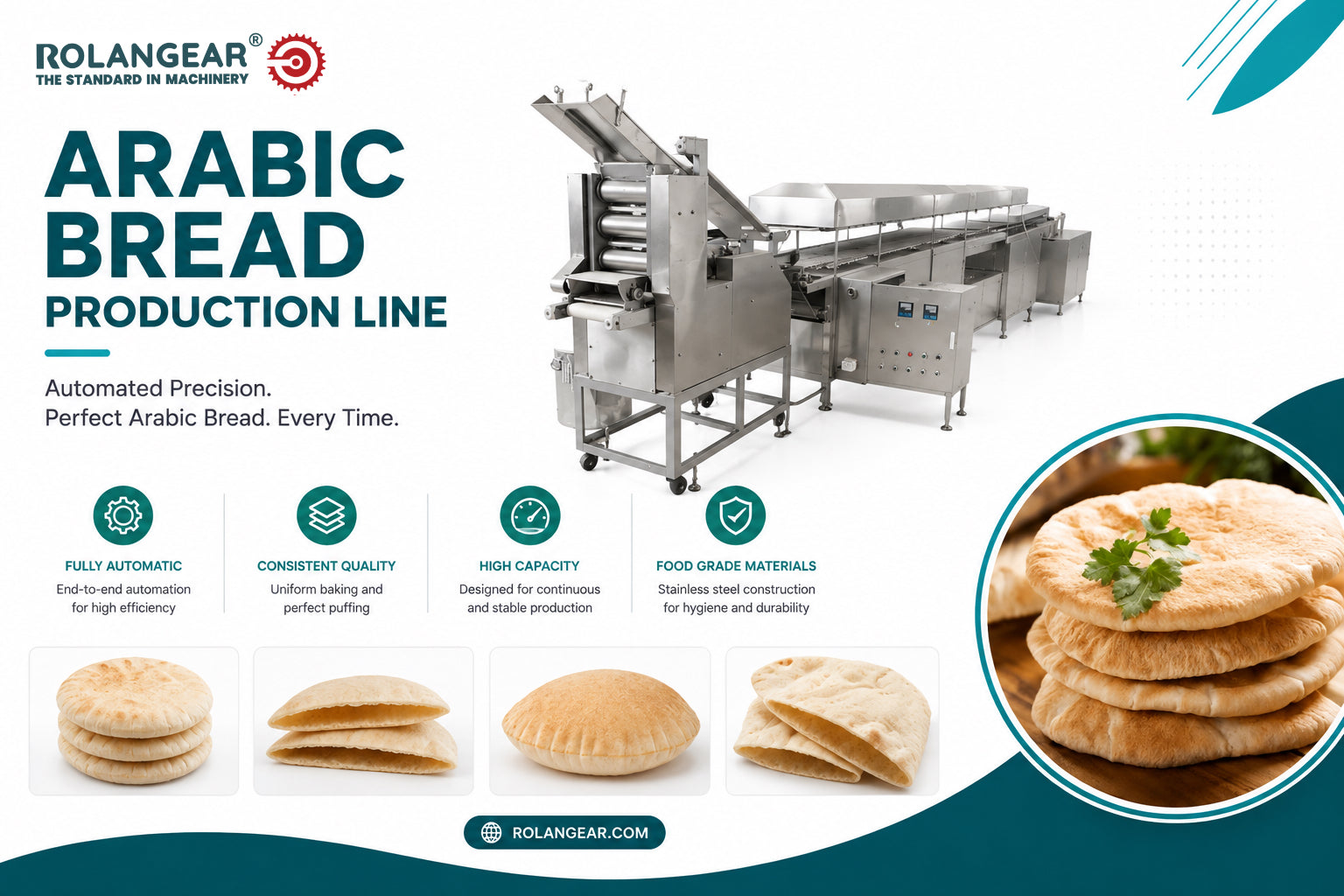
An Arabic pita bread production line is an integrated industrial baking system that combines multiple machines to complete the entire manufacturing process automatically.
The complete production flow usually includes raw material preparation, dough mixing, dividing, rounding, resting, proofing, forming, tunnel oven baking, cooling, counting, and packaging.
Compared with independent machines operating separately, a complete production line provides:

- Better production coordination
- Higher automation level
- Easier operation management
- More stable product quality
- Improved production capacity
For investors, selecting a complete solution instead of purchasing separate machines is usually more effective because the supplier can optimize the entire production process according to factory requirements.
3. Complete Arabic Pita Bread Manufacturing Process
Mixing, dividing, rounding, and resting.
Controlled fermentation, flattening, and diameter adjustment.
Tunnel oven baking, cooling, counting, sealing, and dispatch.

Understanding the production process is essential before selecting equipment. Different manufacturers may require different configurations depending on product specifications, capacity targets, and automation requirements.
3.1 Raw Material Preparation and Weighing
Core ingredients including flour, water, yeast, salt, sugar and vegetable oil are precisely prepared and automatically weighed. Controlled flour protein content, water temperature and yeast activity ensure accurate ingredient ratios, stable dough performance and consistent bread quality.
3.2 Dough Mixing System
Industrial mixers blend all materials with adjustable speed, time, temperature and batch volume. Uniform dough elasticity and stability are achieved to support good fermentation and proper puffing, which forms the unique hollow pocket structure of pita bread.
3.3 Dough Dividing and Portioning
Mixed dough is automatically divided into equal-weight portions. Precise portion control ensures standardized product size, reduces manual errors, stabilizes production speed, and unifies product appearance and packaging specifications.
3.4 Dough Rounding and Intermediate Resting
Dough pieces are rounded into smooth balls for uniform forming. Intermediate resting relaxes gluten, improves dough flexibility, and guarantees consistent thickness, regular shape and stable pocket formation in finished bread.
3.5 Dough Fermentation and Proofing
Climate-controlled proofing chambers regulate temperature, humidity and fermentation time. Standardized fermentation expands dough evenly, enhances flavor, softens texture, and ensures stable puffing performance during baking for mass production.
3.6 Dough Flattening and Forming
Fermented dough is pressed and shaped into round pita sheets with adjustable diameter and thickness. Flexible parameter settings support customized thin pita for wraps and thick pita for traditional use, realizing multi-specification production.
3.7 Tunnel Oven Baking System
As the core equipment, the multi-zone tunnel oven enables continuous automatic baking via precise temperature and conveyor speed control. Even heat distribution generates steam pressure to form the classic pita pocket, delivering golden color, soft texture, stable quality and high energy efficiency.
3.8 Cooling and Product Handling
Baked pita bread is gradually cooled on hygienic conveyors to eliminate residual heat and moisture. This avoids internal condensation, stabilizes texture, prolongs shelf life, and supports subsequent counting, inspection and packaging procedures.
3.9 Automatic Packaging System
The final automatic system completes feeding, counting, bag forming and sealing. It supports two mainstream packaging solutions: retail small printed bags for supermarkets, and bulk carton packaging for catering and wholesale, improving product protection, brand display and logistics efficiency.
4. Main Machines in an Arabic Pita Bread Production Line

A complete industrial pita bread production system consists of several machines working together. The exact configuration depends on production capacity, automation requirements, and product specifications.
4.1 Industrial Dough Mixer
The dough mixer is the foundation of the production line.
Its main functions include:
- Mixing flour and ingredients
- Developing dough structure
- Preparing consistent dough batches
Important selection factors:
- Mixing capacity
- Motor power
- Mixing speed control
- Food-grade construction
For large factories, automatic dough mixing systems can improve production efficiency and reduce operator workload.
4.2 Automatic Dough Divider
The dough divider separates large dough batches into smaller portions.
Its main advantages include:
- Accurate dough weight
- Higher production speed
- Reduced labor requirements
Consistent dough portioning is important because it directly affects:
- Bread size
- Production cost
- Packaging accuracy
4.3 Dough Rounder
The dough rounder creates smooth dough balls before fermentation or forming.
Benefits:
- Improved dough structure
- Better forming performance
- More uniform final products
4.4 Proofing Chamber
The proofing chamber creates controlled fermentation conditions.
Main control factors:
- Temperature
- Humidity
- Time
A stable proofing environment helps manufacturers maintain consistent bread quality throughout long production periods.
4.5 Dough Forming Machine
The forming machine shapes dough into flat pita bread pieces.
Main functions:
- Flattening dough
- Adjusting thickness
- Maintaining diameter consistency
This machine directly influences the appearance and quality of the finished bread.
4.6 Tunnel Oven
The tunnel oven is usually the core section of an industrial pita bread production line.
Key features:
- Continuous baking
- Temperature control
- Multiple heating zones
- Stable output
When selecting an oven, manufacturers should consider:
- Required capacity
- Energy source
- Factory layout
- Product specifications
4.7 Cooling Conveyor
The cooling conveyor connects baking and packaging sections.
Functions:
- Reduce bread temperature
- Maintain product quality
- Prepare products for packaging
4.8 Automatic Packaging Machine
Packaging equipment completes the final production stage.
Depending on requirements, options include:
- Automatic bagging
- Sealing systems
- Counting systems
- Labeling systems
5. Arabic Pita Bread Production Line Capacity Selection
Choosing the correct capacity is one of the most important decisions before investment.
A production line that is too small may limit business growth, while an oversized line may increase unnecessary investment and operating costs.
The right capacity depends on:
- Target market demand
- Sales volume
- Product type
- Working hours
- Future expansion plans
These factories usually require detailed planning, including:

- Factory layout design
- Utility preparation
- Production management systems
6. Arabic Bread Production Line Cost: Complete Investment Guide
One of the most common buyer questions is: How much does an Arabic bread production line cost?

The answer depends on many factors because an industrial pita bread production line is not a single standard machine. It is a complete manufacturing system customized according to production capacity, automation level, product requirements, and factory conditions.
When planning an investment, buyers should evaluate not only the equipment purchase price but also the long-term production value, including operating efficiency, labor savings, product consistency, and future expansion possibilities.
A properly designed production line can help manufacturers achieve stable output and build a competitive advantage in the bakery market.
6.1 How Much Does an Arabic Bread Production Line Cost?
The Arabic bread production line cost is mainly determined by the complete equipment configuration.
A basic production system may include:
- Dough mixing
- Dough dividing
- Dough forming
- Baking
- Cooling
A more advanced automatic production line may include:
- Automatic ingredient handling
- Continuous dough processing
- Controlled fermentation systems
- Automatic packaging
- Inspection systems
- Factory integration solutions
Therefore, two pita bread production lines with similar output capacity may have different investment costs because their configurations are different.
The main factors affecting Arabic bread production line cost include:
- Production capacity
- Automation level
- Machine configuration
- Oven technology
- Packaging requirements
- Factory conditions
- Customization requirements
For accurate investment planning, manufacturers should first define their production goals instead of choosing equipment only based on initial price.
6.2 Main Factors Affecting Arabic Bread Production Line Cost
Production Capacity
Capacity is one of the biggest factors influencing equipment investment.
A higher-capacity production line requires:
- Larger dough processing systems
- Faster forming equipment
- Longer tunnel ovens
- Higher-speed packaging systems
For example, a factory producing for local customers may only require a medium-capacity line, while an export-oriented manufacturer supplying multiple countries may need a larger industrial solution.
Choosing the right capacity helps balance:
- Initial investment
- Production efficiency
- Market demand
- Future growth
A professional supplier should help customers analyze expected sales volume and recommend a suitable production configuration.
Automation Level
Automation level directly affects both equipment cost and production efficiency.
- Semi-Automatic Production Line
A semi-automatic system usually requires more manual operation.
Advantages:
- Lower initial investment
- Suitable for smaller businesses
- Easier operation
However, it may involve:
- More labor requirements
- Lower production consistency
- Higher dependence on skilled workers
- Fully Automatic Production Line
A fully automatic pita bread production line integrates multiple processes into one continuous system.
Advantages:
- Higher production efficiency
- Reduced labor dependency
- More stable product quality
- Better long-term operating performance
Although the initial investment is higher, automatic systems are often more suitable for companies planning large-scale commercial production.
Equipment Configuration
Different factories require different machine combinations.
A basic pita bread production line may focus on core production steps:
- Mixing
- Forming
- Baking
An advanced industrial solution may include:
- Automatic feeding systems
- Fermentation control
- Cooling conveyors
- Automatic packaging
- Quality inspection systems
The final configuration should match the customer's business model.
For example:
A frozen pita bread manufacturer may need additional cooling and packaging solutions, while a fresh bread supplier may focus more on fast production and daily distribution.
- Tunnel Oven Type and Energy System
The oven is one of the most important parts of the production line and has a significant influence on investment.

Different oven options may affect:
- Equipment price
- Energy consumption
- Factory requirements
- Production efficiency
Important considerations include:
- Heating method
- Temperature control accuracy
- Baking speed
- Energy efficiency
A properly selected oven helps maintain:
- Stable bread quality
- Lower energy consumption
- Continuous production performance
- Packaging Requirements
- Packaging systems can also influence total investment.
Different markets require different packaging solutions.
Examples:
Basic Packaging
Suitable for:
- Local distribution
- Wholesale supply
- Automatic Retail Packaging
Suitable for:
- Supermarkets
- Export markets
May include:
- Automatic counting
- Bagging
- Sealing
- Labeling
For companies targeting international markets, an integrated packaging system can improve product presentation and production efficiency.
- Factory Requirements and Supporting Facilities
The production line is only one part of the total factory investment.
Before installation, manufacturers should also consider:
- Workshop preparation
- Electricity supply
- Gas supply (if required)
- Ventilation system
- Storage areas
- Finished product warehouse
Proper factory preparation helps avoid additional costs during installation.
7. Arabic Pita Bread Factory Layout Planning
A successful pita bread factory requires more than purchasing machines. The production environment must be designed according to product flow, hygiene requirements, maintenance needs, and future expansion.
A professional factory layout improves:
- Production efficiency
- Worker movement
- Food safety
- Equipment management
7.1 Recommended Arabic Bread Production Flow
A typical factory layout follows a one-way production direction:
This layout reduces unnecessary movement and helps prevent cross-contamination between different production zones.

7.2 Raw Material Storage Area
The raw material area should be designed for:
- Flour storage
- Ingredient management
- Easy material transportation
Important considerations:
- Dry environment
- Proper ventilation
- Easy cleaning
For large factories, organized storage management helps maintain stable production schedules.
7.3 Production Area Design
The main production area should provide enough space for:
- Machine installation
- Operator movement
- Maintenance access
- Future expansion
Important planning points include:
- Equipment Distance
Machines should have enough space for:
- Operation
- Cleaning
- Inspection
- Repair
- Production Flow
The line should avoid unnecessary back-and-forth movement.
A smooth production flow improves efficiency and reduces management difficulty.
7.4 Packaging and Finished Product Area
The packaging area should be separated from high-temperature production sections.
Benefits:
- Better hygiene control
- Improved working environment
- Easier product management
The finished product warehouse should consider:
- Storage capacity
- Distribution requirements
- Product turnover speed
7.5 Utility Requirements
Before installing an Arabic pita bread production line, factories should prepare suitable utilities.
Common requirements include:
Electricity
Used for:
- Motors
- Control systems
- Conveyors
- Packaging machines
Gas or Heating Supply
- Required for certain tunnel oven systems.
Compressed Air
Used for:
- Pneumatic components
- Automatic control systems
Ventilation
Important for:
- Heat removal
- Worker comfort
- Production environment
A supplier with engineering experience can help customers evaluate these requirements before installation.
8. How to Choose the Right Arabic Bread Production Line Supplier
Choosing the right supplier is just as important as selecting the machines.
A reliable production line supplier should provide more than individual equipment. They should provide a complete manufacturing solution.
8.1 Engineering Experience
A professional supplier should understand:
- Bread production technology
- Equipment integration
- Factory planning
- Production optimization
Different customers have different requirements, so engineering ability is essential for creating suitable solutions.
8.2 Complete Solution Capability
The ideal supplier should support the entire project process:
- Product analysis
- Production line design
- Equipment configuration
- Factory layout planning
- Installation guidance
- Technical support
This reduces communication problems and improves project efficiency.
8.3 Customization Ability
Every factory has different products, space limitations, capacity targets, and investment priorities.
A good supplier should be able to customize according to:
- Production capacity
- Available factory space
- Product specifications
- Market requirements
Customized solutions help customers avoid unnecessary investment.
8.4 After-Sales and Technical Support
- A production line is a long-term investment.
Reliable technical support helps customers:
- Start production smoothly
- Solve operation problems
- Maintain equipment performance
- Improve production efficiency
9. Why Choose Rolangear for Arabic Pita Bread Production Solutions?

As a professional food production solution provider, Rolangear focuses on helping customers build efficient and reliable manufacturing systems.
Instead of providing only individual machines, Rolangear supports customers with complete production solutions, including:
- Customized Production Line Design
Every project begins with understanding customer requirements:
- Target capacity
- Product specifications
- Factory conditions
- Investment plan
Based on these factors, Rolangear helps design a suitable production configuration.
- Complete Equipment Integration
A successful production line requires all machines to work together smoothly.
Rolangear provides integrated solutions covering:
- Dough preparation
- Forming systems
- Baking systems
- Cooling systems
- Packaging solutions
This helps customers achieve a more efficient production process.
- Factory Layout Planning Support
Before installation, proper factory planning is important.
Rolangear can assist customers with:
- Production flow design
- Equipment arrangement
- Space utilization
- Future expansion planning
- Long-Term Technical Cooperation
- Building a food factory is a long-term project.
Rolangear aims to provide continuous support through:
- Technical communication
- Installation assistance
- Production optimization suggestions
The goal is not only to supply equipment but to help customers establish a successful Arabic pita bread manufacturing business.
10. Frequently Asked Questions About Arabic Pita Bread Production Lines
How much does an Arabic bread production line cost?
The cost depends on production capacity, automation level, machine configuration, packaging requirements, and factory conditions. A customized quotation is usually required because every production project has different requirements.
What capacity can an automatic pita bread production line achieve?
The production capacity depends on the machine configuration, bread size, and working conditions. Small, medium, and large industrial solutions can be designed according to market demand.
How much factory space is required for a pita bread production line?
Factory space depends on:
- Production capacity
- Equipment arrangement
- Packaging requirements
- Storage needs
Can one production line make different pita bread sizes?
Yes. Many production lines can be adjusted to produce different diameters and thicknesses according to customer requirements.
How long does it take to install an Arabic bread production line?
Installation time depends on:
- Line complexity
- Factory preparation
- Equipment configuration
- Stable product quality
- Efficient production performance
- Reasonable investment return
- Future expansion possibilities
Plan Your Arabic Pita Bread Production Line with Rolangear
Rolangear can help you evaluate product size, target capacity, automation level, oven configuration, packaging requirements, factory layout, and future expansion needs before equipment selection.
Contact Rolangear for a Customized Solution