Introduction: Choosing the Right Milk Production Strategy
The dairy industry continues to grow as consumers worldwide demand safe, nutritious, and convenient milk products. For investors planning a dairy processing factory, one of the most important decisions is choosing the right milk production system from the beginning.
The choice between a UHT milk production line and a pasteurized milk production line depends on more than equipment selection. It is directly connected with business strategy, target market, distribution method, investment budget, and future expansion plans.
Pasteurized milk and UHT milk serve different market needs, so the best production line depends on how the product will be sold and distributed.

A pasteurized milk production line is commonly selected by businesses focused on fresh milk supply in local or regional markets. It offers lower investment requirements and supports a fresh product positioning, but it also requires reliable cold-chain transportation and faster product turnover.
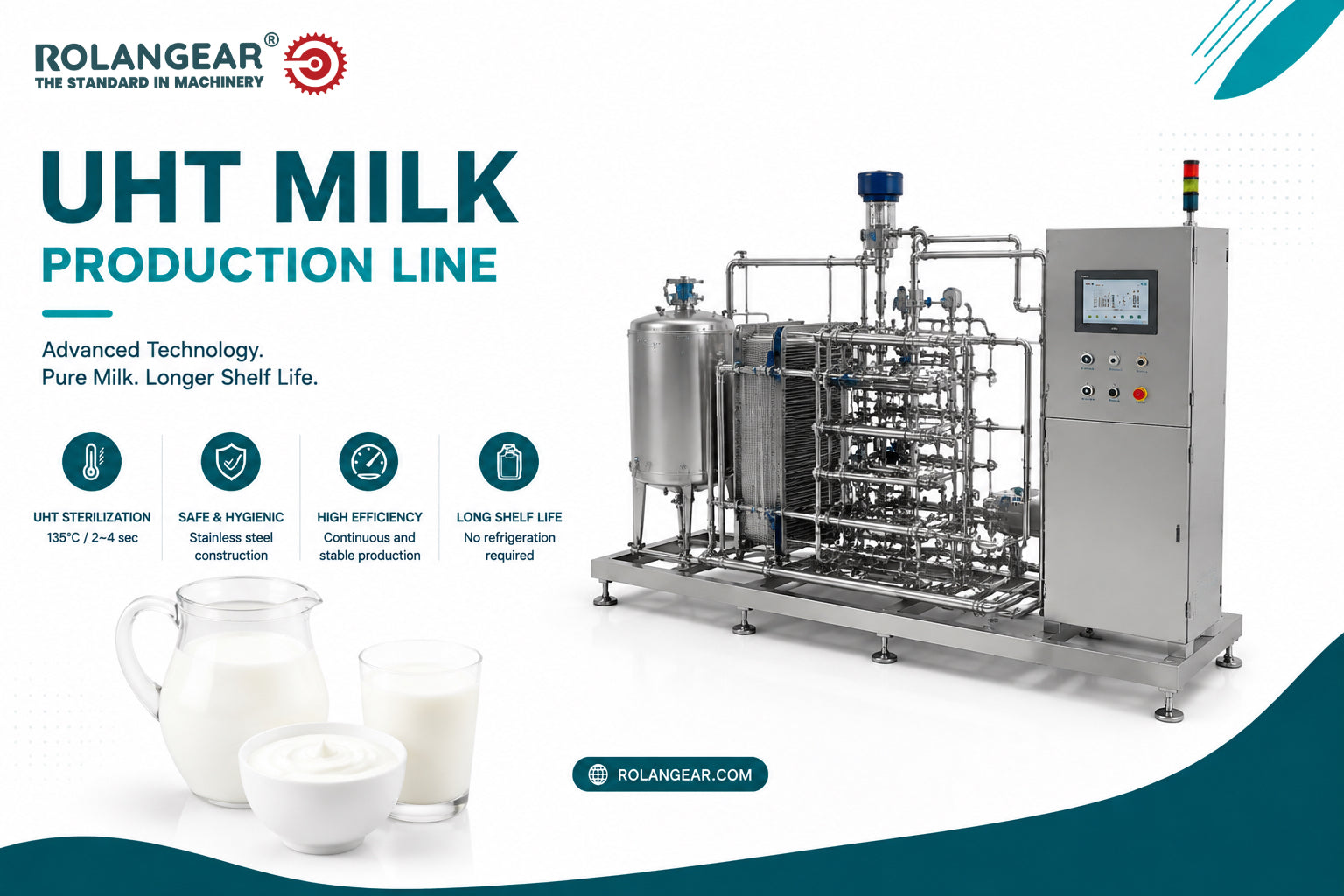
A UHT milk production line is designed for companies that need longer shelf life and wider distribution capability. Although the initial investment is higher, UHT technology can support national distribution, export markets, and large-scale dairy brand development.
For investors, there is no universally better choice. The right solution depends on questions such as:
- Who are your target customers?
- How far will products be distributed?
- What shelf life does the market require?
- What production capacity do you plan to achieve?
- How much investment is suitable for your business stage?
This guide compares UHT milk production lines and pasteurized milk production lines from a practical investment perspective, including equipment differences, cost factors, factory planning, and how to choose the right dairy processing solution.
1. UHT Milk and Pasteurized Milk: Different Business Models

Before comparing equipment and costs, investors should understand that UHT milk and pasteurized milk represent two different dairy business models.
The decision is not only technical. It is about choosing a production model that matches your market opportunity, distribution capability, and brand plan.
1.1 Pasteurized Milk Production: Fresh Market Strategy
Pasteurized milk is mainly positioned as a fresh dairy product. It is commonly supplied to customers who value freshness, local sourcing, and frequent delivery.
This production model is suitable for businesses that operate within a limited distribution area, such as:
- Local dairy brands
- Dairy farms with processing facilities
- Regional supermarket suppliers
- Food service suppliers
The main advantage of pasteurized milk production is its relatively lower investment threshold.
Compared with UHT systems, pasteurized milk lines usually require:
- Lower equipment investment
- Simpler production management
- Easier operation and maintenance
This makes pasteurized milk lines attractive for companies entering the dairy market or businesses that already have a local customer base.
However, pasteurized milk also creates certain business limitations that must be planned carefully.
Because the product has a shorter shelf life, companies need effective:
- Refrigerated storage
- Cold-chain transportation
- Local distribution networks
Therefore, pasteurized milk is usually more suitable for businesses that can control their supply chain within a defined region.
Suitable Business Cases
A pasteurized milk production line may be a good choice for:
- A dairy farm wanting to add value to fresh milk
- A local brand building customer recognition
- A regional supplier serving nearby markets
- A start-up company testing dairy products
For these businesses, controlling product freshness and building direct customer relationships may be more important than long-distance distribution.
1.2 UHT Milk Production: Long Shelf-Life Market Strategy
UHT milk follows a different business model focused on long shelf life and wider market coverage.
Instead of focusing mainly on local fresh supply, UHT production is designed for companies that need broader market coverage and longer product storage capability.
This makes it suitable for:
- National dairy brands
- Export-oriented companies
- Large distributors
- Manufacturers supplying remote markets
The biggest commercial advantage of UHT milk is logistics flexibility.
Because products can have a much longer shelf life, manufacturers can:
- Transport products over longer distances
- Reduce dependence on refrigerated distribution before opening
- Build larger inventory systems
- Access international markets
For businesses planning expansion beyond local markets, UHT technology can create stronger growth opportunities and more flexible distribution options.
However, this advantage requires a higher level of investment and technical planning.
Compared with pasteurized milk production, UHT projects generally involve:
- More advanced equipment
- Higher automation requirements
- More complex packaging solutions
- Greater technical management needs
Therefore, UHT production is usually selected by companies with clear long-term development plans.
Suitable Business Cases
A UHT milk production line is commonly chosen by:
- Established dairy companies
- Export-focused manufacturers
- Companies targeting supermarket chains
- Businesses requiring large distribution networks
For these companies, longer shelf life and wider market reach often justify the higher initial investment.
1.3 Key Differences for Investors
From an investment perspective, the main differences between the two systems can be summarized as follows:
| Factor | Pasteurized Milk Line | UHT Milk Line |
|---|---|---|
| Main market | Local and regional markets | National and international markets |
| Product positioning | Fresh milk | Long shelf-life milk |
| Initial investment | Lower | Higher |
| Distribution | Requires cold chain | More flexible logistics |
| Factory complexity | Moderate | Higher |
| Packaging requirements | Standard packaging | Advanced aseptic packaging |
| Expansion potential | Regional growth | Large-scale market expansion |
The best choice depends on the company’s business goals.
A company focused on fresh local dairy sales may achieve better returns with a pasteurized milk line.
A company planning large-scale distribution or export opportunities may benefit more from a UHT milk production line.
2. UHT Milk Production Line vs Pasteurized Milk Line: Equipment Comparison
Although both systems process fresh milk into commercial products, their equipment configurations are designed for different market requirements.
The key differences are not only in processing equipment, but also in packaging, automation, hygiene control, and factory requirements.

2.1 Core Equipment Configuration
Both UHT and pasteurized milk production lines usually require core dairy processing equipment, including:
- Milk storage tanks
- Processing tanks
- Heat treatment equipment
- Homogenization systems
- Filling equipment
- Cleaning systems
- Control systems
The difference is mainly related to production standards, shelf-life targets, packaging requirements, and final product positioning.
A pasteurized milk line generally focuses on efficient fresh milk production with a simpler configuration.
A UHT milk production line requires more advanced systems to support long shelf-life products and wider commercial distribution.
When selecting equipment, investors should consider:
- Required production capacity
- Product types
- Packaging format
- Automation level
- Future expansion plans
The goal is not to choose the most complex system, but to choose the configuration that best fits the business model.
2.2 Packaging System Differences
Packaging is one of the most important differences between UHT milk production and pasteurized milk production.
For pasteurized milk, packaging mainly focuses on maintaining freshness and supporting refrigerated distribution.
Common packaging options include:
- Plastic bottles
- Milk cartons
- Plastic cups
- Fresh milk containers
The packaging system is usually designed for shorter circulation periods, with products moving quickly from the factory to retailers.

For UHT milk, packaging plays a more critical role because the product must maintain quality during longer storage and transportation periods.
UHT production commonly requires:
- Aseptic filling systems
- High-quality barrier packaging materials
- More controlled packaging environments
This helps products remain stable during transportation and storage without refrigeration before opening.
When selecting packaging equipment, manufacturers should consider:
- Target market requirements
- Package size
- Retail channels
- Production capacity
- Future product expansion
For example, a company supplying local supermarkets may prioritize flexible bottle packaging, while an export-oriented manufacturer may require advanced aseptic packaging solutions.
2.3 Automation and Factory Requirements
Automation level is another important factor when comparing UHT and pasteurized milk production lines.

A pasteurized milk factory can often operate efficiently with a moderate automation level, especially for small and medium capacities.
Typical automation focuses on:
- Equipment coordination
- Temperature monitoring
- Production control
- Basic quality management
This approach helps reduce initial investment while maintaining stable production control.
UHT milk production usually requires a higher automation level because product stability depends on precise equipment coordination and consistent operating conditions.
Advanced systems may include:
- Centralized control systems
- Automated monitoring
- Production data management
- Integrated cleaning systems
For larger dairy companies, higher automation can improve:
- Production consistency
- Labor efficiency
- Quality control
- Long-term operating performance
The correct automation level should be selected according to production scale, labor availability, and business goals rather than simply choosing the highest specification.
3. Which Milk Production Line Is Better for Your Business?
There is no universal answer to whether UHT milk or pasteurized milk production is better.
The right choice depends on market strategy, investment capability, distribution conditions, and long-term business objectives.

3.1 Choose a Pasteurized Milk Line If...
A pasteurized milk production line is usually more suitable for companies focused on fresh dairy products and regional markets.
You may consider pasteurized milk production if:
You Target Local or Regional Customers
If customers are located close to the factory, pasteurized milk can provide a strong competitive advantage through freshness.
Typical markets include:
- Local supermarkets
- Restaurants
- Schools
- Community retailers
You Want a Lower Initial Investment
For businesses entering the dairy industry, controlling investment risk is often a priority.
A pasteurized milk line generally requires:
- Lower equipment investment
- Simpler factory planning
- Easier operation management
This makes pasteurized milk suitable for start-up dairy businesses or companies testing market demand.
You Have Reliable Cold-Chain Distribution
Pasteurized milk requires refrigerated transportation and storage.
Companies with established local logistics networks can manage this requirement effectively.
A strong cold-chain system helps maintain:
- Product quality
- Customer satisfaction
- Market reputation
3.2 Choose a UHT Milk Line If...
A UHT milk production line is more suitable for companies focused on larger markets and long-term expansion.
You may consider UHT production if:
You Plan National or Export Distribution
The biggest advantage of UHT milk is distribution flexibility.
It allows companies to reach:
- Distant regions
- Export markets
- Large retail networks
without depending entirely on refrigerated transportation.
You Need Longer Shelf Life
Longer shelf life provides important commercial benefits, including:
- Easier inventory management
- Reduced product waste
- More flexible transportation schedules
For businesses operating across large geographical areas, this can significantly improve supply-chain efficiency.
You Want to Build a Large Dairy Brand
Companies investing in long-term brand development often choose UHT technology because it supports:
- Wider market coverage
- Large-scale production
- Multiple distribution channels
Although the initial investment is higher, the business potential can be greater when the market strategy supports wider distribution.
4. UHT Milk Production Line vs Pasteurized Milk Line Cost Comparison
One of the most important questions for investors is:
"How much does a UHT milk production line cost compared with a pasteurized milk line?"
The answer depends on many project factors.

There is no fixed price because every dairy factory has different requirements, including:
- Production capacity
- Equipment configuration
- Packaging format
- Automation level
- Factory conditions
- Utility requirements
A professional evaluation should consider the complete project rather than only the equipment purchase price.
4.1 Equipment Investment
The initial equipment investment is usually higher for UHT milk production.
The main reasons include:
- More advanced processing systems
- Higher automation requirements
- More complex packaging solutions
- Additional quality control requirements
A pasteurized milk line generally has a lower entry cost because it focuses on fresh milk production with simpler requirements.
This makes it attractive for:
- Small dairy processors
- Local milk brands
- New market entrants
However, lower initial investment does not always mean lower long-term cost. The best choice depends on expected sales, distribution model, and future growth.
4.2 Factory Setup Cost
Factory requirements also influence total investment.
A pasteurized milk factory mainly needs:
- Processing area
- Refrigerated storage
- Packaging area
- Cold-chain support
A UHT milk factory usually requires more advanced planning, including:
- Higher hygiene standards
- More controlled production environment
- Aseptic packaging area
- More advanced utility systems
For investors planning a new factory, the design should consider both current production needs and future expansion possibilities.
4.3 Operating Cost Considerations
Operating costs should also be evaluated when choosing between the two systems.
Pasteurized milk may have advantages in:
- Lower equipment complexity
- Lower initial operating requirements
However, it requires:
- Continuous refrigeration
- Faster distribution
- Strict inventory management
UHT milk may require higher investment in:
- Equipment operation
- Packaging materials
- Technical management
But it can reduce challenges related to:
- Long-distance transportation
- Product spoilage
- Market distance limitations
The most economical solution depends on the company’s complete business model.
5. Capacity Planning Before Investment
Production capacity is another important factor when selecting between UHT and pasteurized milk production systems.

Investors should evaluate:
- Expected daily sales
- Available milk supply
- Target market size
- Future expansion plans
Choosing a line that is too small may limit business growth, while excessive capacity may create unnecessary investment pressure.
A practical approach is to select equipment that meets current demand while allowing reasonable future expansion.
For example:
- Local dairy businesses may start with smaller pasteurized milk systems
- Growing regional brands may choose medium-scale production
- Export-oriented companies may directly consider larger UHT solutions
The right capacity should support both current operation and future business development.
6. Factory Layout and Planning Considerations for Milk Production Lines
A successful dairy factory requires more than selecting the right equipment. Workshop design, hygiene management, storage conditions, and production organization all influence long-term operating efficiency.
When comparing a UHT milk production line with a pasteurized milk production line, factory requirements are different because each system supports a different product strategy.
6.1 Pasteurized Milk Factory Planning
A pasteurized milk factory is generally designed around fresh product distribution.
Important planning areas include:
- Raw milk receiving area
- Processing workshop
- Packaging section
- Refrigerated storage area
- Finished product dispatch area
Because pasteurized milk depends on cold-chain transportation, sufficient refrigeration capacity is essential.
Factory planning should focus on:
- Efficient product movement
- Easy cleaning and maintenance
- Cold storage management
- Fast delivery preparation
For local and regional dairy businesses, a practical factory layout can help reduce operating costs while maintaining product freshness.
6.2 UHT Milk Factory Planning
A UHT milk factory requires more planning for long-term storage and wider distribution.
Key areas usually include:
- Raw material handling area
- Processing area
- Aseptic packaging section
- Finished product warehouse
- Utility and support areas
Compared with pasteurized milk production, UHT projects often require a higher level of production control and factory management.
A well-designed UHT factory should consider:
- Equipment accessibility
- Hygiene control
- Packaging efficiency
- Future production expansion
For companies targeting export markets, factory planning should also consider logistics requirements and large-volume inventory management.
7. How to Choose the Right Milk Processing Equipment Supplier
Selecting the right equipment supplier is a critical decision because a dairy production line is a long-term investment.

A reliable supplier should provide more than individual machines. They should understand the complete project requirements and provide a suitable production solution.
7.1 Experience in Dairy Processing Projects
Milk processing involves strict requirements for:
- Product safety
- Equipment compatibility
- Production stability
- Factory operation
A supplier with dairy project experience can better understand the differences between UHT and pasteurized milk production requirements.
They should be able to recommend solutions based on:
- Target capacity
- Product type
- Packaging method
- Market requirements
7.2 Customized Production Solutions
Every dairy business has different goals.
A suitable production line should be designed according to:
- Available factory space
- Investment budget
- Expected production volume
- Distribution strategy
- Future expansion plans
A professional supplier should not simply provide a standard equipment list. Instead, they should help customers select the right configuration for their actual business model.
7.3 Complete Project Support
Building a milk processing factory involves many stages, including:
- Equipment selection
- Technical communication
- Factory planning
- Installation guidance
- Operator training
Working with a supplier that provides complete project support helps reduce implementation risks.
This is especially important for first-time investors entering the dairy processing industry.
8. Why Choose Rolangear for Milk Processing Solutions?
Choosing the right partner is as important as choosing the right production technology.
Rolangear provides complete food processing solutions, helping customers design and build practical dairy production systems based on market goals and investment plans.
8.1 Customized Dairy Production Line Design
Different customers require different solutions.
Rolangear focuses on understanding:
- Product requirements
- Production capacity
- Packaging needs
- Factory conditions
- Business development plans
Based on these factors, Rolangear helps customers develop suitable milk processing solutions instead of providing a one-size-fits-all system.
8.2 Complete Equipment Integration
A successful dairy factory requires equipment that works together efficiently.
Rolangear supports customers with integrated solutions covering:
- Milk processing equipment
- Storage systems
- Packaging solutions
- Automation systems
- Supporting equipment
This helps customers simplify project management and improve production reliability.
8.3 Supporting Business Growth
For many customers, a dairy production line is not only an equipment purchase; it is a long-term business investment.
Rolangear helps customers consider:
- Current production needs
- Future expansion possibilities
- Market development plans
The goal is to create a production solution that supports stable and sustainable business growth.
Frequently Asked Questions About UHT Milk Production Lines vs Pasteurized Milk Lines
Which is better, UHT milk or pasteurized milk production?
Neither system is suitable for every business.
Pasteurized milk is often better for local fresh milk markets, while UHT milk is more suitable for companies targeting wider distribution, longer shelf life, and export opportunities.
Is a UHT milk production line more expensive than a pasteurized milk line?
Generally, UHT systems require higher investment because they involve more advanced processing technology, automation, and packaging requirements.
However, final cost depends on capacity, equipment configuration, packaging method, automation level, and factory requirements.
Can one factory produce both UHT and pasteurized milk?
Yes. Some dairy companies design flexible production facilities that can support different milk products.
The suitable configuration depends on product strategy, investment budget, production capacity, and market demand.
Which milk production line is suitable for a small dairy business?
For businesses starting with local or regional sales, a pasteurized milk production line is often a practical choice because of its lower investment and simpler operation.
However, companies with export goals or large-scale distribution plans may consider UHT technology.
What factors affect milk production line cost?
The main factors include:
• Production capacity
• Equipment configuration
• Automation level
• Packaging method
• Factory requirements
• Utility systems
A professional project evaluation is required to determine the most suitable investment plan.
Conclusion: Choosing the Right Milk Production Solution
The decision between a UHT milk production line and a pasteurized milk production line depends on business strategy, not only equipment specifications.
Pasteurized milk production provides an efficient solution for companies focused on fresh products, local markets, and controlled distribution areas.
UHT milk production offers greater market flexibility for companies targeting national sales, export markets, and long-term brand expansion.
Before investing, manufacturers should carefully evaluate:
- Target customers
- Distribution strategy
- Production capacity
- Investment budget
- Future growth plans
Choosing the right production system at the beginning can significantly influence factory efficiency, product competitiveness, and business development.
As a professional food processing solution provider, Rolangear helps customers develop customized dairy production solutions based on market requirements and investment goals.
From equipment selection and production line design to factory planning and technical support, Rolangear provides complete assistance for businesses establishing reliable milk processing operations.
Contact Rolangear to discuss your dairy production project and find the right solution for your market.
Plan Your Dairy Production Line with Rolangear
Rolangear helps customers compare UHT and pasteurized milk production solutions, choose suitable equipment configurations, and plan practical dairy processing projects based on capacity, packaging, factory conditions, and market goals.
Contact Rolangear for a Dairy Line Solution