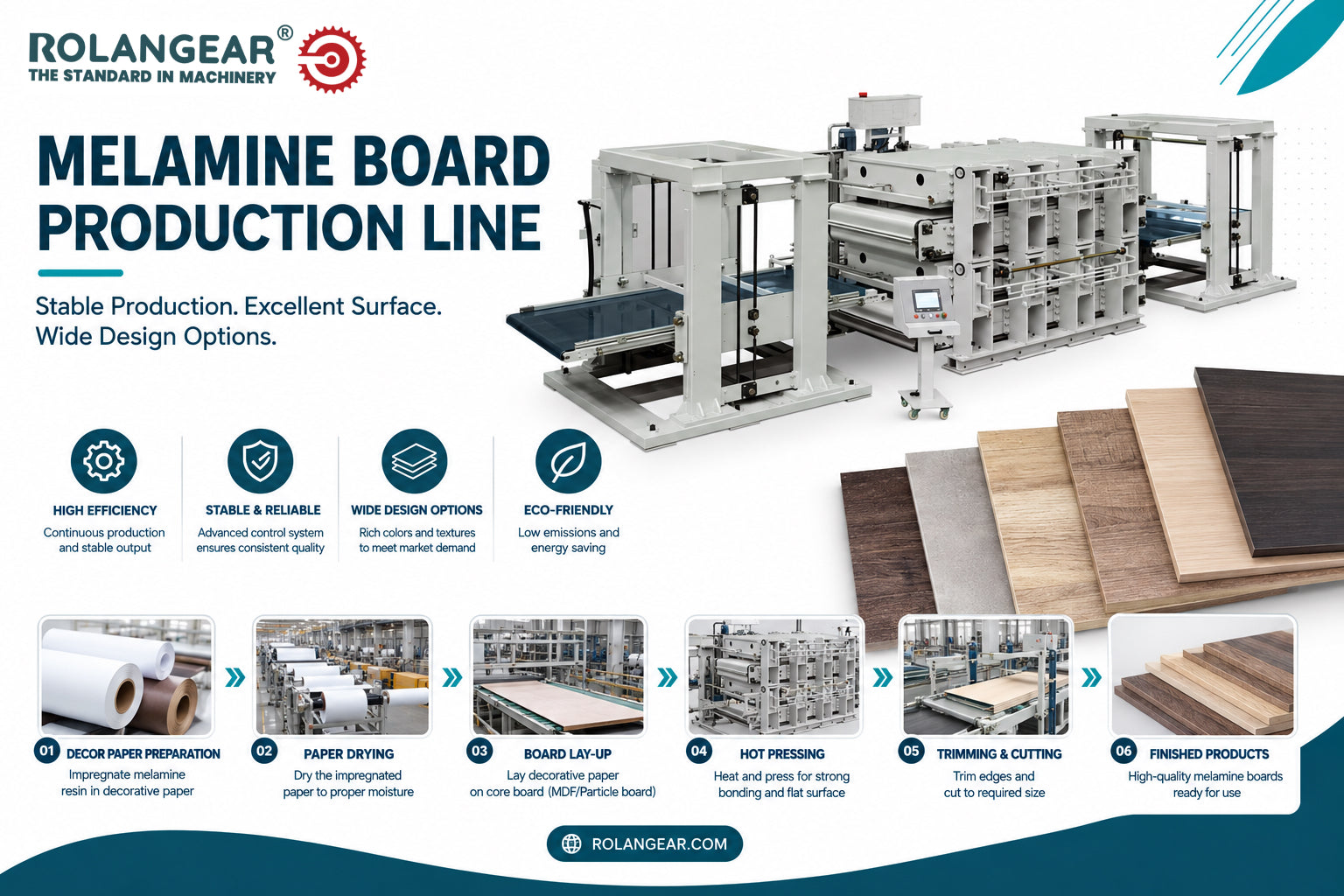
Melamine board is one of the most widely used decorative panel materials in modern furniture, cabinet, wardrobe, interior decoration, and door panel manufacturing. A melamine board production line is designed to combine a selected base board, such as MDF, HDF, particle board, plywood, or moisture-resistant board, with a decorative melamine surface layer through controlled feeding, alignment, pressing, cooling, trimming, inspection, and packaging.

For buyers planning a new furniture board or door panel project, the production line should not be viewed as only a hot press machine. The final board quality depends on the complete system: core board selection, surface paper or decorative layer preparation, temperature and pressure control, surface texture, board thickness accuracy, moisture resistance, cutting precision, and final packaging protection. If one step is unstable, the finished board may show bubbles, warping, poor bonding, uneven thickness, color difference, or edge damage.
This guide explains how a melamine board production line works from raw board selection to finished panel packaging. It also covers main machines, core material options, surface customization, quality control, factory layout, utility requirements, and practical questions to confirm before ordering a complete decorative board production line.
1. What Is a Melamine Board?
A melamine board is a decorative panel made by bonding a melamine-impregnated decorative paper or similar surface layer onto a wood-based or engineered board core. The core provides the panel structure, while the surface layer provides color, pattern, texture, wear resistance, and the final appearance. Depending on the material and process, melamine boards can be produced in wood grain, marble pattern, solid color, matte, glossy, embossed, or other decorative finishes.

In the furniture and door panel industry, melamine boards are valued because they offer stable appearance, a wide range of design options, relatively efficient production, and good suitability for mass manufacturing. A factory can produce panels for cabinets, wardrobes, shelves, office furniture, interior decoration, and flat door panel applications by changing the board core, surface color, texture, thickness, and cutting size.
The production principle is simple, but the engineering details are important. The decorative surface must be aligned accurately with the board core and bonded under controlled temperature, pressure, and pressing time. After pressing, the board must be cooled and stabilized before trimming, sizing, inspection, stacking, and packaging.
2. Common Applications in Furniture and Door Panel Manufacturing
Melamine board is commonly used where a decorative, flat, and easy-to-process panel is required. In furniture factories, it is used for cabinet bodies, cabinet doors, wardrobe panels, drawer panels, shelves, office desks, display furniture, and modular furniture systems. In interior decoration, it may be used for wall panels, partitions, decorative panels, and project-based fit-out work.
 .
.
For door panel manufacturing, melamine board can be used for flat decorative doors, wardrobe sliding doors, cabinet doors, and interior panel components. The exact suitability depends on the core material, panel thickness, screw-holding performance, edge sealing method, and surface requirement. For example, a smooth MDF core may be preferred for decorative furniture doors, while moisture-resistant particle board may be considered for areas where humidity is a concern.
Because application requirements are different, buyers should define the final product before choosing the production line. A cabinet panel factory may need high surface quality and flexible color changeover, while a door panel factory may care more about panel thickness, flatness, strength, and accurate cutting size.
3. Core Materials Used in Melamine Board Production
The core board is the foundation of the finished melamine panel. It affects strength, weight, flatness, moisture resistance, screw-holding ability, edge quality, price, and machining performance. The uploaded board reference shows several possible core materials, including MDF, HDF, fire-retardant MDF, moisture-proof MDF, particle board, moisture-proof particle board, imported particle board, plywood, block board, glossy crystal board, and black board.

MDF is often selected when a smooth surface and good decorative quality are required. It is suitable for furniture panels and some door panel applications, especially when flatness and surface uniformity are important. HDF is denser and may be used where higher density or stronger surface performance is required. Particle board is commonly used in furniture production because it is economical and stable for many panel products. Moisture-proof particle board or moisture-proof MDF may be selected for humid environments, but the final moisture performance must also depend on surface bonding and edge sealing.
Plywood and block board can provide different strength and structural characteristics. Fire-retardant boards may be required for commercial projects or applications where fire performance needs to meet a specific standard. When writing specifications or discussing a new project with a supplier, the buyer should not only say “melamine board.” The correct discussion should include core board type, thickness, density, surface finish, intended application, cutting size, and quality requirements.
| Core Material | Typical Use | Advantages | Points to Confirm |
|---|---|---|---|
| MDF | Cabinet doors, furniture panels, decorative panels | Smooth surface, good for lamination, stable appearance | Moisture resistance, density, thickness tolerance |
| HDF | Higher-density panels and demanding surface applications | Dense structure, good surface strength | Required density and processing method |
| Particle board | Cost-effective furniture and cabinet panels | Economical, stable, widely used | Edge strength, screw holding, moisture grade |
| Moisture-proof board | Kitchen, bathroom, or humid-area furniture | Better humidity resistance than standard board | Actual moisture-resistance grade and edge sealing |
| Plywood / block board | Stronger structural panel applications | Good strength and structural performance | Surface flatness and lamination suitability |
| Fire-retardant board | Commercial or project-based interior use | Improved fire-resistance performance | Required certification or testing standard |
Additional Board Core Options to Confirm
Besides standard MDF, HDF, particle board, plywood, block board, moisture-proof board, and fire-retardant board, buyers may also compare several special board cores according to the final furniture, cabinet, wall panel, or door panel application. These materials can change the board’s strength, weight, moisture performance, fire performance, surface flatness, cost, and processing method.

| Board Type | Common Use | Buyer Notes |
|---|---|---|
| Oriented Strand Board (OSB) | Structural panels, packaging boards, construction-related panels | Confirm surface smoothness and whether it is suitable for decorative lamination. |
| Rubberwood Solid Board | Furniture panels and higher-value solid wood applications | Check wood stability, moisture content, and surface finishing requirements. |
| Carbon Crystal Panel | Decorative interior panels and special surface applications | Confirm actual structure, surface performance, and supplier testing data. |
| Ice-Fire Panel | Decorative panels where special surface or fire-related performance may be required | Confirm the material composition and fire-performance standard before ordering. |
| Marine Plywood | Moisture-demanding applications and stronger plywood-based panels | Confirm glue grade, moisture resistance, and intended environment. |
| General Plywood | Furniture, backing boards, and general panel production | Check surface flatness, veneer quality, and lamination suitability. |
| Film Faced Plywood | Construction formwork and heavy-duty panel use | Normally not a standard decorative furniture core; confirm if it matches the final product. |
| Hollow Particle Board | Lightweight doors and thick panel structures | Confirm screw-holding strength, edge sealing method, and door hardware requirements. |
For a melamine board production line, the safest approach is to confirm the exact board core before finalizing the press size, feeding system, cutting method, and finished panel quality standard. Different cores may require different handling, sanding, pressing, edge trimming, and packaging methods.
4. Decorative Surface and Texture Options
One major advantage of melamine board production is the flexibility of surface design. The reference images show a wide range of colors, wood grain designs, stone-like patterns, dark finishes, light finishes, and textured surfaces. This variety allows factories to serve different furniture styles, interior decoration trends, and project requirements.

Surface design is not only about color. Buyers should also confirm whether the board needs a matte surface, glossy surface, embossed texture, synchronized wood grain effect, marble appearance, solid color, or special decorative pattern. Texture can influence the product’s appearance, touch feeling, cleaning performance, and perceived value.
For a production line, surface diversity also affects operation. Factories that frequently change colors or patterns may need efficient paper handling, accurate alignment, good storage management, and stable changeover procedures. If the surface layer is not aligned correctly before pressing, the final board may have pattern deviation, edge waste, or inconsistent appearance.
5. Complete Melamine Board Production Process
A typical melamine board production process can be described as follows:

5.1 Core Board Preparation
The process begins with selecting the correct core board according to the final product requirement. Operators check board size, thickness, flatness, surface defects, moisture condition, and storage quality. Boards with serious warping, contamination, uneven thickness, or damaged corners may cause pressing defects or final panel quality problems.
In many production lines, the board surface may be cleaned, brushed, or sanded before lamination. Dust and loose particles must be controlled because they can reduce bonding quality and create surface defects after pressing.
5.2 Decorative Paper or Surface Layer Preparation
The decorative surface layer must match the customer order, including color, pattern, texture, surface finish, and quantity. Proper storage is important because decorative paper or surface materials can be affected by humidity, dust, folding, or contamination. The operator prepares the surface layer and positions it correctly before feeding it into the press.
5.3 Feeding and Alignment
Feeding can be manual, semi-automatic, or fully automatic depending on the line configuration. During feeding, the core board and decorative layer must be aligned accurately. Poor alignment can lead to uneven edge margins, exposed core areas, or unnecessary material waste. Automatic feeding systems improve consistency and reduce labor, especially in high-volume production.
5.4 Hot Pressing or Laminating
Hot pressing is the key bonding stage. Heat, pressure, and pressing time activate the surface layer and bond it to the board core. The correct setting depends on board type, surface material, board thickness, press size, and production requirement. If temperature is too low, pressure is unstable, or pressing time is insufficient, bonding strength may be poor. If the process is excessive or uneven, the board may suffer surface marks, deformation, or other quality issues.
A stable press system should provide uniform pressure distribution and accurate temperature control across the working area. For decorative boards used in furniture and door panels, surface appearance is very important, so the pressing surface and operating environment must be kept clean.
5.5 Cooling and Stabilization
After hot pressing, the board needs to cool and stabilize before further processing. If the board is moved, stacked, or cut while still unstable, it may warp, deform, or develop internal stress. Cooling conveyors, stacking intervals, and production speed should match the pressing capacity.
5.6 Trimming and Cutting
After lamination, the board edges are trimmed to remove excess decorative material and create clean panel edges. The board may then be cut to the required size using a panel saw or sizing machine. Cutting accuracy is especially important for furniture and door panel manufacturing because inaccurate panel sizes can cause assembly problems later.
5.7 Inspection, Stacking, and Packaging
Finished boards are inspected for surface defects, color consistency, bonding quality, thickness, flatness, edge condition, and packaging readiness. Good packaging protects the decorative surface from scratches, moisture, corner damage, and transportation impact. For export or long-distance shipment, pallet design, corner protection, protective film, and stacking method should be confirmed.
6. Main Machines in the Production Line
| Machine | Function | Key Selection Points |
|---|---|---|
| Board feeding system | Feeds core boards into the line | Board size range, automation level, alignment accuracy |
| Cleaning or sanding machine | Prepares the board surface before lamination | Dust removal, surface flatness, dust collection system |
| Decorative paper feeding system | Positions melamine paper or decorative layer | Paper handling, alignment, changeover convenience |
| Hot press machine | Bonds decorative layer to board core | Press size, pressure, temperature control, pressing time |
| Cooling conveyor or cooling area | Stabilizes board after pressing | Line speed, cooling time, board handling method |
| Trimming machine | Removes excess surface material from board edges | Cutting accuracy, edge cleanliness, waste removal |
| Panel saw / sizing machine | Cuts board to final dimensions | Cutting precision, capacity, dust extraction |
| Inspection table | Allows operators to check surface and dimensional quality | Lighting, working height, inspection access |
| Stacking system | Collects finished boards safely | Stacking height, surface protection, labor reduction |
| Packaging system | Protects finished boards for storage or delivery | Film, pallet, corner protection, export packing requirement |
7. Important Technical Parameters to Confirm
Before ordering a melamine board production line, buyers should confirm the technical parameters that determine whether the line can meet their product requirements. These include maximum and minimum board size, board thickness range, core material type, decorative layer type, target production capacity, press working size, heating method, required automation level, power supply, factory space, dust collection, labor arrangement, and packaging method.
Exact machine capacity, power consumption, heating system, dimensions, and final configuration should be confirmed according to the manufacturer’s proposal. Buyers should avoid choosing equipment only by price. A lower-cost line may not be suitable if it cannot maintain stable surface quality, accurate thickness, or required output.
8. Quality Control in Melamine Board Manufacturing
Quality control is one of the most important parts of melamine board production. The board must look good, remain flat, maintain consistent thickness, and perform reliably during cutting, edge banding, furniture assembly, or door panel use. The uploaded reference highlights waterproof performance and sufficient thickness, which are two important buyer concerns.

Thickness control should be checked using suitable measuring tools such as calipers or thickness gauges. Uneven thickness can affect furniture assembly, door panel flatness, hinge installation, and final customer satisfaction. Surface quality should be checked under proper lighting to identify scratches, bubbles, stains, color differences, texture inconsistency, press marks, or delamination.
Bonding strength is also essential. Poor bonding may not be visible immediately, but it can cause surface peeling or bubbling later. The factory should also monitor board flatness, edge quality, moisture condition, and packaging damage. A good quality-control system includes incoming core board inspection, process inspection during pressing, final board inspection, and proper finished goods storage.
9. Waterproof and Moisture-Resistant Board Considerations
Many customers ask whether melamine board is waterproof. The careful answer is that moisture performance depends on the core material, surface bonding quality, edge sealing, board grade, and application environment. A melamine surface can provide protection, but exposed edges and unsuitable core material can still absorb moisture if they are not properly sealed.
Moisture-proof MDF or moisture-proof particle board may be selected for kitchens, bathrooms, or humid interior environments. However, buyers should confirm actual moisture-resistance requirements, testing standards, and edge sealing methods. For door and furniture applications, the production line should support stable bonding and clean cutting because poor edges can reduce moisture resistance.
10. Semi-Automatic vs Automatic Melamine Board Production Line
| Line Type | Best For | Advantages | Limitations |
|---|---|---|---|
| Semi-automatic line | Small and medium factories, flexible production | Lower initial investment, easier operation, flexible color changes | More labor required, lower consistency at high output |
| Automatic line | Large-scale furniture or panel factories | Higher efficiency, stable feeding, reduced labor, better repeatability | Higher investment and stronger layout planning required |
| Customized line | Special board size, special surface, or project-based requirements | Designed around exact product and capacity needs | Requires detailed technical confirmation before ordering |
The right choice depends on production volume, labor cost, product variety, quality level, available space, and budget. A small factory producing many custom colors may prefer flexible semi-automatic operation. A large furniture panel producer may prefer automatic feeding, pressing, trimming, stacking, and packaging to improve consistency and reduce labor cost.
Factory Layout and Utility Requirements

A practical factory layout should allow smooth material flow from raw board storage to finished board packaging. The layout normally includes raw board storage, decorative paper storage, surface preparation, feeding area, press area, cooling area, trimming and cutting area, inspection area, stacking area, packaging area, and finished product storage.
Utilities may include electricity, compressed air, heating system, dust collection, ventilation, and suitable lifting or transport equipment. Dust collection is especially important when sanding, trimming, or cutting boards. The factory should also provide safe walking space for operators, maintenance access around major machines, and enough storage area to prevent board damage before and after production.
12. Common Production Problems and Solutions
Common problems in melamine board production include bubbles, poor bonding, surface scratches, board warping, uneven thickness, color difference, edge chipping, paper misalignment, and moisture swelling. Each problem usually comes from a specific process condition.

Bubbles and poor bonding may be related to dust, incorrect temperature, insufficient pressure, short pressing time, or unsuitable material condition. Warping may be related to core board quality, moisture imbalance, pressing stress, or improper cooling and stacking. Surface scratches can happen during feeding, handling, stacking, or packaging. Edge chipping may result from cutting tools, board quality, or incorrect trimming settings.
A professional production line should not only process boards quickly. It should also make defects easier to control by using stable feeding, clean operation, accurate press control, good cooling, precise cutting, proper inspection, and protective packaging.
13. How to Choose the Right Board Production Line
To choose the right melamine board production line, buyers should start from the final product instead of only asking for machine prices. Important information includes board size, thickness, core material, surface design, target capacity, automation level, factory layout, utilities, labor arrangement, and packaging requirement.
If the factory mainly produces cabinet and wardrobe panels, it may need flexible color changeover, clean surface handling, and accurate cutting. If the factory focuses on door panels, it may need stronger attention to board thickness, flatness, large-size handling, and surface consistency. If the factory serves project-based interior decoration, it may need a wider range of core materials and decorative finishes.
Before discussing the project with a supplier, prepare sample board photos, target panel size, thickness range, desired surface styles, production capacity target, factory drawing if available, local power information, and packaging requirement. This allows the supplier to recommend a more accurate line configuration.
14. Frequently Asked Questions
What is a melamine board production line?
It is a production system used to laminate decorative melamine surface material onto a core board, then cool, trim, cut, inspect, stack, and package the finished decorative panels.
What core materials can be used for melamine board?
Common core materials include MDF, HDF, particle board, moisture-proof board, plywood, block board, fire-retardant board, and other engineered boards depending on the application.
Is melamine board waterproof?
Melamine board can have moisture-resistant performance, but full waterproof performance depends on the core board, surface bonding, edge sealing, and application environment. The exact grade should be confirmed before ordering.
Can the surface color and texture be customized?
Yes. Melamine boards can be produced with wood grain, marble pattern, solid color, matte finish, glossy finish, embossed texture, and other decorative effects according to available surface materials.
What machines are included in a typical line?
A typical line may include board feeding, surface cleaning or sanding, decorative paper feeding, hot press, cooling conveyor, trimming machine, sizing machine, inspection table, stacking system, and packaging equipment.
How is board thickness controlled?
Thickness is controlled through core board quality, pressing stability, process settings, and final inspection. Finished boards should be checked with suitable measuring tools according to the required tolerance.
What causes bubbles on melamine board?
Bubbles may be caused by dust, poor board surface condition, incorrect press temperature, insufficient pressure, short pressing time, moisture imbalance, or unsuitable decorative material.
Is an automatic line better than a semi-automatic line?
An automatic line is better for high output and stable mass production, while a semi-automatic line may be more suitable for smaller factories, flexible production, or lower initial investment.
What should I prepare before asking for a quotation?
Prepare board size, thickness, core material, surface style, target capacity, factory layout, automation preference, power information, and packaging requirement.
Can one production line make different board colors?
Yes, but the changeover method and efficiency depend on the feeding system, paper handling method, production planning, and operator process control.
15. Conclusion
A melamine board production line is a complete manufacturing system for producing decorative panels used in furniture, cabinets, wardrobes, interior decoration, and door panel applications. The process includes core board preparation, decorative surface selection, feeding and alignment, hot pressing, cooling, trimming, cutting, inspection, stacking, and packaging.
For successful production, buyers should pay attention to more than the hot press machine. Core material selection, surface design, moisture resistance, thickness accuracy, bonding strength, edge quality, automation level, and factory layout all influence the final board quality. A well-designed production line helps factories produce attractive, stable, and commercially useful panels with consistent quality.
If you are planning a melamine board or decorative door panel production project, prepare your target board size, core material, surface style, required capacity, and factory layout before discussing the production line configuration. Rolangear can help review your production needs and develop a suitable board production line solution based on your product and factory requirements.
Plan a Melamine Board Production Line With Rolangear
Prepare your target board size, core material, surface style, capacity, factory layout, and packaging requirement. Rolangear can help review your production needs and recommend a suitable board production line configuration.
Contact Rolangear