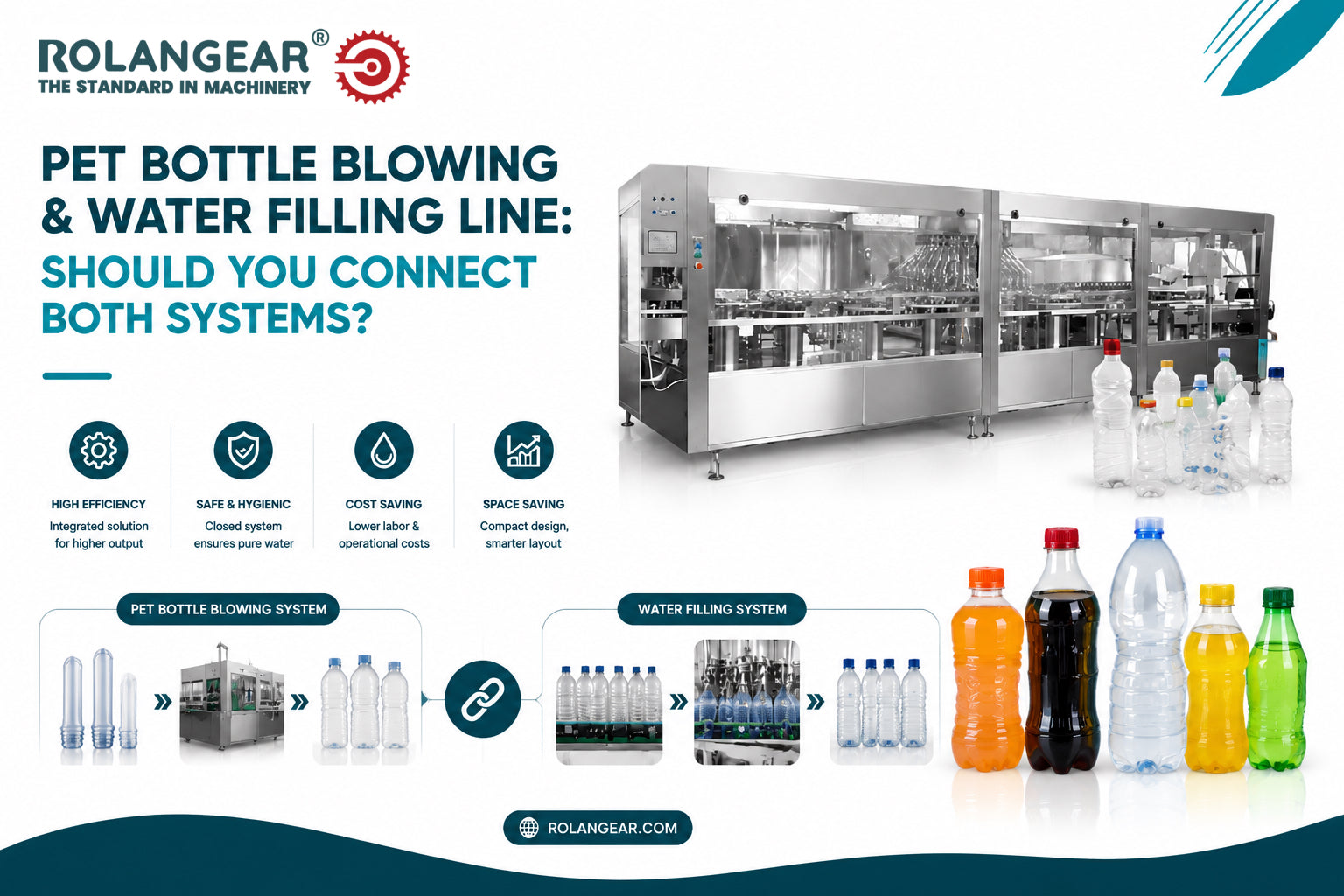

Building a bottled water factory requires more than selecting a water filling machine. Bottle supply, water treatment, filling, capping, labeling, packaging, storage and factory layout all influence production efficiency and long-term operating cost. One of the most important planning decisions is whether to connect the PET bottle blowing system directly with the water filling line or operate the two sections separately.
An integrated PET bottle blowing and water filling line can create a continuous workflow from PET preforms to finished bottled water. This can reduce empty-bottle storage, improve production coordination and give the manufacturer better control over bottle supply. However, separate systems can also be practical for startups, smaller factories or companies that already have reliable bottle suppliers.
What Is a PET Bottle Blowing and Water Filling Line?
A PET bottle blowing and water filling line is a bottled water production system that combines bottle manufacturing and water packaging into one coordinated process. PET preforms are heated and blown into bottles, then transferred to the filling section where treated water is filled, capped, labeled and packaged for distribution.

In a traditional factory, empty bottles may be purchased from an outside supplier or produced in a separate area before filling. This requires bottle transportation, storage and handling before the filling machine can run. In an integrated system, bottle blowing connects more directly with filling, allowing bottles to move through a controlled production flow with less manual movement.
The purpose of integration is not only to make the factory look more advanced. The goal is to reduce bottlenecks, control packaging supply and improve production efficiency. A professional solution should match the customer’s production capacity, bottle size, factory space, automation level and long-term business plan.
Why Water Factories Use PET Bottle Blowing Systems
PET bottles are one of the most important packaging materials in bottled water production. Some factories purchase finished bottles, while others buy PET preforms and blow bottles on site. Producing bottles internally can provide several practical advantages, especially when daily bottle consumption is high.

Better Control Over Bottle Supply
When a factory depends only on external bottle suppliers, production can be affected by delivery schedules, supplier capacity, bottle quality variation and market price changes. Internal bottle blowing gives the factory more control over when bottles are produced and how quickly production can respond to demand.
This control is especially valuable for manufacturers with stable sales, high output or seasonal demand peaks. If the filling line is ready but empty bottles are delayed, the entire production schedule may be affected. Producing bottles from preforms can reduce this risk.
Reduced Bottle Storage and Transportation
Empty PET bottles occupy much more space than PET preforms. A large volume of empty bottles requires warehouse space, internal transportation and careful inventory control. PET preforms are compact and easier to store, so on-site bottle blowing can reduce storage pressure and improve warehouse efficiency.
For factories with limited space, this is a major advantage. Instead of reserving a large area for empty bottles, the factory can store preforms and produce bottles shortly before filling. This supports a cleaner and more efficient production layout.
Packaging Flexibility for Different Markets
Bottled water brands often need different bottle sizes, shapes, weights and label styles. A PET bottle blowing system allows the manufacturer to adjust bottle production according to product strategy, mold design and market needs. This can help brands launch new bottle formats or develop private-label packaging more easily.
How the Water Filling System Works
The water filling system is the core section that turns treated water into finished bottled products. It normally includes water treatment, bottle rinsing, filling, capping, conveying, labeling and packaging. Every section must maintain hygiene and stable operation because bottled water quality depends on both the water and the packaging process.

Water Treatment System
Water treatment prepares raw water before filling. The configuration depends on the source water condition and product requirement. Typical systems may include filtration, activated carbon treatment, reverse osmosis, UV sterilization, ozone treatment or other processes selected according to the project. Stable water quality helps protect taste, safety and consistency.
Filling and Capping Machine
The filling machine transfers treated water into bottles with controlled volume and hygienic operation. For bottled water, many lines use rinsing, filling and capping equipment arranged together for efficient production. Capping must be stable because weak sealing can cause leakage, contamination risk or poor customer experience.
Labeling and Packaging System
After filling and capping, bottles move to labeling and secondary packaging. Labeling improves brand presentation, while shrink wrapping, tray packing or carton packing prepares bottles for transport and storage. A smooth packaging section prevents finished products from accumulating and creating bottlenecks after filling.
Integrated PET Blowing and Filling Line vs Separate Systems
The decision to connect bottle blowing and filling should be based on business needs, not only equipment preference. Both solutions can work well when correctly matched to the factory’s production scale, budget and operating plan.

Option 1: Integrated PET Blowing and Filling Line
An integrated PET blowing and filling line connects bottle production directly with the water filling process. PET preforms are blown into bottles and then transferred through a connected conveyor or air conveyor system to the filling section. This solution is often selected by medium and large bottled water factories.
Main advantages of integration include:
- Continuous production flow from bottle making to filling
- Less empty-bottle storage and internal transportation
- Better control over bottle supply and bottle specifications
- Lower labor dependency in high-volume production
- Improved coordination between packaging and filling
- Stronger long-term value for factories with stable demand
The main consideration is investment. An integrated line usually requires higher initial equipment cost and more careful factory planning. It is most effective when the factory has enough production volume to benefit from the efficiency improvement.
Option 2: Separate PET Blowing and Filling Systems
Separate systems mean bottle blowing and filling operate independently, or the factory purchases ready-made bottles from a supplier. This option may be more practical for startups, smaller bottled water brands or factories that want to enter the market with lower initial investment.
Main advantages of separate systems include:
- Lower entry investment for some startup projects
- Flexible bottle sourcing from outside suppliers
- Independent expansion of filling or bottle production sections
- Simpler initial operation for smaller factories
- Practical choice when bottle suppliers are reliable and nearby
The limitation is that separate systems may require more bottle storage, more handling and greater dependence on external suppliers. As production volume increases, the long-term cost of buying and storing empty bottles may become less attractive.
Key Factors Before Connecting Both Systems
1. Production Capacity
Production capacity is the first factor to evaluate. Small bottled water factories may not need the efficiency benefits of a fully integrated line. Medium factories may begin to benefit from connected blowing and filling because the daily bottle demand becomes more stable. Large factories usually gain the strongest value from integration because bottle consumption is high and production stability is critical.
2. Bottle Demand and Bottle Design
A factory using a large number of bottles every day can often justify internal bottle production more easily. Bottle size, shape, weight and design also affect the decision. If the brand uses customized bottles, frequent bottle changes or private-label packaging, a PET blowing system may provide stronger flexibility.
3. Factory Space
Factory space is a practical issue. Empty bottles occupy large storage areas, while preforms require much less space. An integrated blowing and filling line can reduce bottle storage and internal movement. However, the blowing machine, compressor system, conveyors and filling equipment still need a well-planned layout with enough maintenance space.
4. Investment Budget
Investment planning should consider both initial cost and long-term operating value. A separate filling line may reduce starting pressure, but the factory may continue paying for bottle transportation and storage. An integrated line requires more investment at the beginning but can improve supply control and production efficiency over time.
5. Long-Term Expansion Plan
If the business expects rapid growth, integration may support future expansion better. If the brand is still testing the market, a separate system can keep the project flexible. A good production plan should avoid over-investment while still leaving room for upgrades when demand increases.
Main Equipment in a Complete PET Blowing and Water Filling Line
A complete system includes multiple machines working together. The final equipment list depends on capacity, bottle specifications, water treatment requirements and packaging format.

- PET preform storage and feeding: supplies preforms to the blowing section.
- Preform heating system: heats preforms before stretching and blowing.
- PET bottle blowing machine: converts preforms into finished bottles using molds and compressed air.
- Air conveyor or bottle conveyor: transfers bottles from blowing to filling with stable movement.
- Water treatment system: prepares clean and stable water before filling.
- Rinsing, filling and capping machine: completes the main bottled water packaging process.
- Cap feeding system: supplies caps to the capping unit efficiently.
- Labeling machine: applies sleeve, adhesive or other labels according to bottle design.
- Shrink wrapping or carton packing machine: prepares bottles for transportation and retail distribution.
- Inspection and coding equipment: supports quality checks, date coding and packaging control where required.
Equipment should be selected as one coordinated line. If the blowing machine output does not match the filling machine, the factory may experience bottle shortage or accumulation. If packaging speed is too low, finished bottles may build up after filling. Balance between each section is essential.
Compressed air planning is also important for PET bottle blowing. The blowing section normally requires stable high-pressure air, while other machines may require lower-pressure compressed air for control and movement. Air system planning, cooling, power supply and maintenance access should be discussed before installation so the complete line can run reliably during long production periods.
Cost, Layout and ROI Planning
The cost of a PET bottle blowing and water filling line depends on production capacity, bottle size, bottle design, automation level, water treatment configuration, packaging method, factory layout and future expansion requirements. A small line and a high-speed integrated system require very different investment structures.

Factory layout should support smooth movement from preform storage to bottle blowing, water treatment, filling, labeling, packaging and finished goods storage. Good layout reduces unnecessary handling, improves hygiene management and makes maintenance easier. Enough space should be reserved around blowing machines, compressors, filling machines and packaging equipment for inspection and service.
Return on investment should be evaluated as a long-term manufacturing project. Integration can reduce empty-bottle transportation, lower storage requirements, improve production coordination and reduce labor. However, the benefit depends on stable market demand and sufficient production volume. Smaller factories may prefer lower initial investment until sales are proven.
A practical ROI review should include preform cost, bottle transportation cost, warehouse space, labor arrangement, energy consumption, compressed air demand, maintenance cost and expected sales growth. This gives the investor a clearer picture of the true operating value instead of comparing only the purchase price of separate machines.
Quality Control, Cleaning and Maintenance
Quality control should cover the full production process, from preform quality and bottle appearance to water treatment, filling level, cap sealing, label position and secondary packaging. Bottle defects can affect filling performance, while poor filling or capping can affect product safety and customer satisfaction.

Cleaning and hygiene are important because bottled water products must maintain safe and consistent quality. Water treatment equipment, filling valves, caps, conveyors and the filling environment should be managed according to suitable hygiene procedures. Proper zoning between bottle blowing, filling and packaging areas helps support cleaner operation.
Preventive maintenance reduces downtime and protects production stability. Blowing molds, heating lamps, compressed air systems, filling valves, capping heads, sensors, conveyors and packaging machines should be inspected regularly. Spare parts planning is important for factories with continuous orders because one small component can stop the entire line.
Why Choose Rolangear?
Rolangear provides customized PET bottle blowing and water filling line solutions for bottled water manufacturers planning new factories or upgrading existing facilities. Instead of focusing only on individual machines, Rolangear helps customers plan a complete production system from PET preforms to finished packaged bottled water.
A Rolangear project can include production line design, equipment configuration, factory layout planning, water treatment matching, installation support, commissioning assistance and operator guidance. The solution can be designed according to production capacity, bottle size, automation level, packaging method, investment plan and future expansion goals.
Frequently Asked Questions
What is a PET bottle blowing and water filling line?
It is a production system that combines PET bottle manufacturing with bottled water filling, capping, labeling and packaging. In an integrated line, bottles are blown from preforms and transferred directly to the filling section.
Should PET bottle blowing and water filling machines be connected?
They should be connected when the factory has medium or large production demand, stable sales, limited empty-bottle storage space or a long-term need for better bottle supply control. Smaller factories may choose separate systems first.
What are the advantages of an integrated line?
Advantages include reduced bottle storage, less internal transportation, better bottle supply control, lower labor dependency, improved production flow and stronger long-term efficiency for high-volume bottled water factories.
Is a combined line suitable for small water factories?
It depends on budget, production volume and business goals. Small factories may prefer separate systems to reduce initial investment, while growing factories may plan integration as a future upgrade.
How much does a PET blowing and filling line cost?
Cost depends on capacity, bottle size, automation level, water treatment configuration, packaging system and factory requirements. A customized project evaluation is required for accurate pricing.
Can Rolangear design a complete bottled water factory?
Yes. Rolangear can help plan PET bottle blowing, water treatment, filling, labeling, packaging, factory layout and technical support as a complete bottled water production solution.
Conclusion
The decision to connect PET bottle blowing and water filling systems affects production efficiency, factory layout, operating cost and long-term growth. An integrated line can be highly valuable for manufacturers with stable output, high bottle demand and a need for stronger packaging control. Separate systems can still be practical for startups, smaller factories or projects with reliable bottle suppliers.
The best solution is not simply the most advanced system. It is the configuration that matches production capacity, bottle requirements, investment budget, factory space and market plan. By evaluating the full production process before purchasing equipment, bottled water manufacturers can build a more efficient and reliable factory.
For most investors, the safest approach is to compare both short-term startup pressure and long-term manufacturing value. A well-matched line should help the factory produce stable bottled water today while leaving enough flexibility for new bottle sizes, higher output and future packaging upgrades.
Plan Your PET Bottle Blowing and Water Filling Line with Rolangear
Rolangear can help you design a practical PET bottle blowing and water filling line based on your bottle size, target capacity, water treatment needs, factory layout and packaging format. Contact Rolangear to discuss your bottled water project and request a customized turnkey quotation.
Contact Rolangear