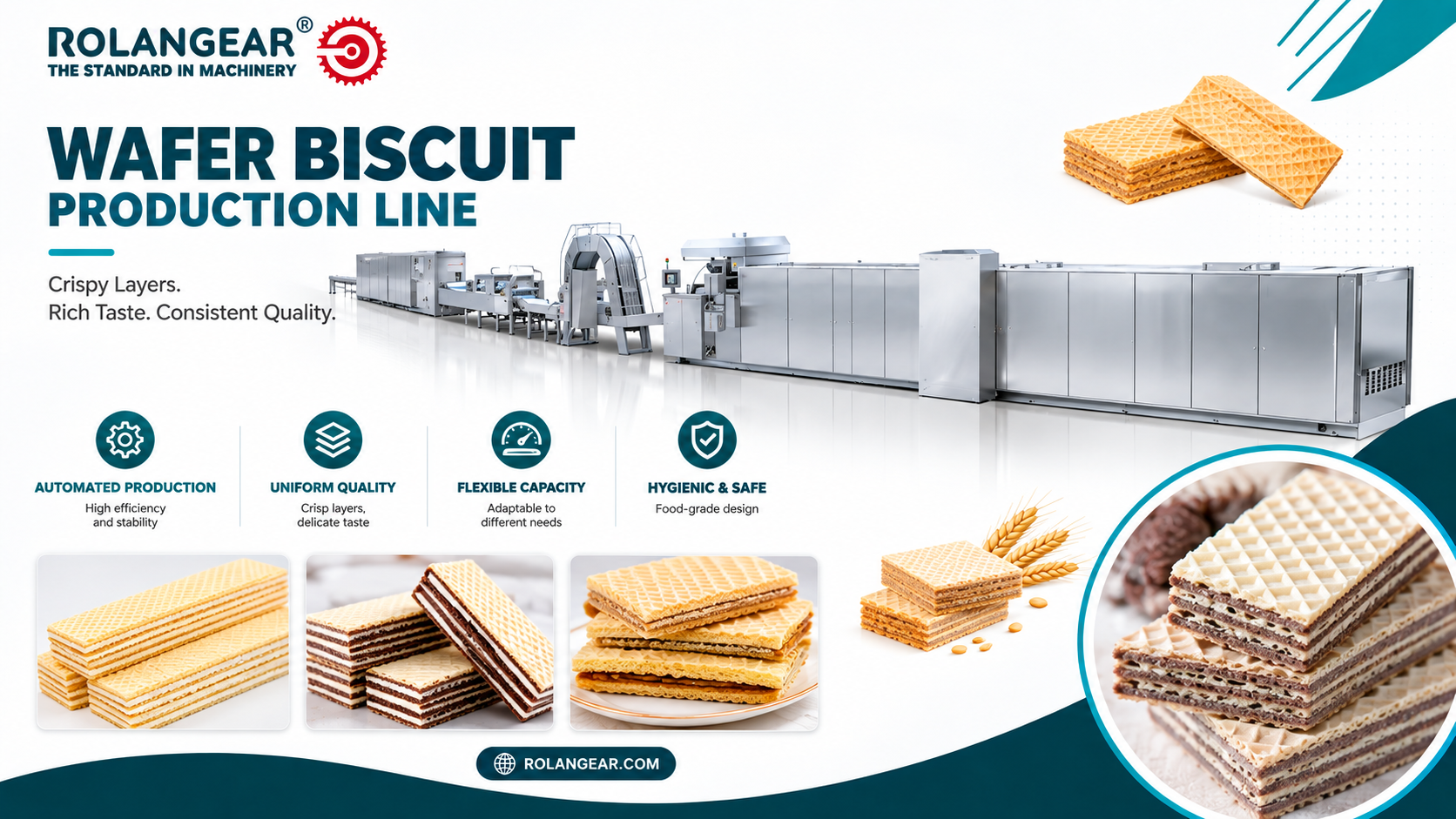
Wafer biscuits are popular worldwide because they are light, crisp, flavorful and easy to package for many retail channels. From classic vanilla and chocolate cream wafers to hazelnut, fruit, matcha, mini snack packs and protein wafer products, manufacturers can build strong product lines for supermarkets, convenience stores, private-label customers and export markets.

As demand grows, factories need production systems that can deliver consistent quality at commercial speed. Manual wafer production is difficult to control because batter thickness, baking conditions, cream spreading, stacking, cooling, cutting and packaging must all work together. An automatic wafer biscuit production line connects these stages into one coordinated process, helping manufacturers improve efficiency, reduce labor dependency and maintain stable product quality.
In this guide:
1. Why manufacturers invest in wafer automation
2. What a wafer biscuit production line includes
3. Complete wafer biscuit manufacturing process
4. Main machines and cost factors
5. Capacity selection and factory layout
6. ROI, quality control and maintenance
7. How to choose the right supplier
8. FAQ
Why Invest in an Automatic Wafer Biscuit Production Line?
The global biscuit market continues to expand as consumers look for convenient snacks, affordable treats and new flavor experiences. Wafer biscuits are especially attractive for manufacturers because they can be produced in many sizes, layers, fillings and packaging formats. However, market opportunity also brings pressure: retailers expect stable supply, private-label customers require consistent specifications, and consumers expect every pack to look and taste the same.

Automation helps factories meet these expectations. A modern wafer biscuit production line reduces manual transfer between machines and keeps product movement continuous from batter preparation to final packaging. This improves line efficiency and reduces the risk of product damage, inconsistent cream application or packaging delays.
Key benefits of automatic wafer production:
- Higher production output with smoother workflow
- More consistent wafer thickness, color, crispness and size
- Accurate cream spreading and stable product weight
- Reduced labor requirements and fewer repetitive manual tasks
- Lower ingredient waste through controlled dosing and cutting
- Better hygiene because product contact is reduced
- Stronger flexibility for new flavors, private-label orders and seasonal products
Automation is useful for both growing factories and large industrial producers. Smaller manufacturers may begin with a semi-automatic line to control investment, while larger companies often require fully automatic systems for continuous, multi-shift production. The right choice depends on capacity target, available space, labor cost and product strategy.
What Is a Wafer Biscuit Production Line?
A wafer biscuit production line is an integrated manufacturing system that produces cream-filled wafer biscuits through continuous processing. Instead of using separate standalone machines, the line synchronizes batter mixing, wafer baking, cooling, cream preparation, cream spreading, layer stacking, block cooling, cutting and packaging.

The line can be configured for different automation levels. A compact line may use automatic baking and cutting with some manual transfer or packaging. A high-output industrial line may include automatic ingredient feeding, long baking ovens, continuous cooling conveyors, precision cream spreading, automatic stacking, high-speed cutting, flow wrapping, cartoning, metal detection, checkweighing and case packing.
The most important point is synchronization. If baking output is higher than cooling or packaging capacity, bottlenecks will appear. If cream spreading is not stable, product weight and appearance will vary. A well-designed wafer line balances each section so the factory can produce continuously with fewer interruptions.
Types of Wafer Biscuit Products
One advantage of wafer manufacturing is product flexibility. By adjusting recipes, cream flavors, layer structure, cutting dimensions and packaging formats, one production system can support many product categories. This flexibility is important for brands serving different market segments or OEM customers.

Common wafer product options:
- Classic cream wafer biscuits with vanilla, chocolate or strawberry filling
- Premium hazelnut, coffee, pistachio, caramel or matcha wafers
- Mini wafer snacks for lunchboxes and convenience stores
- Rectangular wafer bars or square wafer biscuits
- Reduced-sugar or sugar-free wafer products
- Protein wafers and functional snack formats
- Private-label wafers with customized size, flavor and packaging
Product variety should be considered before buying equipment. Multiple cream flavors may require additional cream mixers, storage tanks or flavor dosing systems. Different product sizes may require adjustable cutting equipment and flexible packaging machines. Planning these needs early helps avoid costly modifications later.
Complete Wafer Biscuit Manufacturing Process
1. Batter Preparation
The process begins with wafer batter preparation. Unlike many traditional biscuits, wafer batter is relatively fluid so it can spread evenly across the baking plates. Typical ingredients may include wheat flour, water, vegetable oil, sugar, lecithin, salt, baking agents and flavorings. Depending on the recipe, manufacturers may also add cocoa powder, milk powder, whole grain flour or functional ingredients.
Automatic batter mixers combine ingredients into a uniform mixture while controlling viscosity and reducing variation between batches. Stable batter is essential because it affects sheet thickness, baking color, crispness and breakage rate. After mixing, the batter is transferred to a storage tank with gentle agitation before being supplied continuously to the wafer oven.
2. Wafer Sheet Baking
Baking is the core stage of wafer biscuit manufacturing. The oven deposits batter onto heated baking plates, closes the plates and bakes the batter into thin wafer sheets. During baking, moisture is removed and the wafer develops its crisp texture, structure and color.
Important baking parameters include oven temperature, baking time, plate pressure, batter quantity and conveyor speed. These factors influence wafer thickness, color, moisture content, surface quality and crispness. A professional oven should maintain stable heating conditions during long production runs and match the factory’s required output.
3. Wafer Sheet Cooling
Freshly baked wafer sheets leave the oven hot and fragile. They must cool before cream filling because hot sheets can soften the cream, create uneven spreading or cause deformation. Automatic cooling conveyors allow sheets to stabilize gradually before entering the filling section.
Effective cooling improves sheet strength, dimensional stability, cream adhesion and finished product appearance. Cooling design should match oven output and factory conditions. In warm or humid environments, air management may be especially important to maintain crisp texture and reduce quality problems.
4. Cream Preparation
Cream filling is a major part of wafer biscuit taste and product identity. Common fillings include chocolate, vanilla, hazelnut, strawberry, lemon, coffee, caramel, pistachio and customized flavors. The cream must have the correct viscosity for smooth spreading and stable bonding between wafer layers.
Automatic cream preparation systems mix ingredients uniformly and may include heating, temperature control and storage tanks. Accurate cream preparation reduces flavor variation and helps the spreading machine apply filling consistently. Factories producing many flavors should consider whether multiple mixers or quick-cleaning systems are needed.
5. Cream Spreading and Layer Stacking
After wafer sheets and cream are ready, the cream spreading machine applies a controlled layer of filling onto each sheet. Uniform cream distribution affects taste, product weight, layer adhesion, appearance and production cost. Too much cream increases ingredient cost and may create messy cutting; too little cream reduces product quality and customer satisfaction.
The stacking system aligns sheets into multi-layer wafer blocks. Depending on the design, manufacturers may produce three-layer, five-layer, seven-layer or customized products. Gentle compression helps the cream bond with the wafer sheets and prepares the block for cooling and cutting.
6. Block Cooling and Cutting
After stacking, wafer blocks must cool again so the cream becomes stable enough for cutting. Proper block cooling improves cutting accuracy, reduces cream displacement, supports clean edges and maintains finished product appearance. Cooling time depends on the cream formulation, product thickness, ambient conditions and line speed.
Automatic cutting machines divide the wafer block into individual biscuits, bars, squares or mini snacks. Accurate cutting is essential because product dimensions must match the packaging machine. Flexible cutting systems allow manufacturers to adjust product size by changing blade settings or tooling, supporting different retail formats without replacing the whole line.
7. Packaging, Coding and Inspection
Packaging protects wafer biscuits from moisture, contamination and handling damage while creating an attractive retail presentation. Flow wrapping is commonly used for individual wafer biscuits and bars because it is fast and suitable for many product sizes. After wrapping, products may be grouped into cartons, multipacks or shipping cases.
A complete packaging section may include automatic feeding, flow wrapping, date coding, metal detection, checkweighing, cartoning, case packing and palletizing. Coding systems print production date, expiration date, batch number or traceability information. Inspection equipment helps protect food safety and reduce the risk of defective products reaching customers.
Main Machines in a Wafer Biscuit Production Line

A complete wafer biscuit production line is built from several machines that must work together. The final equipment list depends on capacity, product type and automation level, but the core machines are usually similar across most projects.
Core equipment functions:
- Batter mixer: prepares uniform wafer batter with stable viscosity.
- Batter storage tank: keeps batter ready for continuous feeding to the oven.
- Wafer baking oven: bakes batter into thin, crisp wafer sheets.
- Sheet cooling conveyor: cools baked sheets before cream filling.
- Cream mixer: prepares smooth filling with consistent texture.
- Cream spreading machine: applies a controlled cream layer to wafer sheets.
- Stacking and compression system: forms multi-layer wafer blocks.
- Block cooling conveyor: stabilizes cream-filled blocks before cutting.
- Cutting machine: cuts blocks into finished wafer sizes.
- Packaging line: wraps, codes, inspects, cartons and prepares products for shipment.
Optional systems may include automatic ingredient feeding, multiple cream flavor stations, quick-change cutting tools, metal detectors, checkweighers, robotic loading, case packing and palletizing. These options should be selected according to production needs, not added only to make the line look more advanced.
What Affects Wafer Biscuit Production Line Cost?
Wafer biscuit production line cost varies because every project has different requirements. A small semi-automatic line for local production will not have the same investment level as a fully automatic industrial line with high-speed packaging and export-oriented quality control. Understanding the main cost factors helps manufacturers compare quotations more accurately.

Major cost factors include:
- Target capacity per hour, shift or year
- Baking oven width, number of plates and heating method
- Automation level from semi-automatic to fully automatic
- Cream preparation capacity and number of flavors
- Product size range, layer structure and cutting flexibility
- Packaging format, wrapping speed and end-of-line automation
- Food safety, hygiene and inspection requirements
- Factory layout, utilities and installation conditions
- Spare parts, service support and future expansion needs
The cheapest offer is not always the best investment. Low-cost equipment may create higher long-term costs if it has unstable baking, poor cream control, frequent downtime, difficult cleaning or weak after-sales support. A practical quotation should match the customer’s product plan, capacity target and factory conditions.
Capacity Selection Guide
Selecting the right capacity is one of the most important decisions in a wafer project. If the line is too small, the factory may soon face bottlenecks and need another investment. If the line is too large, the customer may pay for capacity that is not fully used. The best choice should match current demand while leaving reasonable room for future growth.

Typical capacity planning options:
- Small factory: suitable for startups, local bakeries, regional snack brands and product development.
- Medium factory: suitable for supermarket supply, distributors, regional brands and private-label production.
- Industrial factory: suitable for national brands, exporters, contract manufacturers and multi-shift production.
- OEM/private-label factory: needs strong flexibility for different flavors, sizes and packaging formats.
- Export-oriented factory: should consider electrical standards, documentation, traceability, packaging requirements and local regulations.
Before confirming capacity, manufacturers should estimate expected sales volume, number of SKUs, working hours per day, seasonal demand, packaging speed and future expansion plans. These details allow the supplier to recommend a line that avoids bottlenecks between baking, cooling, cutting and packaging.
Factory Layout and Utility Planning
A good factory layout improves production efficiency, hygiene and maintenance access. The line should support logical material flow from raw material storage to batter preparation, baking, cooling, filling, cutting, packaging and finished goods storage. Operators should have enough space for inspection, cleaning, tooling changes and safe movement around machines.

Utility planning is also important. Wafer production may require electricity, compressed air, gas or electric heating, ventilation, water and drainage depending on the equipment configuration. Packaging machines may need stable compressed air and adequate space for film rolls, cartons and finished product handling. Planning utilities before installation reduces delays and makes commissioning easier.
ROI, Quality Control and Maintenance
When evaluating wafer biscuit production line cost, manufacturers should consider long-term return on investment rather than only the purchase price. Automation can reduce labor costs, increase output, lower material waste, improve quality consistency and support faster order fulfillment. These benefits can improve profitability over the equipment’s service life.
Quality control should be built into the full process. Key points include batter viscosity, baking color, sheet moisture, cream weight, layer alignment, cooling stability, cutting accuracy, wrapper sealing, coding accuracy and metal detection. If one section is unstable, problems may appear later in packaging or shelf life.
Maintenance planning protects the investment. Operators should regularly check baking plates, chains, conveyors, cream spreaders, cutting blades, sensors, motors and packaging sealing parts. Preventive maintenance reduces downtime and helps the line maintain stable performance during long production runs.
How to Choose the Right Wafer Biscuit Production Line Supplier
A reliable supplier should understand the complete wafer manufacturing process, not only individual machines. The supplier should help confirm product type, capacity, recipe requirements, cream system, cutting size, packaging format, factory space, utilities and future expansion. Good engineering support reduces project risk and helps the factory start production smoothly.

Questions to answer before requesting a quotation:
- What wafer products, sizes and flavors will be produced first?
- What is the target output per hour or per shift?
- Will the factory produce one flavor or multiple cream flavors?
- What packaging format is required for retail and distribution?
- How much factory space is available for the line?
- What level of automation matches the budget and labor situation?
- Are inspection, metal detection, cartoning or case packing required?
- Is future capacity expansion planned?
The most suitable production line should balance investment, efficiency, flexibility and long-term reliability. It should also be easy for operators to run, clean and maintain. A strong supplier provides clear communication, layout planning, installation guidance, commissioning, training and after-sales service.
Why Choose Rolangear?
Rolangear provides professional wafer biscuit production line solutions for customers building new factories, expanding production capacity or upgrading older equipment. Our team can support equipment configuration, process design, factory layout planning, installation guidance, commissioning, operator training and long-term technical service.
Every wafer project has different requirements, so Rolangear designs solutions according to product type, capacity target, factory space, packaging method and investment plan. Whether you need a compact semi-automatic wafer line or a fully integrated industrial wafer biscuit manufacturing system, Rolangear can help you build a practical, efficient and scalable production solution.
Frequently Asked Questions
What is a wafer biscuit production line?
It is an integrated system that produces wafer biscuits through batter preparation, baking, cooling, cream filling, stacking, block cooling, cutting and packaging. It improves efficiency, consistency and hygiene compared with manual production.
How much does a wafer biscuit production line cost?
The cost depends on capacity, oven configuration, automation level, cream system, product variety, packaging automation, hygiene requirements and factory layout. A customized quotation should be prepared according to the customer’s production plan.
Can one line produce different wafer sizes and flavors?
Yes. With adjustable cutting systems, recipe changes and suitable cream preparation equipment, one line can produce different sizes, layers and flavors. Multiple-flavor production may require additional cream mixers or tanks.
What packaging is used for wafer biscuits?
Flow wrapping is commonly used for individual wafer biscuits and bars. Depending on market requirements, the line may also include cartoning, multipack grouping, case packing, coding, checkweighing and metal detection.
What information is needed before buying a wafer production line?
Manufacturers should prepare product size, target capacity, number of flavors, packaging format, factory dimensions, utility conditions, automation preference and future expansion plans before requesting a quotation.
Does Rolangear provide turnkey wafer biscuit solutions?
Yes. Rolangear can provide customized wafer biscuit production line solutions, including equipment selection, layout planning, installation guidance, commissioning, training and after-sales support.
Conclusion
A modern wafer biscuit production line helps manufacturers produce crisp, attractive and consistent wafer products with higher efficiency and better cost control. From batter preparation and baking to cream filling, cutting and packaging, every stage must be designed as part of one complete workflow.
When reviewing wafer biscuit production line cost, manufacturers should look beyond the initial equipment price and consider capacity, automation, product flexibility, layout, hygiene, maintenance and after-sales service. Rolangear supports customers with customized wafer biscuit manufacturing solutions designed around real production goals. Contact Rolangear to discuss your project and request a tailored turnkey quotation for your wafer biscuit factory.
Plan Your Wafer Biscuit Production Line with Rolangear
Rolangear can help you design a practical wafer biscuit production solution based on your product type, factory space, target capacity, packaging format and automation requirements. Contact Rolangear to discuss your project and request a customized turnkey quotation.
Contact Rolangear