Choosing a liquid filling machine based on product viscosity is one of the most important decisions when planning a filling line. Viscosity affects how easily a product flows, how quickly it can be dosed, what pump or measuring system is required, and how much anti-drip control is needed. A machine that works well for water or juice may not be suitable for honey, cream, shampoo or thick sauce. In the same way, a heavy-duty piston system may be unnecessary for thin liquids and can increase investment cost without improving production results.

For manufacturers, the right filling solution should match the product’s flow behavior, container type, filling accuracy requirement, output target, hygiene level and future product range. A professional liquid filling line is not only a filler. It may also include product feeding, bottle handling, capping, labeling, date coding, inspection, conveying and final packaging.
Rolangear helps buyers select liquid filling equipment according to real production conditions. This guide explains viscosity categories, common filling technologies, machine-selection logic, factory layout, cost factors and buyer questions to confirm before ordering a filling system.
Why Viscosity Matters in Liquid Filling
Viscosity describes the resistance of a liquid when it flows. Thin products such as water move quickly and require less force. Medium-viscosity products such as shampoo or cooking oil flow more slowly and need more controlled feeding. High-viscosity products such as honey, cream or paste may need piston dosing, stronger pumps, heated tanks or special nozzles to fill accurately.

If viscosity is ignored, the filling line may suffer from unstable volume, slow speed, dripping, splashing, foaming, blocked pipelines or high product waste. A thin beverage may overflow if the filling speed is not controlled. A thick sauce may leave product inside the pipe if the pump is too weak. A foaming detergent may need bottom-up filling or nozzle control to reduce bubbles.
Therefore, viscosity should be checked before machine selection. Buyers should also consider whether the product viscosity changes with temperature, mixing time or formula variation. Many food, cosmetic and chemical products become thicker or thinner under different conditions, so the filling system should be selected with real operating conditions in mind.
What Is a Liquid Filling Machine?
A liquid filling machine is equipment designed to transfer a measured amount of liquid product into containers such as bottles, jars, cups, drums or pouches. The machine may be semi-automatic for small batches or fully automatic for continuous production. A complete line can connect filling with container feeding, capping, sealing, labeling, coding and packing.

The main purpose is to improve filling consistency. Manual filling can be slow and difficult to control, especially when the product is expensive, sticky, foamy or sensitive to contamination. A suitable filling machine improves output efficiency, reduces labor, controls product loss and creates a more professional finished package.
Different filling systems use different measuring principles. Some rely on gravity, some use pumps, some measure volume by flow meter, and others use pistons or servo control. The best choice depends on the liquid, container size, filling accuracy, production speed and cleaning requirements.
Common Industries and Product Examples
Liquid filling machines are used across many industries. In beverage production, typical products include drinking water, juice, milk drinks, tea beverages and functional drinks. These products often require hygienic handling, accurate volume control and stable high-speed filling.

In food production, filling machines are used for cooking oil, sauces, syrup, honey, jam, dairy products and condiments. These products may vary widely in viscosity. Some are thin and fast-flowing, while others contain particles or require heated filling.
In cosmetics and personal-care manufacturing, common products include shampoo, lotion, liquid soap, cream, gel and conditioner. These products often require attractive packaging, clean filling, anti-drip nozzles and flexible changeover.
In chemical and household-product production, filling systems handle detergent, cleaning liquids, lubricants, disinfectants and industrial chemicals. Depending on the formula, the equipment may need corrosion-resistant contact parts, special seals, explosion-proof options or customized pipelines.
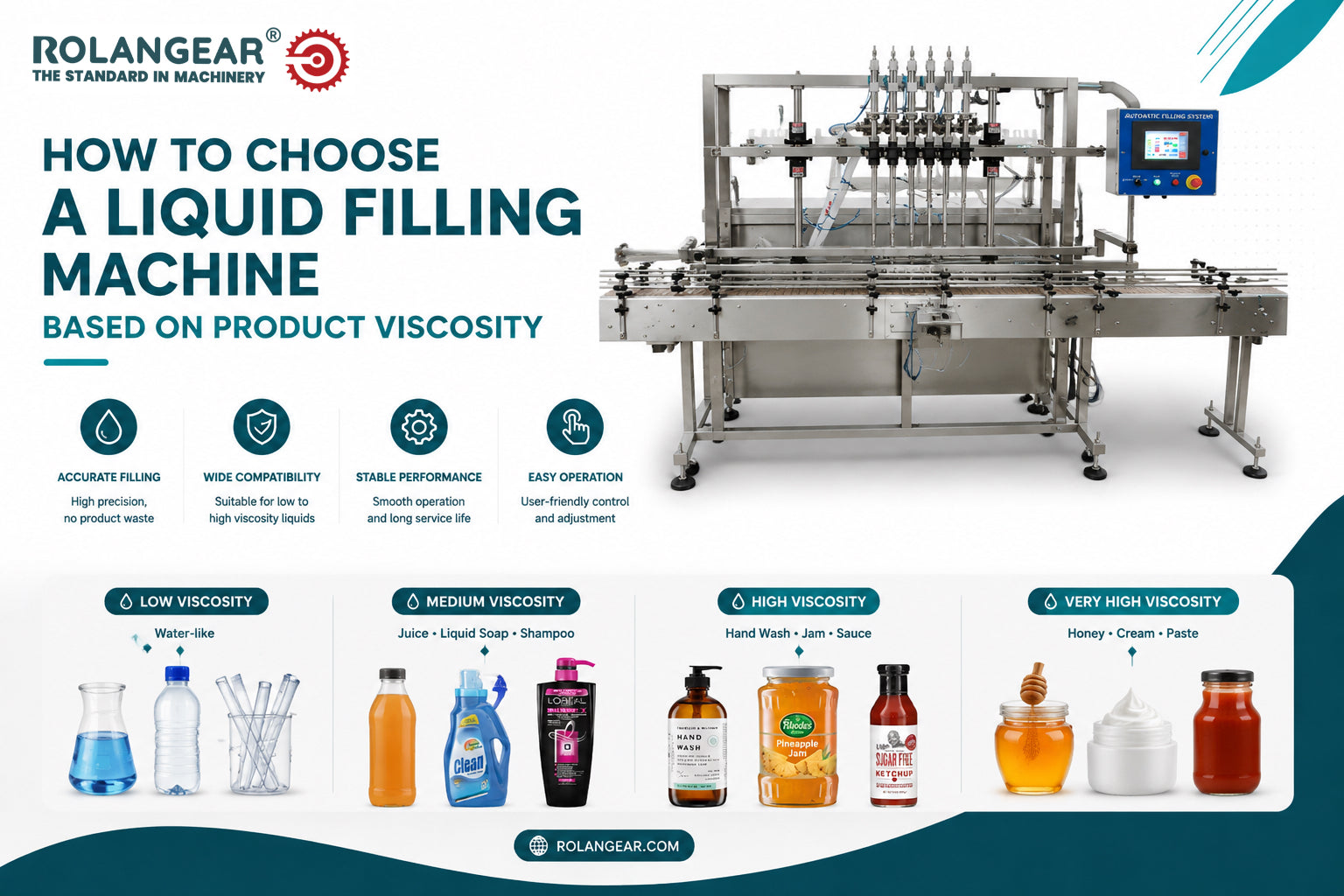
Low, Medium and High Viscosity Products

Low Viscosity Products
Low-viscosity liquids flow easily and behave similarly to water. Examples include drinking water, juice, thin milk beverages, light solvents and some cleaning liquids. These products are usually suitable for gravity filling, flow meter filling or pump filling. The machine can focus on speed, hygiene and accurate volume control.
Medium Viscosity Products
Medium-viscosity liquids move slower than water but still flow steadily with the right pump or filling pressure. Examples include cooking oil, shampoo, liquid detergent, syrup and some sauces. These products often need pump filling or piston filling to maintain accuracy and avoid unstable dosing.
High Viscosity Products
High-viscosity products are thick and slow-moving. Examples include honey, cream, paste, thick sauces, peanut butter, cosmetic creams and some gels. These products often require piston filling, servo piston filling, stronger pumps, larger pipelines, anti-drip nozzles and sometimes heating or agitation. Filling speed may be lower, but accuracy and clean cutoff are more important.
Main Filling Technologies

Gravity Filling
Gravity filling allows liquid to flow into containers by natural pressure from a higher tank. It is suitable for thin, free-flowing liquids. The structure is simple, operation is easy and investment can be lower. However, it is not ideal for thick products because gravity alone may not provide stable flow.
Flow Meter Filling
Flow meter filling measures liquid as it passes through a flow sensor. It is useful for products requiring accurate volume control and flexible container sizes. It is commonly used for water, beverages, oils and some chemicals. The product must be compatible with the selected flow meter type.
Pump Filling
Pump filling uses a pump to move product into the container. Different pump types can be selected according to viscosity and product characteristics. Pump filling is flexible and can handle many medium-viscosity liquids, but pump selection is critical for accuracy and durability.
Piston Filling
Piston filling uses a cylinder and piston to draw and discharge a fixed volume of product. It is widely used for medium and high viscosity liquids because the dosing volume is controlled mechanically or by servo movement. Piston filling is suitable for sauces, creams, paste, honey and many cosmetic products.
Servo-Controlled Filling
Servo systems provide more precise control over piston movement, filling speed and filling volume. They are useful when the product range changes often or when high accuracy is required. The investment is higher, but the system can improve flexibility and repeatability.
Matching Machine Type to Product Viscosity

The most practical selection method is to match viscosity and product behavior with filling technology. Thin liquids can often use gravity or flow meter systems. Medium products usually perform better with pump or piston systems. Thick products often require piston or servo piston filling.
| Product Type | Typical Examples | Recommended Filling Method | Key Notes |
|---|---|---|---|
| Low viscosity | Water, juice, thin beverages | Gravity, flow meter, pump filling | Focus on speed, splash control and hygiene |
| Medium viscosity | Cooking oil, shampoo, detergent, syrup | Pump or piston filling | Confirm pump type, nozzle design and filling speed |
| High viscosity | Honey, cream, paste, thick sauce | Piston or servo piston filling | Need anti-drip control, strong dosing and possible heating |
| Foaming liquid | Detergent, some beverages | Controlled pump or bottom-up filling | Reduce foam and overflow |
| Product with particles | Sauces, pulpy products | Piston filling with suitable valve/nozzle | Confirm particle size and blockage risk |
This table is a starting point. Final selection should be confirmed using product samples because two products with the same name may have different viscosity, foam behavior, temperature sensitivity or particle content.
Key Machine Components to Confirm
A filling machine should be evaluated by its complete structure, not only the filling nozzle count. Important components include the product tank, feeding pump, filling valves, nozzles, cylinders or servo drives, conveyor, container positioning system, control panel and cleaning system.
For viscous products, pipeline diameter, pump strength, piston cylinder size and nozzle cutoff design are especially important. If the pipe is too narrow, thick product may move slowly or create pressure problems. If the nozzle is not designed correctly, the product may drip after filling.
For food, beverage and cosmetic products, contact materials should be easy to clean and suitable for the product. Stainless steel contact parts are common, but the exact grade, seal material and surface finish should be confirmed according to hygiene and product requirements.
Filling Accuracy, Speed and Anti-Drip Control
Filling accuracy affects cost and customer satisfaction. Overfilling wastes product and reduces profit. Underfilling may cause complaints or compliance problems. Accuracy depends on the filling principle, product stability, container positioning, valve control and operator settings.

Filling speed should be balanced with accuracy. A machine may fill thin liquids quickly, but the same speed may cause splashing or foam in another product. Thick liquids usually need slower filling or staged speed control. Servo systems can help by using fast filling at the beginning and slower filling near the target volume.
Anti-drip control is essential for oils, sauces, shampoo, honey and cosmetic products. Dripping can contaminate the bottle, affect label adhesion and create cleaning problems. Nozzle design, suck-back function, shutoff valves and product temperature control can all help reduce dripping.
Container Type and Packaging Line Integration
The container strongly affects machine design. Buyers should confirm bottle material, bottle shape, mouth diameter, filling volume, cap type and label position before selecting the line. A small bottle with a narrow opening may require different nozzle design compared with a large jar or wide-mouth container.
A filling machine is often part of a larger packaging line. The line may include bottle unscrambling, rinsing, filling, capping, induction sealing, labeling, coding, inspection and cartoning. If these machines are not synchronized, the filler may wait for containers or downstream packaging may become a bottleneck.
For a complete production line, buyers should plan the full workflow:
This helps ensure that filling capacity, capping speed, labeling speed and packing capacity are balanced.
Hygiene, Material and Cleaning Requirements
Different products require different hygiene standards. Beverage, dairy, sauce and cosmetic products may need sanitary design, easy disassembly, smooth contact surfaces and effective cleaning. Chemical products may need corrosion-resistant materials and seals compatible with the formula.
Cleaning requirements are important when one machine handles multiple products. If product changeover is frequent, the machine should be easy to clean and adjust. Some products may require CIP-style cleaning, while others can be cleaned manually after disassembly. The cleaning method should be confirmed based on product safety, viscosity and production schedule.
For sticky or colored products, residue can remain in pipelines, valves and nozzles. Good design reduces dead corners and makes cleaning faster. Buyers should ask how long changeover takes and which parts need manual cleaning.
Automation Level and Capacity Planning
Semi-automatic filling machines are suitable for small batches, trial production or factories with lower starting budgets. They require more manual bottle handling but can be flexible for different products. Automatic filling machines are suitable for larger output and continuous production. They reduce labor and improve consistency, but require more investment and better line management.

Capacity planning should consider real containers per hour, not only filling head count. Output depends on product viscosity, filling volume, nozzle number, filling speed, capping speed, labeling speed and operator efficiency. A 500 ml thin beverage can fill much faster than a 1 liter thick sauce, even on the same number of heads.
Buyers should prepare target bottle size, expected output, working hours, product viscosity, package format and future expansion plan. This information helps Rolangear recommend a filling system that fits both current demand and future growth.
Cost Factors and ROI Considerations
The cost of a liquid filling machine depends on filling technology, number of filling heads, automation level, contact material, pump type, servo control, anti-drip design, cleaning system and integration with capping or labeling machines. A simple gravity filler costs less than a servo piston filling line, but it may not be suitable for thick or high-value products.
Operating cost includes labor, product waste, cleaning time, spare parts, maintenance, electricity, compressed air and downtime. A cheaper machine can become expensive if it wastes product, requires frequent cleaning or cannot maintain accuracy. For high-value products such as cosmetics, honey or specialty sauces, accurate filling and clean cutoff can protect profit.
ROI should be calculated by total production performance. Buyers should compare investment cost with output, product savings, labor reduction, market demand and long-term reliability.
How to Choose the Right Liquid Filling Machine

The selection process should start with product samples. Buyers should confirm viscosity, temperature sensitivity, foam behavior, particle content, corrosiveness and cleaning requirements. Then they should match the product with the container and required capacity.
Questions to prepare before requesting a quotation include:
What product will be filled?
Is the product low, medium or high viscosity?
Does viscosity change with temperature?
Does the product foam, drip, crystallize or contain particles?
What bottle or container size will be used?
What filling volume and accuracy are required?
What output per hour is needed?
Is the line semi-automatic or fully automatic?
What capping, labeling and packaging machines are required?
What hygiene or material requirements must be met?
Clear answers help avoid wrong machine selection and reduce later modification costs.
Why Choose Rolangear?
Rolangear provides practical liquid filling machine solutions for beverage, food, cosmetic, chemical and household-product manufacturers. Instead of recommending one standard machine for every product, Rolangear evaluates viscosity, bottle type, filling accuracy, capacity, automation level and factory layout.
For thin liquids, Rolangear can help compare gravity, flow meter and pump filling systems. For medium or high viscosity products, Rolangear can recommend suitable pump or piston filling solutions with anti-drip control and proper product contact parts. For complete projects, Rolangear can also support filling-line integration with capping, labeling, coding, inspection and packing equipment.
Before confirming equipment, buyers can share product samples, bottle drawings, target speed, filling volume and factory layout. This allows Rolangear to provide a more accurate and practical filling-machine configuration.
Frequently Asked Questions
What filling machine is best for water or juice?
Low-viscosity products such as water and many juices are commonly filled by gravity, flow meter or pump filling systems. The final choice depends on required speed, accuracy, hygiene level and container type.
What machine is suitable for honey or thick sauce?
Honey and thick sauces usually require piston filling or servo piston filling because these systems can push viscous products more accurately and reduce unstable flow.
Can one filling machine handle different viscosity products?
Sometimes yes, but it depends on the viscosity range, pump type, nozzle design and cleaning requirements. A machine designed for thin liquids may not work well for thick products. Buyers should provide all product samples before confirming.
How does viscosity affect filling speed?
Higher viscosity usually means slower filling because the product moves through pipelines and nozzles more slowly. The machine may need larger pipes, stronger pumps, slower speed settings or heating to maintain stable output.
How can dripping be reduced during filling?
Dripping can be reduced by using anti-drip nozzles, suck-back function, proper valve design, correct filling speed and suitable product temperature control.
What information should I prepare before ordering?
Prepare product type, viscosity, bottle size, filling volume, output target, cap type, hygiene requirements, automation level and whether the product foams or contains particles.
Is a fully automatic filling line always better?
Not always. A fully automatic line is better for larger production and lower labor dependence, but a semi-automatic machine may be more practical for small batches, testing or budget-sensitive projects.
Conclusion
Choosing a liquid filling machine based on product viscosity helps manufacturers avoid filling problems and build a more stable production line. Low-viscosity liquids may use gravity, flow meter or pump filling. Medium-viscosity products often need pump or piston filling. High-viscosity products usually require piston or servo piston filling with proper anti-drip design.
The best machine should match the product, container, filling volume, output target, hygiene requirement and future expansion plan. A complete filling project should also consider capping, labeling, coding, inspection and packaging integration.
If you are planning a liquid filling project, Rolangear can help evaluate your product viscosity, container type and production target to recommend a suitable filling-machine solution.
Plan Your Liquid Filling Machine Project with Rolangear
Share your product viscosity, container size, filling volume, target capacity and packaging requirements. Rolangear can help recommend a practical filling-machine configuration for your factory.
Contact Rolangear