Toilet Roll vs Facial Tissue Production Line: Machines and Investment Comparison
Toilet Roll vs Facial Tissue Production Line: Machines and Investment Comparison
Compare toilet roll and facial tissue production lines, including equipment configuration, production flow, packaging, investment planning and buyer selection guidance.
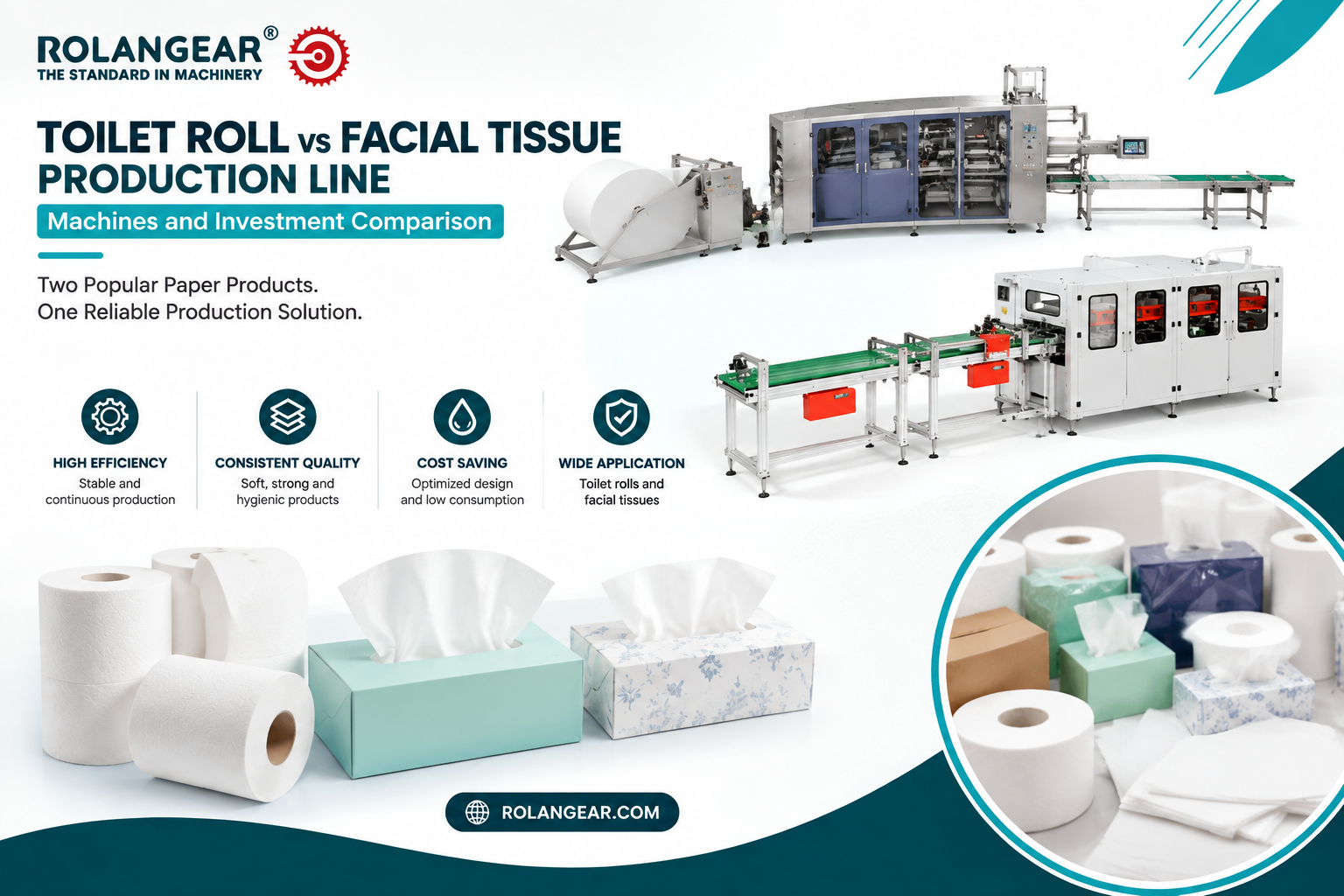
A toilet roll vs facial tissue production line comparison helps tissue manufacturers and investors understand which product direction is more suitable for their market, budget and factory plan. Both products use tissue paper as the main raw material, but the converting process, machine configuration, packaging style and commercial positioning are different. Toilet roll production normally focuses on high-volume converting, rewinding, perforation, cutting and roll packaging. Facial tissue production focuses on folding, counting, stacking and packing sheets into soft packs or boxes.

For a new tissue factory, the decision should not be based only on which machine is cheaper. A practical investment plan should consider local demand, product positioning, raw material supply, packaging requirements, labor level, factory space, target capacity and future expansion. A toilet roll line may be suitable for high-consumption household and commercial channels, while a facial tissue line may support higher-value personal-care products and branded retail packaging.
Rolangear provides tissue production line solutions based on product type, automation level, output target, packaging method and factory layout. This guide explains the main differences between toilet roll and facial tissue production lines, the machines involved, the process flow, cost factors and the questions buyers should confirm before ordering equipment.
Why Tissue Paper Manufacturing Is a Practical Investment
Tissue paper products are daily-consumption goods used in homes, hotels, restaurants, offices, schools, hospitals and public facilities. Unlike many seasonal products, tissue products are consumed continuously. This creates repeat purchasing demand and gives manufacturers opportunities to serve distributors, supermarkets, commercial suppliers and private-label customers.

The global focus on hygiene and convenience continues to support demand for toilet rolls, facial tissues, kitchen towels, napkins and other paper products. For investors, tissue manufacturing can be attractive because the product categories are familiar, market channels are broad and production can be scaled according to budget. A small factory may begin with basic converting machines for a local market, while a larger manufacturer may build an automated system with multiple product types and advanced packaging.
However, tissue manufacturing is also competitive. Buyers need to plan more carefully than simply purchasing a machine. Product softness, sheet count, roll size, packaging appearance, embossing quality, cutting accuracy and production stability all affect customer acceptance. A professional tissue production line should therefore connect raw material supply, converting equipment, packaging and quality control into one organized workflow.
Product Difference: Toilet Roll vs Facial Tissue
Toilet rolls and facial tissues are both made from tissue paper, but they serve different usage scenarios and require different converting systems. Understanding this difference is the first step before selecting equipment.

Toilet Roll Products
Toilet rolls are cylindrical paper products mainly used in bathrooms, hotels, commercial buildings and public restrooms. They are normally produced from jumbo tissue rolls through rewinding, embossing, perforation, core insertion or coreless forming, log cutting and packaging. Toilet roll manufacturing usually emphasizes continuous output, stable roll diameter, perforation accuracy, roll firmness and cost control.
Because toilet paper is consumed in large quantities, many manufacturers target high-volume production and competitive pricing. Product variations may include different ply numbers, roll length, sheet size, embossing patterns, core size and packaging quantity. Buyers should confirm local preferences before selecting equipment because roll dimensions and package formats differ between markets.
Facial Tissue Products
Facial tissues are sheet-based products used for personal care, cleaning, travel, offices and household convenience. They are commonly packed in soft packs, boxes or pocket packs. A facial tissue production line converts jumbo tissue rolls into folded sheets through slitting, folding, counting, cutting, stacking and packaging.
Facial tissues often compete on softness, sheet size, ply structure, folding style, packaging design and brand positioning. Compared with basic toilet rolls, facial tissue products may have higher retail value but can require more attention to folding accuracy, counting stability, packaging appearance and product cleanliness.
Key Commercial Difference
The main difference is product strategy. Toilet rolls are often volume-driven and suitable for broad household and commercial demand. Facial tissues are often more packaging-driven and can support branded, premium or convenience-focused products. A factory may produce both eventually, but the first investment should match the strongest market demand and the company’s sales channel.
How a Toilet Roll Production Line Works
A toilet roll production line converts jumbo tissue rolls into finished toilet paper rolls through a continuous converting process.

1. Jumbo Roll Unwinding
The process begins with jumbo tissue rolls. The unwinding stand feeds paper into the converting machine at a stable tension. Good tension control is important because uneven paper feeding can cause wrinkles, misalignment or unstable rewinding. Buyers should confirm the suitable jumbo roll width, roll diameter and paper ply requirements before selecting the machine.
2. Embossing and Perforation
Embossing improves appearance, softness and bonding between layers. Perforation creates tear lines that allow consumers to separate sheets easily. The embossing pattern, perforation distance and paper tension must be coordinated. Poor perforation may cause difficult tearing, while unstable embossing can affect roll appearance and product quality.
3. Rewinding and Roll Forming
The rewinding section forms the tissue paper into long logs. The machine controls roll diameter, tightness and length. Roll firmness must be balanced: too loose may cause deformation, while too tight may reduce softness. For different product grades, the rewinding system may need flexible settings.
4. Cutting and Packaging
After rewinding, the long log is cut into finished roll widths. Cutting accuracy affects package appearance and customer satisfaction. Finished rolls are then transferred to single-roll, multi-roll or bundle packaging depending on the market. Automatic packaging can reduce labor and improve presentation for supermarkets and distributors.
How a Facial Tissue Production Line Works
A facial tissue production line converts jumbo tissue rolls into folded sheets and packed consumer products.
1. Paper Feeding and Slitting
Jumbo tissue rolls are unwound and slit according to the required facial tissue width. Stable feeding is important because facial tissue sheets must align properly during folding. If tension is unstable, the product may have uneven edges, poor fold quality or inaccurate counting.
2. Folding and Sheet Formation
The folding unit is the core of the facial tissue line. It folds tissue paper into the required format, such as V-fold or interfold, depending on the product design. Folding accuracy affects how smoothly tissues are pulled from the package. For boxed facial tissues, stable interfolding is especially important because each sheet should pull the next sheet upward cleanly.
3. Counting, Cutting and Stacking
After folding, the machine counts sheets and cuts stacks to the required quantity. Accurate counting is essential for customer trust and packaging consistency. Stacking quality also affects final package shape. If stacks are uneven, the package may look poor or cause problems during automatic packing.
4. Packing and Final Handling
Facial tissues may be packed in soft packs, boxes or pocket packs. The packaging system must match product size, stack height, film or carton material and output target. For retail markets, packaging appearance is very important because it directly influences shelf presentation and brand value.
Main Machine Comparison
The two production lines share some basic principles, but their core equipment is different. A toilet roll line is built around rewinding and log cutting, while a facial tissue line is built around folding, counting and stack packing.

| Item | Toilet Roll Production Line | Facial Tissue Production Line |
|---|---|---|
| Main raw material | Jumbo tissue roll | Jumbo tissue roll |
| Core process | Rewinding, perforation, log cutting | Folding, counting, stacking |
| Main product shape | Cylindrical roll | Folded sheet stack |
| Key machine | Toilet roll rewinder | Facial tissue folding machine |
| Packaging focus | Roll packs, multi-roll bundles | Soft pack, box, pocket pack |
| Main quality points | Roll diameter, tightness, perforation, cutting | Folding accuracy, sheet count, stack shape, package appearance |
| Typical market logic | High-volume daily consumption | Personal care and branded retail products |
| Expansion options | Coreless rolls, kitchen towels, automatic packing | Box tissue, soft pack tissue, pocket tissue, automatic cartoning |
Buyer tip: if your target customers are supermarkets and household distributors, both product types may be attractive. If your strongest customers are hotels, offices and public facilities, toilet rolls may provide stable volume. If your market values branded personal-care packaging, facial tissue may offer stronger retail differentiation.
Packaging and Market Positioning

Packaging is one of the biggest differences between toilet roll and facial tissue production. Toilet rolls are commonly packed as single rolls, 4-roll packs, 6-roll packs, 10-roll packs, 12-roll packs or larger bundles. Packaging must protect roll shape, keep products clean and support easy transportation.
Facial tissue packaging is more closely connected to brand image. Soft packs and boxes often use printed film or carton design. Package appearance, opening style, stack height, sheet count and softness perception influence purchasing decisions. A facial tissue factory should consider packaging from the beginning instead of treating it as an afterthought.
For toilet roll production, efficient bundling and sealing can improve output and reduce labor. For facial tissue production, accurate stack transfer and neat packing are critical because small misalignment can affect package shape. In both cases, the packaging machine must match product size, output speed and material type.
Capacity, Labor and Automation Differences

Capacity planning should be based on real products rather than only machine speed. Toilet roll output depends on jumbo roll width, ply number, roll length, rewinding speed, cutting efficiency and packaging method. Facial tissue output depends on folding lanes, sheet size, stacking count, cutting speed and packing capacity.
A semi-automatic line may be suitable for small factories, flexible orders or budget-sensitive projects. It usually requires more manual handling, especially after cutting or stacking. A fully automatic line can reduce labor, improve consistency and support larger production volume, but it requires higher investment and better operator training.
Labor planning is different for the two lines. Toilet roll production may need operators for jumbo roll loading, rewinder operation, log cutting, packaging and finished product handling. Facial tissue production may need operators for folding machine setup, stack transfer, packing material preparation and quality checks. With automatic packing and conveying, labor can be reduced, but factory management must still maintain process control and quality inspection.
Factory Layout and Utility Requirements

A tissue factory should be designed for smooth material movement. Jumbo rolls are large and should be stored in a clean, dry area near the converting line. Finished products require more storage space than raw paper because packaging increases volume. The layout should also provide access for maintenance, roll loading, packaging material storage and finished goods dispatch.
Recommended layout logic:
Utility requirements normally include electrical power, compressed air for some packaging machines, clean working space, dust control, ventilation and suitable lighting. Exact power and air requirements depend on the selected machine model and automation level. For tissue products, factory cleanliness is important because products are used for hygiene and personal care.
Cost Factors and ROI Considerations
The investment cost of a tissue production line depends on product type, automation level, output target, packaging method and supporting equipment. A basic toilet roll line may require a rewinder, log saw cutter and packing equipment. A more automated system may include automatic core feeding, tail sealing, conveying, multi-roll packing and cartoning.

A facial tissue line may require a folding machine, cutting and counting system, stack transfer, soft-pack or box-packing machine and cartoning equipment. If the product is positioned for retail branding, packaging material and printing quality can also influence operating cost.
Buyers should compare investment by total production plan, not only machine price. A low-cost machine may require more labor, have slower changeover or create inconsistent products. A higher automation line may cost more at the beginning but can reduce labor and improve output stability. ROI depends on local selling price, raw paper cost, packaging cost, labor cost, production efficiency and sales channel strength.
How to Choose the Right Tissue Production Line
Choosing between a toilet roll production line and a facial tissue production line should start with market demand. Buyers should identify which products are already selling well, which distributors they can serve and what price level customers accept. Equipment should then be selected around product size, quality grade, packaging method and output target.
For a new investor, toilet roll production may be easier to understand because the product has broad daily demand and common packaging formats. Facial tissue production may be attractive when the buyer has access to retail channels, brand design capability or customers who value convenience and softness. If budget allows, some manufacturers may later add the second product line to expand their catalog.
Questions to consider include:
Which product has stronger demand in the local market?
Will the factory sell to households, hotels, distributors or supermarkets?
What product sizes and package counts are required?
What level of automation is realistic for the budget?
How much factory space is available for raw rolls and finished products?
Is the priority low-cost volume or higher-value branded packaging?
What spare parts, installation support and operator training are needed?
Quality Control and Maintenance Points
Quality control should begin with raw paper selection. Jumbo roll softness, basis weight, ply structure, moisture level and surface quality affect finished products. During production, operators should check tension, embossing, perforation, folding accuracy, cutting quality, sheet count, package sealing and finished product appearance.

For toilet rolls, important checks include roll diameter, roll width, perforation distance, tightness, core position and package sealing. For facial tissues, checks include sheet size, fold alignment, sheet count, stack shape, softness, cleanliness and packaging appearance.
Maintenance planning should include regular cleaning, lubrication, blade inspection, belt replacement, sensor checking, air system inspection and electrical control maintenance. Cutting blades, sealing parts, belts, rollers and pneumatic components should be prepared as spare parts. Preventive maintenance reduces downtime and helps the factory maintain stable output.
Why Choose Rolangear?
Rolangear supports tissue manufacturers with practical production line solutions for different product goals. Whether the buyer is planning a toilet roll production line, facial tissue production line or a future multi-product tissue factory, the equipment plan should match real market demand and factory conditions.
Rolangear can help buyers evaluate product type, capacity, automation level, packaging method, factory layout and expansion direction. Instead of supplying isolated machines only, Rolangear focuses on complete production logic: raw paper handling, converting process, packaging connection, quality control and long-term operation.
Before requesting a quotation, buyers can prepare target product samples, roll or sheet dimensions, packaging style, expected output, factory layout and budget range. This allows Rolangear to recommend a more accurate and practical tissue production line solution.
Frequently Asked Questions
Which line is better for a new tissue factory?
It depends on local demand, budget and sales channels. Toilet rolls are often suitable for high-volume daily consumption, while facial tissues can support branded personal-care products. New investors should study local product demand before selecting equipment.
Can one factory produce both toilet rolls and facial tissues?
Yes. A factory can produce both if it installs separate converting lines or suitable equipment for each product. The two products use similar raw tissue paper but require different converting machines.
What is the main machine for toilet roll production?
The core machine is the toilet roll rewinder, usually supported by embossing, perforation, log cutting and packaging equipment. The final configuration depends on automation level and packaging requirements.
What is the main machine for facial tissue production?
The core machine is the facial tissue folding machine. It may be connected with counting, cutting, stacking, soft-pack packing, box packing or cartoning equipment.
Which line needs more attention to packaging?
Facial tissue production usually requires more attention to packaging appearance because the product is often sold as a branded personal-care item. Toilet roll packaging is also important, especially for retail multi-roll packs.
What information should buyers prepare before ordering?
Buyers should prepare product type, size, ply, sheet count or roll length, packaging style, target output, factory space and preferred automation level. This helps the supplier design a practical solution.
Does higher automation always mean better investment?
Not always. Higher automation can reduce labor and improve consistency, but it also increases investment cost. The best choice depends on production volume, labor cost, operator skill and sales demand.
Conclusion
A toilet roll vs facial tissue production line comparison shows that both product directions can be profitable when planned correctly, but they require different machines, packaging systems and market strategies. Toilet roll production is often volume-oriented and suitable for broad household and commercial demand. Facial tissue production is more folding- and packaging-focused and can support branded personal-care markets.
For investors, the best decision should be based on target customers, product specifications, automation level, factory layout and long-term expansion plans. A well-matched tissue production line can improve efficiency, reduce waste and help build a competitive tissue manufacturing business.
If you are planning a tissue production project, Rolangear can help compare toilet roll and facial tissue equipment options, confirm the production process and recommend a practical line configuration based on your market and factory requirements.
Contact Rolangear