Demand for packaged drinking water continues to grow as customers look for safe, convenient, and affordable water products. In many developing markets, sachet water and bottled water are used daily in cities, industrial areas, schools, hospitals, events, and rural communities.

For entrepreneurs and investors, this demand creates a strong business opportunity. Before starting a water manufacturing project, one key question should be answered first:
Should you invest in a sachet water production line, a bottled water production line, or a factory designed for both products?
This choice influences the complete factory plan, including:
- Factory size
- Equipment selection
- Packaging costs
- Labor requirements
- Selling price
- Profit margins
- Future expansion opportunities
Some investors assume bottled water is always more profitable, while others believe sachet water gives the fastest return. In practice, both models can work well. The right choice depends on market demand, startup budget, selling price, distribution channels, and long-term expansion plans.
Rolangear helps customers evaluate these factors, select suitable water treatment and packaging equipment, and design complete turnkey water production factories.
This guide compares sachet water vs bottled water factory investment and explains:
- Which factory requires lower investment?
- Which equipment is needed?
- What are the operating costs?
- Which model provides better profit potential?
- Which production line is suitable for your market?
By the end, you can better decide which water production project matches your market, investment level, and business strategy.
Why Packaged Drinking Water Manufacturing Is a Strong Investment
Drinking water is an essential daily consumer product with stable year-round demand.
Unlike many seasonal food and beverage products, packaged water can support continuous production and distribution, making it attractive for first-time investors and growing manufacturers.

Several market trends continue to support investment in packaged drinking water production:
Population Growth
Urban population growth increases demand for convenient, hygienic drinking water products.
Improved Living Standards
As living standards improve, many consumers prefer professionally purified and packaged water instead of untreated water sources.
Tourism and Hospitality Growth
Hotels, restaurants, airports, schools, hospitals, factories, and event venues consume large volumes of packaged water every day.
Expanding Distribution Networks
Retail shops, wholesalers, supermarkets, delivery platforms, and institutional buyers continue to create new sales channels.
Government and Institutional Projects
Public and private organizations also buy packaged water in bulk for:
- Schools
- Construction sites
- Factories
- Events
- Relief projects
These market factors make both sachet water and bottled water attractive investment options.
However, they serve different market segments.
Understanding the difference between them is the first step in choosing the right production line.
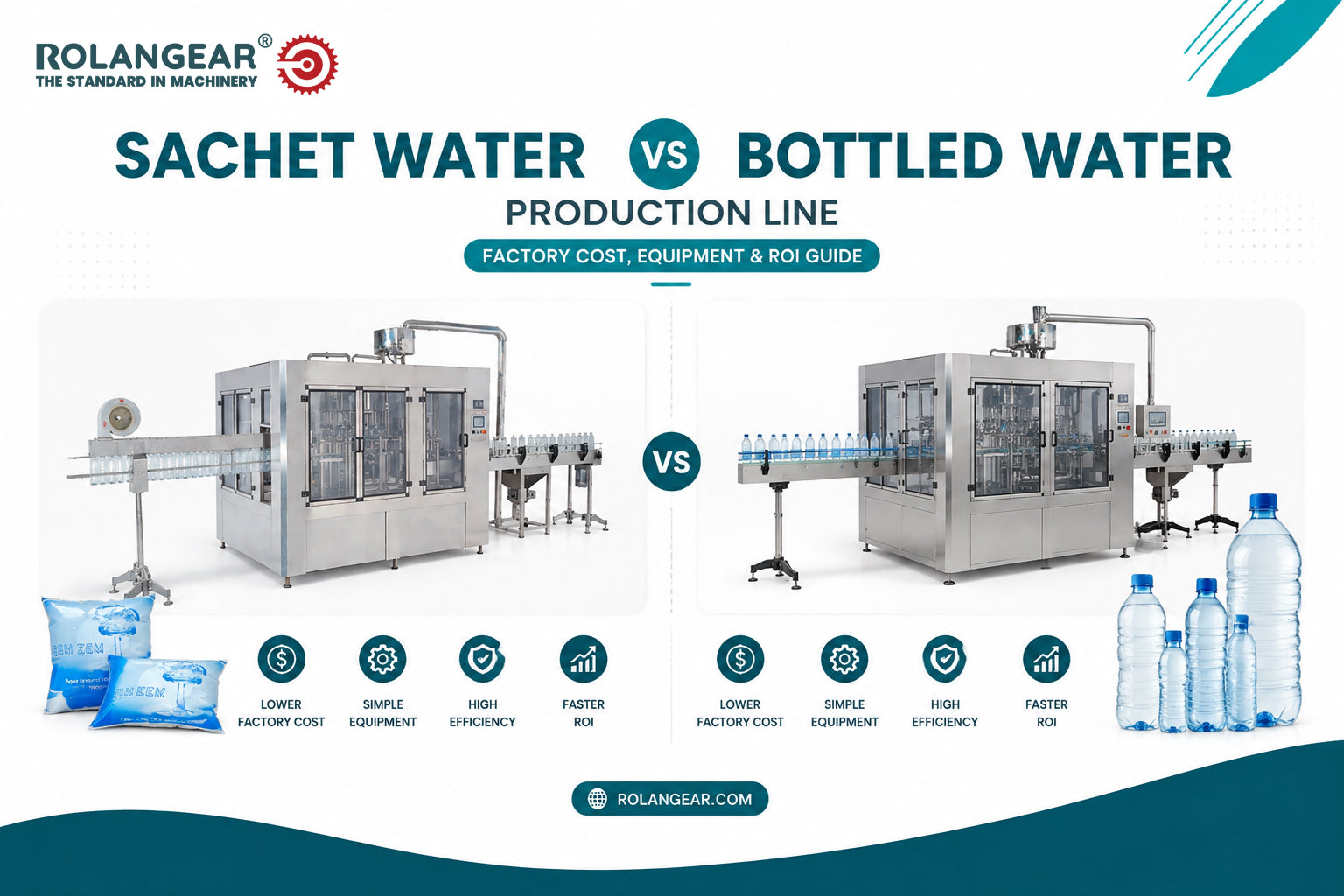
Sachet Water vs Bottled Water: Product and Market Differences
Both products provide drinking water, but they are positioned for different customers, price points, and distribution models.
Sachet Water
Sachet water is filled into flexible packaging film and sealed into small individual bags.

Typical sizes include:
- 250 ml
- 350 ml
- 500 ml
Sachet water is popular because it is:
- Affordable
- Easy to distribute
- Low-cost to produce
- Suitable for high-volume consumption
It is widely used in:
- Local markets
- Schools
- Public events
- Rural areas
- Construction sites
- Community distribution
For many regions, sachet water is an important low-cost solution for safe daily drinking water.
Bottled Water
Bottled water is filled into rigid PET bottles, then capped, labeled, and packed for retail or distribution.

Common bottle sizes include:
- 330 ml
- 500 ml
- 1 liter
- 1.5 liters
- 5 liters
Bottled water targets:
- Retail stores
- Supermarkets
- Hotels
- Restaurants
- Premium markets
- Export channels
Bottled water usually supports higher selling prices, stronger brand recognition, and wider retail opportunities.
Sachet Water vs Bottled Water Factory Comparison
| Item | Sachet Water Factory | Bottled Water Factory |
|---|---|---|
| Initial Investment | Lower | Higher |
| Equipment Complexity | Simple | More complex |
| Factory Area | Smaller | Larger |
| Packaging Cost | Lower | Higher |
| Selling Price | Lower | Higher |
| Labor Requirement | Lower | Moderate |
| Product Image | Economy market | Premium market |
| Brand Value | Limited | Strong |
| Export Potential | Moderate | High |
| Expansion Flexibility | Medium | High |
The comparison shows an important investment difference:
Sachet water usually requires lower startup investment, while bottled water offers stronger branding, product value, and expansion potential.
The best choice depends on your business objectives.
Decision Guide: Which Water Factory Is Right for Your Market?

Instead of only asking:
Which factory is better?
Investors should ask:
Which factory is better for my target market, budget, and growth plan?
The answer depends on your business situation.
Choose a Sachet Water Factory If:
You:
- Have limited startup capital
- Want faster market entry
- Serve local communities
- Target high-volume sales
- Need lower packaging costs
- Have limited factory space
Sachet water factories often provide a lower investment threshold and faster startup path.
Choose a Bottled Water Factory If:
You:
- Want to build a strong brand
- Target supermarkets and retail chains
- Plan long-term expansion
- Serve premium customers
- Need export opportunities
- Have a larger investment budget
Bottled water offers stronger product differentiation, higher brand value, and greater long-term market potential.
Can One Factory Produce Both Sachet and Bottled Water?
Yes. Many investors start with one product type and expand later as sales increase.
Many investors begin with one product type and later expand.
Because both products can share the same water treatment system, a factory can be planned with:
- One water purification system
- Separate packaging lines
This combined approach offers several advantages:
- Better equipment utilization
- Product diversification
- Reduced investment duplication
- Greater market flexibility
For example:
One factory may supply:
- Sachet water to local distributors
- Bottled water to supermarkets
- Large bottles to offices and institutions
This creates multiple revenue streams from one water treatment system while reducing duplicated investment.
Production Flow Overview for Sachet and Bottled Water

Although sachet water and bottled water use different packaging methods, both factories begin with the same core water purification process:
The main difference appears after purified water storage, where each product uses a different packaging process.
Sachet Water Production Flow
Bottled Water Production Flow
Which Water Factory Costs Less?

At first glance, the answer is clear:
Sachet water factories usually require lower initial investment.
However, the cheapest factory is not always the most profitable factory.
Investors must evaluate:
- Local market demand
- Product pricing
- Packaging costs
- Distribution channels
- Competition
- Expansion opportunities
The most profitable factory is the one that matches market demand, controls operating costs, and supports efficient daily production.
Successful manufacturers analyze these factors before selecting equipment:
- Investment cost
- Production capacity
- Operating cost
- Product positioning
- Long-term growth
before selecting equipment.
Production Line Comparison: Equipment, Capacity & Factory Requirements
After choosing between sachet water and bottled water, the next step is understanding the equipment required for each production line.

Both factories produce safe drinking water, but the systems differ after purification. Sachet water focuses on simple, high-volume flexible packaging, while bottled water requires bottle handling, rinsing, filling, capping, labeling, and secondary packaging.
Instead of asking which line is more advanced, investors should ask:
Which production line best matches my investment budget, target capacity, and customer market?
The following sections compare both systems from a practical business perspective.
Water Treatment System: The Foundation of Every Water Factory
Every drinking water project starts with one essential system: the water treatment plant.
Water quality directly affects product safety, shelf life, compliance, and brand reputation. A reliable purification system is one of the most important parts of any water factory investment.
A complete water treatment system may include:
- Raw water storage tank
- Multi-media sand filter
- Activated carbon filter
- Water softener (when required)
- Precision filtration
- Reverse Osmosis (RO) system
- UV sterilizer
- Ozone sterilization system
- Pure water storage tank
The exact configuration depends on local water source quality and applicable drinking water standards.
A properly designed treatment system can support both sachet and bottled water production, helping manufacturers expand product range without duplicating purification equipment.
Sachet Water Production Line Equipment
Sachet water remains one of the most affordable packaged drinking water solutions in many markets. Because packaging cost and equipment complexity are lower, it is often a practical entry point for entrepreneurs.
A typical sachet water production line includes:
- Water treatment system
- Pure water storage tank
- Automatic sachet water filling and sealing machine
- Date coding system
- Finished product packing equipment
Compared with bottled water production, the equipment configuration is simpler, making installation, operation, and maintenance more straightforward.
Key Equipment
Water Treatment System
Purifies the incoming water to meet drinking water standards before filling.
Pure Water Storage Tank
Stores treated water and ensures a continuous supply to the filling machine, helping maintain stable production.
Automatic Sachet Filling Machine
This is the core machine of the sachet water production line.
It performs multiple operations in one continuous process, including:
- Film feeding
- Bag forming
- Water filling
- Heat sealing
- Bag cutting
Modern automatic machines offer stable operation, accurate filling, and consistent sealing quality while reducing manual labor.
Packaging Equipment
Finished sachets are collected, counted, and packed into larger bags or cartons for transportation and distribution.
Advantages of Sachet Water Production

Many startup investors choose sachet water because it offers practical business advantages:
- Lower initial investment
- Compact factory layout
- Lower packaging material costs
- Faster equipment installation
- Easy operation
- High daily production volume
For businesses serving local markets or high-volume distribution channels, sachet water can provide an efficient and cost-effective production model.
Bottled Water Production Line Equipment
Bottled water production requires a more complete manufacturing system because each bottle must be prepared, filled, sealed, labeled, and packed before delivery.
Although the investment is higher, bottled water products generally provide stronger brand recognition and higher retail value.
A complete bottled water production line may include:
- Water treatment system
- Pure water storage tank
- PET bottle blowing system (optional)
- Bottle rinsing machine
- Filling and capping monoblock
- Labeling machine
- Date coding machine
- Shrink wrapping or carton packing system
The exact configuration depends on production capacity, bottle size, packaging style, and whether bottles are produced in-house or purchased from suppliers.
Key Equipment
PET Bottle Blowing Machine
Manufacturers have two options:
- Purchase finished PET bottles from suppliers.
- Produce bottles in-house using a bottle blowing machine.
Producing bottles internally provides greater control over bottle quality, design, and long-term production costs, especially for high-volume operations.
Bottle Rinsing, Filling & Capping Machine
This integrated system is the heart of the bottled water production line.
It combines three processes into one continuous operation:
- Bottle rinsing
- Water filling
- Cap sealing
The monoblock design improves efficiency while maintaining hygienic production conditions.
Labeling Machine
Labels provide important product information while strengthening brand identity.
Depending on the packaging design, manufacturers may use:
- Sleeve labels
- Adhesive labels
- Wrap-around labels
Shrink Wrapping or Carton Packing
After labeling, bottles are grouped into packs for transportation and retail distribution.
Automatic packaging systems improve productivity while reducing labor requirements.
Advantages of Bottled Water Production

Although bottled water factories require higher investment, they also provide significant business advantages, including:
These include:
- Stronger product branding
- Higher retail value
- Wider product range
- Better export opportunities
- Premium market positioning
- Greater long-term scalability
For businesses targeting supermarkets, hotels, restaurants, offices, and export markets, bottled water often offers greater growth potential.
Equipment Comparison: Sachet Water Line vs Bottled Water Line
The biggest difference between the two factories is the packaging stage and the number of supporting machines required.
| Sachet Water Factory | Bottled Water Factory |
|---|---|
| Water treatment system | Water treatment system |
| Pure water storage tank | Pure water storage tank |
| Sachet filling & sealing machine | PET bottle blowing machine (optional) |
| Date coding | Bottle rinsing, filling & capping machine |
| Packing equipment | Labeling machine |
| Finished product packing | Shrink wrapping or carton packing |
Although the bottled water line includes more equipment, automation can help manufacturers achieve efficient, stable, and hygienic production.
Production Capacity Planning
Production capacity is one of the main factors influencing water factory investment.
Higher-capacity equipment generally requires:
- Larger production workshops
- More utilities
- Greater investment
- Higher automation
Typical sachet water capacities include:
- 2,000 bags/hour
- 4,000 bags/hour
- 8,000 bags/hour
Typical bottled water capacities include:
- 2,000 bottles/hour
- 6,000 bottles/hour
- 12,000 bottles/hour
- 24,000 bottles/hour
Actual output depends on product size, equipment configuration, operator skill, and factory operating schedule.
Instead of selecting the largest available machine, investors should choose a capacity that matches expected sales while leaving reasonable room for future expansion.
Factory Requirements and Layout Comparison
Equipment selection also influences workshop size, material flow, utility planning, and storage requirements.

Sachet Water Factory
A sachet water factory generally requires:
- Smaller production area
- Simpler production flow
- Fewer supporting machines
- Lower power consumption
- Lower maintenance workload
This makes it attractive for businesses with limited startup budgets.
Bottled Water Factory
A bottled water factory usually requires:
- Larger production workshop
- Additional packaging area
- Bottle storage space
- Label storage
- Finished goods warehouse
- Larger logistics area
Although the factory footprint is larger, it provides more flexibility for product diversification and future expansion.
Factory Cost, ROI & How to Choose the Right Water Production Line

At this stage, you already understand the equipment and production differences between sachet water and bottled water factories. The final decision comes down to one practical question:
Which factory can deliver the best return on investment for your market?
Many first-time investors focus only on equipment price. A successful water factory should be evaluated by total cost of ownership, including factory construction, packaging materials, labor, utilities, maintenance, and future expansion.
Instead of asking only, “Which factory is cheaper?”, ask:
“Which investment can create the most sustainable and profitable business?”
The following cost factors can help you make a more informed decision.
Initial Investment Comparison
Initial investment includes more than production machines. A complete water factory may require:
- Water treatment system
- Filling and packaging equipment
- Factory building or workshop
- Electrical installation
- Water supply system
- Air compressor (where required)
- Storage tanks
- Warehousing
- Installation and commissioning
Sachet Water Factory
A sachet water factory generally has a lower startup cost because:
- Equipment configuration is simpler
- Packaging machinery is less complex
- Factory space requirements are smaller
- Packaging materials are less expensive
This makes sachet water production attractive for startups and businesses with limited investment capital.
Bottled Water Factory
A bottled water factory usually requires a higher investment due to additional equipment such as:
- PET bottle blowing machine (optional)
- Bottle rinsing, filling, and capping system
- Labeling machine
- Shrink wrapping or carton packaging equipment
- Larger storage areas for bottles and finished products
Although investment is higher, bottled water factories also create more opportunities for brand development, premium pricing, and large-scale distribution.
Operating Cost Comparison
Daily operating cost has a major impact on long-term profitability.
Packaging Materials
Packaging is one of the biggest ongoing expenses.
Sachet Water
- Plastic film
- Outer packing bags or cartons
Bottled Water
- PET bottles
- Bottle caps
- Labels
- Shrink film or cartons
Because bottled water uses more packaging components, packaging cost is generally higher than sachet water.
Labor Requirements
Modern production lines reduce manual work through automation.
A sachet water factory usually requires fewer operators because filling and sealing are completed by a single integrated machine.
A bottled water factory may require additional personnel for:
- Bottle handling
- Label management
- Secondary packaging
- Warehouse logistics
As capacity increases, automated systems can reduce labor pressure in both types of factories.
Energy Consumption
Energy requirements vary depending on equipment configuration.
Both production lines require electricity for:
- Water treatment
- Filling equipment
- Conveyors
- Air compressors
If a bottled water factory includes a PET bottle blowing machine, electricity consumption is usually higher.
Selecting energy-efficient equipment can help reduce long-term operating expenses.
Maintenance
Routine maintenance is essential for reliable production.
Regular servicing helps:
- Extend equipment lifespan
- Maintain production efficiency
- Reduce unexpected downtime
- Protect product quality
Working with an experienced supplier helps ensure spare parts, technical support, and maintenance guidance are available when needed.
Factory Layout Planning for Drinking Water Production
A well-designed factory layout improves production efficiency, reduces unnecessary handling, supports hygiene control, and leaves space for future expansion.

A typical water factory follows this production sequence:
When planning a new project, Rolangear engineers also consider:
- Production workflow
- Equipment arrangement
- Utility connections
- Operator movement
- Food safety requirements
- Maintenance access
- Future production expansion
A practical layout can improve daily operations, reduce operating costs, and make later capacity expansion easier.
Why Choose Rolangear for Water Production Solutions?
Building a successful drinking water factory requires more than purchasing machines. It requires careful planning, engineering experience, and reliable long-term support.
Rolangear provides customized turnkey water production solutions for different markets, capacities, budgets, and packaging requirements.
Our support can include:
Customized Production Solutions
Every project is designed according to:
- Water source
- Product type
- Production capacity
- Investment budget
- Local market requirements
Complete Equipment Supply
We provide integrated solutions covering:
- Water treatment systems
- Sachet water production lines
- Bottled water production lines
- Packaging systems
- Quality inspection equipment
Engineering & Factory Planning
Our engineering team assists with:
- Equipment configuration
- Factory layout design
- Utility planning
- Production workflow optimization
Installation & Training
We support customers through:
- Equipment installation
- Commissioning
- Operator training
- Technical documentation
- Production startup
Global After-Sales Support
Our commitment continues after installation through:
- Spare parts supply
- Remote technical assistance
- Maintenance guidance
- Equipment upgrades
- Long-term technical support
Whether you are launching a small sachet water startup or building a larger bottled water factory, Rolangear helps you create a reliable, efficient, and profitable production operation.
Frequently Asked Questions About Sachet Water vs Bottled Water Production Lines
Which factory requires less investment?
In most cases, a sachet water factory has a lower startup cost because it uses fewer machines and lower-cost packaging materials.
Is bottled water more profitable than sachet water?
Not always. Bottled water often has a higher selling price, while sachet water usually depends on high-volume sales. Profitability depends on local demand, pricing strategy, packaging cost, distribution, and operating efficiency.
Can I upgrade from sachet water to bottled water later?
Yes. Many manufacturers begin with sachet water and later add a bottled water production line. Sharing the same water treatment system can make future expansion more cost-effective.
What production capacity should I choose?
The ideal capacity depends on expected demand, available budget, distribution network, product size, and future growth plans. Choosing equipment with room for expansion is often a practical long-term strategy.
Does Rolangear provide complete turnkey water factories?
Yes. Rolangear supplies customized turnkey solutions, including water treatment systems, sachet and bottled water filling equipment, factory layout planning, installation, commissioning, and technical support.
Conclusion: Choosing the Right Water Production Line
Choosing between a sachet water factory and a bottled water factory is not only about comparing equipment cost. It is about selecting the business model that best fits your target customers, investment budget, distribution channel, and long-term growth strategy.
Sachet water production offers a lower barrier to entry, making it suitable for businesses focused on affordable, high-volume local distribution. Bottled water production requires a larger investment but provides stronger branding opportunities, greater product variety, and access to premium retail or export markets.
For many manufacturers, the most effective strategy is to design a factory that allows future expansion, using one shared water treatment system with flexible packaging options as market demand grows.
Rolangear helps customers move beyond machine selection by delivering complete turnkey drinking water solutions. From water treatment and production line configuration to factory layout, installation, and after-sales support, our goal is to help you build a safe, efficient, and profitable water manufacturing business.
Ready to Build Your Water Factory?
Whether you are planning a sachet water production line, a bottled water production line, or a combined turnkey water factory, Rolangear can help you choose the right solution.
Contact Rolangear for:
- Free project consultation
- Customized production line recommendations
- Factory layout planning
- Capacity and investment analysis
- Turnkey quotation
- Professional technical support from project planning to production
Rolangear – The Standard in Machinery. Your trusted partner for complete drinking water production solutions.
Plan Your Sachet or Bottled Water Factory with Rolangear
Rolangear helps customers design practical turnkey drinking water production solutions, including water treatment systems, sachet water lines, bottled water lines, packaging equipment, factory layout planning, installation, and technical support.
Contact Rolangear for a Water Factory Solution