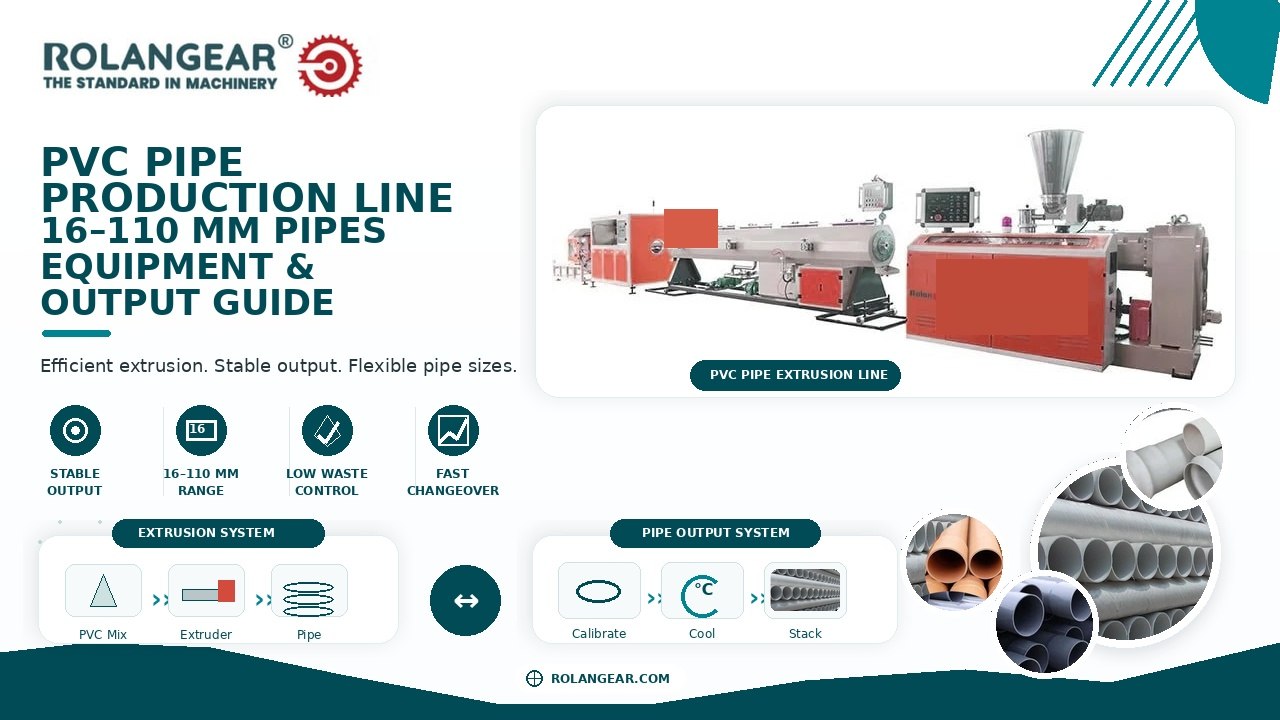
A PVC pipe production line is a complete extrusion system used to manufacture plastic pipes from PVC resin, additives and selected processing materials. For many investors, the 16–110 mm diameter range is one of the most practical starting points because it covers common water supply pipes, drainage pipes, electrical conduit pipes, building installation pipes and agricultural irrigation pipes. These products are widely used in residential, commercial, industrial and infrastructure projects, which makes this line attractive for both new pipe factories and existing plastic-product manufacturers.

A successful PVC pipe factory requires more than one extruder. The line must connect material mixing, stable feeding, plasticizing, die forming, vacuum calibration, cooling, haul-off, cutting and pipe handling into one continuous workflow. If these sections are not matched correctly, the factory may face unstable pipe diameter, uneven wall thickness, poor surface quality, slow production speed or excessive material waste.
Rolangear provides practical PVC pipe production line solutions based on pipe diameter range, wall thickness, application market, material formula, automation level and factory layout. This guide explains how a 16–110 mm PVC pipe production line works, what machines are normally included, what buyers should confirm before ordering and how to plan a reliable pipe manufacturing project.
What Is a PVC Pipe Production Line?
A PVC pipe production line is an integrated manufacturing system that converts prepared PVC material into finished pipes through extrusion. The line can produce different pipe diameters by changing moulds, calibration sleeves, haul-off settings and cutting requirements. For the 16–110 mm range, the system is often used for small and medium-diameter pipes required in construction, agriculture, cable protection and water-related applications.

The basic production principle is easy to understand. PVC resin and additives are mixed into a uniform compound, then fed into an extruder. Inside the extruder, the material is heated, compressed and plasticized by the screw and barrel. The melted material passes through a pipe die to form a continuous pipe shape. After leaving the die, the pipe enters a vacuum calibration tank to control diameter and roundness, then passes through cooling tanks, haul-off equipment and a cutting machine. Finished pipes are finally stacked, inspected and prepared for storage or delivery.
Why Choose the 16–110 mm Pipe Range?
The 16–110 mm pipe range is popular because it covers many common market applications. These sizes are small enough for flexible production and large enough to serve real construction and infrastructure demand. For a new factory, this range can reduce market risk because the products are not limited to one customer group.

Strong Demand in Construction and Infrastructure
PVC pipes are widely used because they are lightweight, corrosion resistant, easy to install and cost-effective compared with many traditional metal pipe options. In construction projects, they may be used for water distribution, drainage, cable protection and building installation systems. In agriculture, they support water transportation and irrigation networks. In municipal or infrastructure projects, selected PVC pipe specifications may be used for utility and drainage-related applications depending on local standards.
Flexible Product Applications
A 16–110 mm PVC pipe production line can support several product directions. Smaller diameters are often suitable for electrical conduit and building installation. Medium diameters may be used for water supply, drainage or irrigation. Larger sizes in this range can serve infrastructure, agricultural and commercial building projects. The final product application depends on raw material formula, wall thickness, pipe standard and customer requirements.
Raw Materials for PVC Pipe Manufacturing
Raw material preparation is one of the most important parts of PVC pipe production. A stable production line cannot produce consistent pipes if the material formula is unstable. Typical PVC pipe manufacturing uses PVC resin combined with functional additives. The exact formula should always be confirmed according to pipe application, local standards, customer requirements and production technology.

PVC Resin
PVC resin is the main material used to form the pipe structure. Its quality, grade and processing performance directly affect extrusion stability, pipe strength and surface quality. Different pipe applications may require different resin characteristics. For example, water supply pipes, drainage pipes and electrical conduit pipes may have different performance expectations. Buyers should confirm suitable raw material specifications with material suppliers and equipment engineers before mass production.
Stabilizers, Lubricants and Processing Aids
PVC material requires additives to improve processing and finished product performance. Stabilizers help protect the material during heating. Lubricants support smoother extrusion and reduce processing resistance. Processing aids can improve melt strength and surface quality. Other additives may be used for impact resistance, color, filler balance or special product requirements.
Fillers and Color Materials
Calcium carbonate and other fillers may be used in some formulas to balance cost, rigidity and processing performance. Color materials are added when the pipe needs a specific appearance, such as white, gray, blue or other customer-required colors. However, filler levels and color additives must be controlled carefully. Excessive or poorly mixed additives may affect pipe quality, surface finish or mechanical performance.
Material Formula Control
Formula control is not only about material cost. It affects pipe performance, machine stability and long-term product reputation. A well-planned factory should create standard operating procedures for weighing, mixing, storage and batch tracking. When recycled or reprocessed materials are considered, buyers should confirm whether they are suitable for the intended pipe application and comply with local regulations and customer requirements.
Complete PVC Pipe Production Process

A typical PVC pipe production line follows this process:
Each step must support the next step. If the material is not mixed evenly, extrusion will be unstable. If the die and calibration system are not aligned correctly, pipe dimensions may vary. If the haul-off speed is not synchronized with extrusion output, the pipe may become too thin, too thick or out of round.
1. Raw Material Preparation
The process begins by preparing PVC resin, additives, fillers and color materials according to the selected formula. Materials should be dry, clean and stored correctly. Dust control and accurate weighing are important, especially for factories that produce different pipe types or colors.
2. Mixing and Cooling
PVC resin and additives are normally processed through a high-speed mixer and cooling mixer. The high-speed mixer heats and disperses materials, while the cooling mixer helps stabilize the mixed compound before feeding. Good mixing improves material uniformity, extrusion stability and finished pipe appearance.
3. Feeding and Extrusion
The prepared compound is transferred into the extruder. The extruder heats, compresses and plasticizes the material through the screw and barrel. For PVC pipe production, screw design, temperature control, motor performance and gearbox stability are important selection points. The extruder should provide stable output without overheating or uneven plasticization.
4. Pipe Die Forming
The molten PVC material passes through the pipe die and forms a continuous pipe. The die determines the basic pipe shape, wall thickness distribution and initial diameter. A high-quality die helps reduce surface defects and supports stable production when changing pipe sizes.
5. Vacuum Calibration and Cooling
After forming, the pipe enters the vacuum calibration tank. This section controls the pipe outer diameter, roundness and surface stability. Vacuum strength, cooling water circulation and calibration sleeve design all influence pipe quality. The pipe then continues through cooling tanks to reduce temperature and stabilize its shape before cutting.
6. Haul-Off and Cutting
The haul-off machine pulls the pipe at a controlled speed. Stable haul-off is essential because speed changes can affect wall thickness and pipe dimensions. After the pipe reaches the correct length, the cutting machine cuts it automatically. Cutting accuracy affects packaging, installation and customer satisfaction.
7. Stacking, Inspection and Storage
Finished pipes are transferred to a stacker or collection area. Operators should inspect pipe appearance, diameter, wall thickness, length, color consistency and surface quality. Pipes should be stored properly to prevent bending, contamination or damage before delivery.
Main Machines in a PVC Pipe Production Line
A complete PVC pipe production line for 16–110 mm pipes usually includes several connected machines. The exact configuration depends on pipe size, material formula, output target, automation level and factory requirements.

| Equipment | Function | Key Selection Points |
|---|---|---|
| Raw material storage system | Stores PVC resin and additives before production | Clean storage, moisture control, easy handling |
| High-speed mixer | Mixes PVC resin, stabilizers, lubricants and additives | Batch capacity, heating control, mixing uniformity |
| Cooling mixer | Cools mixed material before feeding | Cooling efficiency, discharge method, dust control |
| Feeding system | Transfers material to the extruder | Stable feeding, low material loss, easy cleaning |
| PVC pipe extruder | Plasticizes and pushes material through the die | Screw design, temperature control, output stability |
| Pipe mould/die | Forms pipe diameter and wall thickness | Size range, die quality, changeover convenience |
| Vacuum calibration tank | Controls pipe diameter and roundness | Vacuum stability, cooling water circulation, alignment |
| Cooling tank | Stabilizes pipe temperature and shape | Tank length, water flow, cooling efficiency |
| Haul-off machine | Pulls pipe at synchronized speed | Belt/caterpillar design, traction stability, speed control |
| Cutting machine | Cuts pipes to required length | Cutting accuracy, dust collection, size range |
| Stacker | Collects finished pipes | Pipe length, handling method, factory layout |
| Control system | Coordinates line operation | HMI interface, alarms, speed synchronization |
Capacity, Pipe Size and Output Planning

Capacity planning should begin with the target market. A factory producing electrical conduit pipes may need frequent size changes and flexible mould management. A factory producing water supply or irrigation pipes may focus on stable long runs with fewer size changes. The best production line configuration depends on product size range, wall thickness, raw material formula and expected daily output.
For 16–110 mm pipes, buyers should confirm the exact diameter list before requesting a quotation. Common questions include: Which pipe sizes are most important? What wall thickness is required? Which standards or customer specifications must the pipe meet? How often will the factory change moulds? Will the line produce one pipe type or several applications?
Output should be discussed carefully with the supplier because pipe diameter and wall thickness affect production speed. Smaller pipes may run faster, while larger or thicker pipes require more material and may run at a different speed. The stated capacity should be connected to a specific pipe size and formula instead of treated as one fixed number for every product.
Factory Layout and Utility Requirements

A PVC pipe production line requires a logical factory layout to improve workflow, safety and efficiency. The layout should support material receiving, storage, mixing, extrusion, cooling, cutting, stacking, inspection and finished product storage. If the layout is poorly planned, operators may spend too much time moving materials and finished pipes, creating unnecessary labor cost and safety risk.
The factory should reserve enough space for pipe length, cooling tanks, operator access, mould storage and maintenance work. Long pipes require clear handling space after cutting. Electrical cabinets should be positioned safely and protected from water, dust and unnecessary vibration. Water circulation, drainage and cooling systems should also be planned before installation.
Utility requirements normally include electrical power, cooling water, compressed air for some equipment, ventilation, dust collection and suitable drainage. Exact power and utility requirements must be confirmed according to the selected line model and factory configuration.
Quality Control Points for PVC Pipes
Quality control should be built into the full production process instead of only checked at the end. Stable raw material mixing supports stable extrusion. Stable extrusion supports accurate diameter and wall thickness. Accurate cooling and haul-off help maintain pipe straightness and dimensional consistency.
Important quality checks include pipe outer diameter, wall thickness, length, surface smoothness, color consistency, roundness, impact performance and application-specific requirements. For water supply or building applications, buyers may need to follow local product standards or customer inspection rules.
Common production problems include uneven wall thickness, rough surface, bubbles, color variation, pipe bending and cutting inaccuracy. These issues may be caused by unstable feeding, poor mixing, wrong temperature settings, die problems, insufficient cooling or haul-off speed mismatch. A professional line should provide stable control and allow operators to adjust parameters clearly.
Automation, Operation and Maintenance
Automation level affects labor requirement, production stability and investment cost. A basic line may use more manual handling, while a higher automation line can include automatic feeding, synchronized speed control, automatic cutting, pipe stacking and more advanced control functions. The correct automation level depends on budget, operator skill, product range and target production volume.
Operator training is also important. Even a well-designed PVC pipe production line requires correct temperature settings, mould change procedures, calibration adjustment, cutting setup and routine inspection. Buyers should confirm whether installation guidance, commissioning support and operator training are available.
Maintenance planning should include daily cleaning, lubrication, screw and barrel inspection, cutter maintenance, vacuum system checking, water system cleaning and electrical cabinet inspection. Wearing parts such as cutting blades, seals, belts, heaters and calibration-related components should be prepared in advance to reduce downtime.
Cost Factors and Investment Planning
The cost of a PVC pipe production line depends on several factors. These include pipe diameter range, output target, extruder size, mould quantity, automation level, control system, cooling length, cutter type, auxiliary equipment, factory utilities and spare parts. Because every project has different requirements, the final price should be confirmed after reviewing the buyer’s product plan.
Buyers should avoid comparing quotations only by the total price. A lower-cost line may have limited output, weaker control, shorter cooling capacity or fewer supporting machines. A higher-quality line may provide better production stability, easier operation and lower long-term downtime. The most suitable choice is usually the line that matches real production needs and supports stable product quality.
Before investing, prepare the main product list, target capacity, available factory area, local utility conditions, packaging method and budget range. This information helps the supplier provide a practical solution instead of a generic quotation.
How to Choose the Right PVC Pipe Production Line
Choosing the right PVC pipe production line starts with the product, not the machine model. Buyers should confirm pipe application, diameter, wall thickness, length, color, standard and expected output. After that, the supplier can recommend suitable extrusion equipment, moulds and auxiliary machines.

For new investors, a balanced configuration is often better than the highest automation level. The factory should be able to produce marketable pipe sizes reliably, control material cost and manage daily operation. For experienced manufacturers, the priority may be higher output, faster mould change, better automation and more consistent product quality.
Questions to consider include:
Which pipe sizes will generate the highest local demand?
What pipe standards or customer requirements must be followed?
How many moulds are needed at the start?
Will the factory use virgin material, approved recycled material or a controlled blend?
What production capacity is required per shift?
How much factory space is available?
What level of operator skill is available?
What spare parts and service support are required?
A professional equipment supplier should help buyers connect these answers with a realistic production-line plan.
Why Choose Rolangear?
Rolangear focuses on practical industrial production line solutions for manufacturers, investors and project buyers. For PVC pipe production, Rolangear can help evaluate the product diameter range, production process, equipment configuration, factory layout and buyer requirements before recommending a suitable system.
The goal is not only to supply machines, but to support a complete production plan. This includes understanding the raw material system, extrusion process, pipe application, capacity target, layout conditions and future expansion possibilities. A well-planned PVC pipe production line can improve production stability, reduce unnecessary operating problems and help buyers build a stronger manufacturing business.
When discussing a project with Rolangear, buyers can prepare pipe size requirements, target applications, expected output, factory drawings if available and preferred automation level. This allows the solution to be designed more accurately from the beginning.
Frequently Asked Questions
What pipe sizes can a 16–110 mm PVC pipe production line make?
It can be configured to produce selected pipe sizes within the 16–110 mm diameter range. The exact sizes depend on the moulds, calibration sleeves, haul-off settings and product requirements selected for the project.
Can one line produce both water pipes and electrical conduit pipes?
One production line may produce different PVC pipe products if the equipment configuration, moulds and material formulas are suitable. However, product standards and formula requirements may differ, so each application should be confirmed before production.
How many moulds are needed for the line?
The number of moulds depends on the pipe diameters and wall thicknesses the factory wants to produce. Buyers should prepare a diameter list and expected demand for each size before ordering.
What affects the output of a PVC pipe production line?
Output is affected by pipe diameter, wall thickness, material formula, extruder capacity, cooling efficiency, haul-off speed and product quality requirements. Capacity should always be discussed for specific pipe sizes.
Does the line require experienced operators?
Operators need training in temperature setting, mould change, calibration, haul-off adjustment, cutting setup and quality inspection. Good supplier support can help the factory start production more smoothly.
What utilities are required for installation?
Typical requirements include electrical power, cooling water, drainage, ventilation and sometimes compressed air. Exact requirements depend on the selected equipment configuration and should be confirmed before installation.
How can buyers reduce production problems?
Buyers should use a stable material formula, maintain proper mixing, control extrusion temperature, align calibration equipment, check cooling conditions and perform regular maintenance. Operator training is also important.
Is the 16–110 mm range suitable for a new factory?
Yes, it can be a practical range for new factories because it covers many common pipe applications. However, the final decision should be based on local market demand, investment budget, factory space and product standards.
Conclusion
A PVC pipe production line for 16–110 mm pipes is a practical manufacturing solution for producing common pipe sizes used in construction, irrigation, drainage, water supply and electrical conduit applications. The line connects material preparation, mixing, extrusion, die forming, vacuum calibration, cooling, haul-off, cutting and finished pipe handling into a continuous production process.
For buyers, the most important step is to choose a line based on real product requirements rather than only comparing machine prices. Pipe diameter, wall thickness, material formula, output target, automation level, factory layout and quality standards all influence the final configuration. A well-matched line can improve pipe quality, reduce downtime and support long-term production growth.
If you are planning a PVC pipe manufacturing project, Rolangear can help you evaluate pipe size requirements, equipment configuration, factory layout and practical production needs. Prepare your target pipe sizes, applications, capacity expectations and available factory conditions, then discuss the project with Rolangear to build a more reliable PVC pipe production line solution.
Contact Rolangear